Is AI Content Good for Answer Engine Optimization? A B2B SaaS Verdict
is ai content good for answer engine optimizationAI-generated content citationsAI content and AI Overviews
Is AI Content Good for Answer Engine Optimization? A B2B SaaS Verdict
AI content can earn citations, but B2B SaaS teams win with original data and human checks. See what the studies show and a workflow to use AI safely.
Ishan ManchandaNov 6, 2026
Last updated: Nov 6, 2026
Is AI Content Good for Answer Engine Optimization? A B2B SaaS Verdict
By AEO for B2B SaaS Editorial Team | Last updated: November 4, 2026
Answer engine optimization (AEO) for B2B SaaS is the practice of earning AI citations, and AI content supports it only as a drafting aid paired with original data, named expertise and human fact checks. The stakes are real. When Google shows an AI summary, users clicked a traditional result in 8% of visits, against 15% without one (, 2025). Being cited inside the answer matters more than before. This guide sets out what the studies measure, where they disagree, and a workflow for B2B SaaS teams. It sits within the wider comparison of .
AI-written pages do get cited by answer engines, so AI authorship alone is not a barrier to citation.
Studies on AI content and citations disagree because their detectors, samples and query types differ.
In B2B SaaS buyer queries, ChatGPT credited third parties for 87.4% of citations (DerivateX, 2026), so on-site content is one input among several.
Google's May 2026 guide says generative AI search optimization is still SEO and asks for unique, non-commodity content.
A safe AI content workflow uses AI for drafting and formatting, and people for data, quotes, authorship and accuracy.
Is AI content good for answer engine optimization?
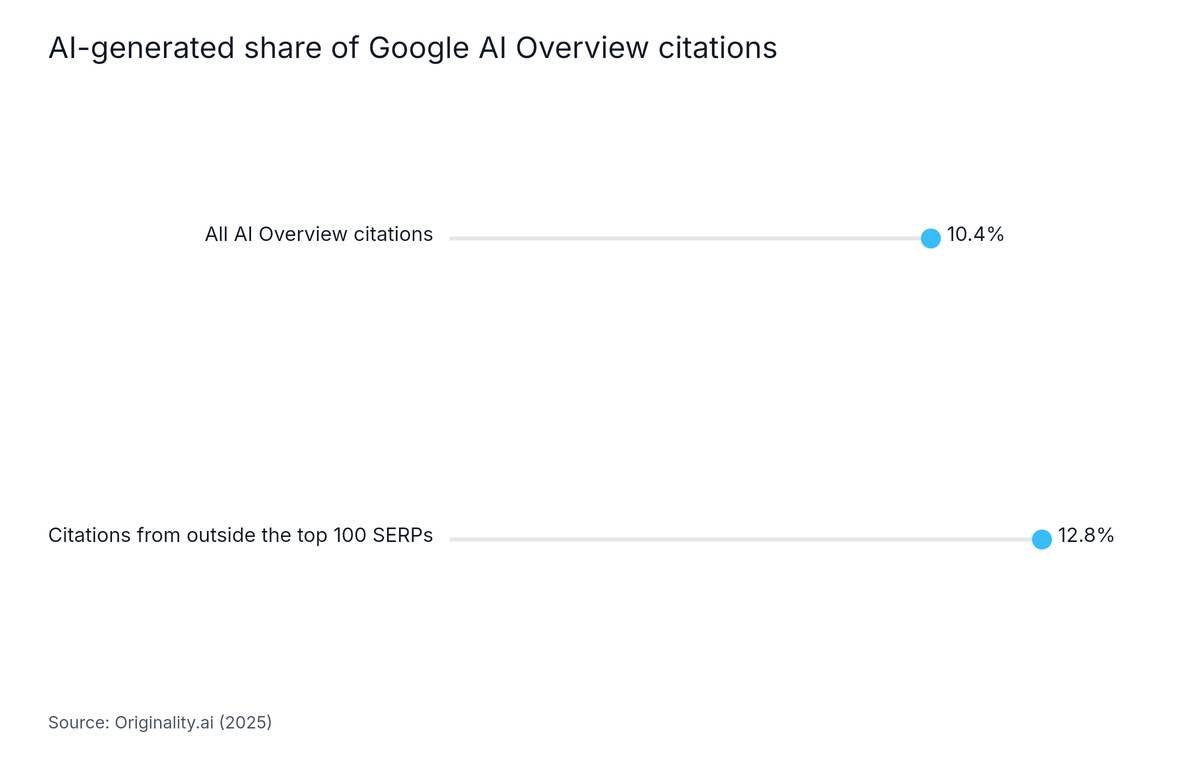
AI content is neither good nor bad for answer engine optimization on its own. AI-written pages do get cited: 10.4% of Google AI Overview citations were AI-generated in a 2025 study (Originality.ai, 2025). For B2B SaaS teams, AI works as a drafting tool, while original data, named expertise and fact checks decide whether a page earns a citation.
A pencil and a fountain pen resting side by side on a clean desk beside a blank sheet of paper
Answer engine optimization (AEO) is the practice of structuring a site and its content so AI assistants and AI search features choose to cite it. Some readers also meet the overlapping terms generative engine optimization (GEO) and large language model (LLM) optimization; the GEO explainer covers the naming. AI-generated content is text drafted wholly or mostly by an LLM instead of a person.
The useful question is not who typed the words. It is whether the page gives an engine something worth lifting. A peer-reviewed study found that "AI-generated documents are cited more frequently than human-authored documents even after controlling for retrieval rank" (Kakimov et al., PMLR, 2026). That result covers YMYL queries, not B2B SaaS. It shows AI text can be cited, not that it should be published unedited.
The table below sums up how common uses of AI compare for citation purposes.
Use of AI
Main risk
Verdict for B2B SaaS
Outlines and research synthesis
Shallow sourcing
Good, if people verify sources
Unedited AI articles
Generic, commodity text
Weak, nothing unique to cite
AI formatting of tables and FAQs
Wrong figures inserted
Good, with a fact check
AI rewrite of expert material
Lost nuance
Acceptable, with expert sign-off
Why do studies on AI content and citations disagree?
Studies on AI content and citations disagree because they measure different things. Originality.ai counted AI-generated pages among Google AI Overview citations and found 10.4% (Originality.ai, 2025). Kakimov et al. studied YMYL queries and found AI documents cited more often after controlling for rank. Detectors, query types and the definition of AI-written all differ.
Lollipop chart: AI-generated share of Google AI Overview citations. Highest: Citations from outside the top 100 SERPs at 12.8%.
The Originality.ai share rises to 12.8% for citations from outside the top 100 results, and 48% of citations come from the top 100 organic results (Originality.ai, 2025). That study is vendor-run, and the vendor sells AI detection. Treat it as one measurement, not a verdict.
YMYL means Your Money or Your Life, a Google term for topics such as health and finance where inaccurate content could cause real harm. Query type matters because engines may treat those topics differently from software buying questions.
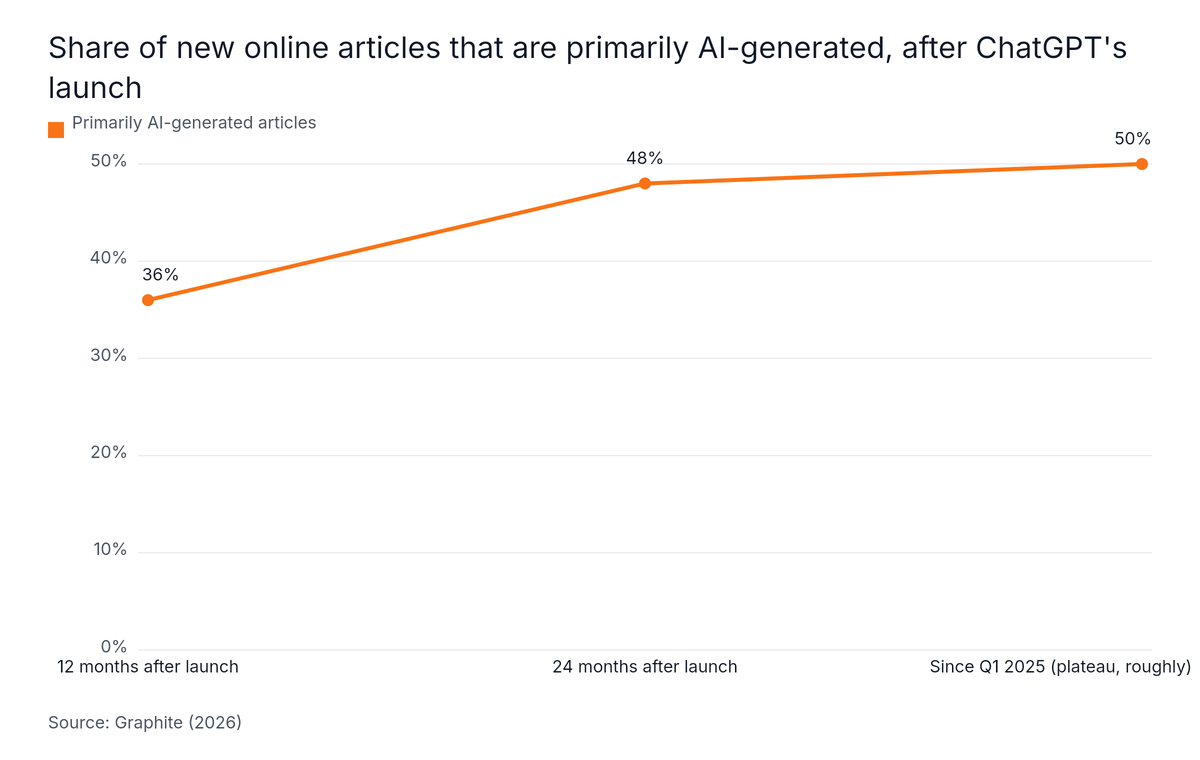
The Graphite study measures what gets published, not what gets cited. It found 36% of new articles primarily AI-generated within 12 months of ChatGPT's launch, 48% by 24 months, and a plateau at roughly 50% since Q1 2025 (Graphite, 2026). "Primarily AI-generated" means most of the text is detected as AI-written or AI-assisted. Volume has stalled, so more AI articles will not win by sheer count.
Line chart: Share of new online articles that are primarily AI-generated, after ChatGPT's launch. Highest: Since Q1 2025 (plateau, roughly) at 50%.
What does Google say about AI content and AI search?
Google's May 2026 guide treats optimizing for generative AI search as ordinary search engine optimization, so the same fundamentals apply to AI content. The stakes are measurable: Pew found users clicked a traditional result in 8% of visits with an AI summary, against 15% without one (Pew Research Center, 2025). The guide asks for helpful, original content.
A printed page being checked with a magnifying glass beside a highlighted line
Search engine optimization (SEO) is the practice of earning ranked links in traditional search results. Google's guide, as quoted by Search Engine Journal, says: "From Google Search's perspective, optimizing for generative AI search is optimizing for the search experience, and thus still SEO." (Search Engine Journal, 2026). Crawlable pages, clear content and real usefulness still apply to AI Overviews and AI Mode.
As of May 2026, Google says llms.txt, chunking, special schema and AI-specific rewriting are not needed for its features. Google's guide, as quoted by DemandSphere, puts it this way: "You don't need to create new machine readable files, AI text files, markup, or Markdown to appear in generative AI search." (DemandSphere, 2026). That statement covers Google only. Other engines publish less, and the LLM optimization comparison explains where behavior may differ.
Our data: The AEO for B2B SaaS evidence base records two measured click results. Ahrefs found that an AI Overview correlated with a 58% lower average click-through rate (CTR) for the top-ranking page across 300,000 keywords, December 2023 against December 2025 (Ahrefs, February 2026). Seer Interactive reported that CTR on results with an AI Overview rebounded 85% in the first two months of 2026, and that informational results without one rose from 2.93% to 3.97% CTR across 901 million impressions in 2025 (Seer Interactive, 2026). The evidence points both ways.
Google's earlier guidance already set the bar for any content, AI-assisted or not: "Focus on making unique, non-commodity content that visitors from Search and your own readers will find helpful and satisfying." (Google for Developers, 2025). Non-commodity content is material a reader cannot get from a generic page on the same topic, such as original data, firsthand examples or expert insight. A raw AI draft is, by default, commodity text.
Where do B2B SaaS citations actually come from?
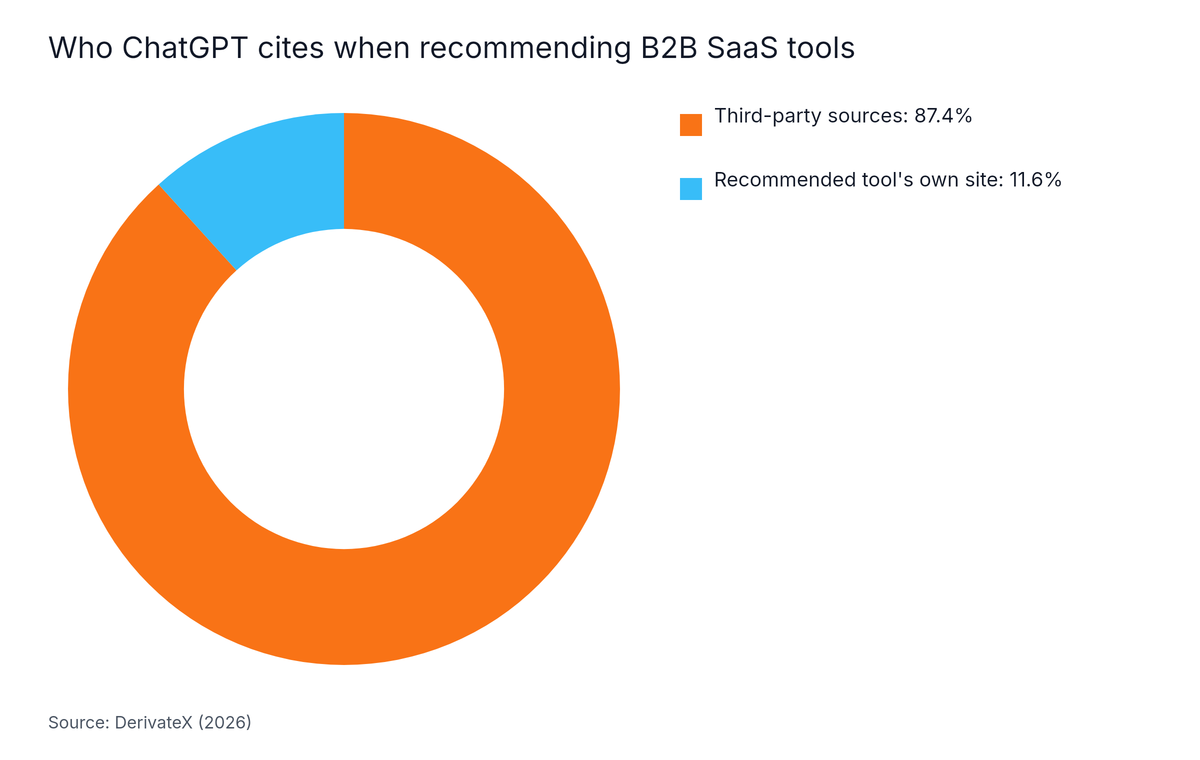
In B2B SaaS buyer queries, citations mostly come from third parties, not the vendor's own site. A 2026 DerivateX study found ChatGPT cited a recommended tool's own site 11.6% of the time, while 87.4% of citations credited a third party (DerivateX, 2026). Publishing more on-site content, AI-written or not, is therefore only one input.
A signpost with many arms pointing in different directions toward one small office door
The DerivateX study ran 40 B2B SaaS categories, with each prompt run 10 times in ChatGPT with web search. It analyzed 233 recommendations, 219 tools and 169 cited URLs. It is an agency-run study with a small URL sample, so read it as a direction, not a precise rate.
Donut chart: Who ChatGPT cites when recommending B2B SaaS tools. Highest: Third-party sources at 87.4%.
A second 2026 report points the same way. AnswerManiac found that 53 of 100 B2B SaaS companies (53%) received zero citations across ChatGPT and Perplexity (AnswerManiac, 2026). It ran 42 buyer-intent queries once each, so it is also small and vendor-run.
The practical reading is that AI-assisted drafting should be paired with earned presence: reviews, comparison coverage, community discussion and partner pages that third parties write. The guide on getting cited by AI search engines covers those inputs.
How should a B2B SaaS team use AI to write content?
A B2B SaaS team should use AI for outlines, research synthesis and formatting, and keep people responsible for first-party data, expert quotes, named authors and fact checks. This split keeps the speed of AI drafting while adding what Google calls unique, non-commodity content (Google for Developers, 2025). Every draft then passes a human accuracy review before publication.
A notebook with a hand-written checklist beside a laptop showing a plain document draft
A five-step workflow
Start from a buyer question. Pick a real question from sales calls or support tickets, and write the direct answer first.
Use AI for the scaffold. Ask for an outline, a research summary and a table layout. Treat all output as unverified.
Add what AI cannot supply. Insert first-party numbers, customer examples, a subject-matter expert quote and a named author.
Fact check every claim. Open each cited source and confirm the figure and its date.
Publish, then review. Check the page for citation after a few weeks and refresh it if it is not cited.
Task
AI role
Human role
Outline
Draft structure
Choose angle and questions
Research
Summarize sources
Verify against the original page
Data and quotes
None
Supply first-party figures and expert input
Formatting
Build tables and FAQ drafts
Check every value
Sign-off
None
Named author approves
Accuracy deserves its own step. A large arXiv measurement of 55,393 queries found 11.0% of claims in AI Overviews were unsupported by their cited pages (arXiv, 2026). AI drafts add their own factual risk, so a human review is not optional. The citation basics for AI assistants give a wider checklist.
How can you tell if AI-written pages are being cited?
A B2B SaaS team can tell whether AI-assisted pages are cited by fixing a list of buyer questions, running them on each answer engine on a regular schedule, and recording whether the site is cited and how the product is described. Comparing refreshed pages before and after a change shows the effect better than any detector score.
Detector scores are a weak test. Different detectors give different answers, so use them, if at all, as a rough screen. Tracking tools can automate the checks; the tools overview explains what to look for.
Who should not rely on this evidence?
Teams that want a guaranteed citation rate from AI content should not rely on the AI content and citation studies cited here. The studies are mostly vendor-run, use different detectors and cover Google AI Overviews or YMYL queries, and AnswerManiac ran 42 queries once each (AnswerManiac, 2026). No study measures whether AI-assisted B2B SaaS pages are cited more or less often than human-written ones.
An empty signpost frame on a foggy countryside path in early morning
Other limits are worth stating plainly:
Small samples. The DerivateX and AnswerManiac studies use limited URL and query samples, and AnswerManiac ran each query once.
Disputed method. Google disputed the methodology of the Pew study, so treat its click figures as one measurement.
Single-engine scope. Originality.ai covers Google AI Overviews only, and Google's guide covers Google only.
No promised outcome. No change to a page can be promised to produce a citation, or to produce one by a set date.
Teams with no subject-matter experts or first-party data will find the workflow harder, since those are the inputs that make AI-assisted pages distinct.
Frequently Asked Questions
Does Google penalize AI-generated content in AI Overviews?
Google's published guidance does not ask for human authorship; it asks for helpful, unique, non-commodity content. Google also says optimizing for generative AI search is still SEO. Originality.ai measured 10.4% of AI Overview citations as AI-generated in 2025, so AI-written pages do appear as cited sources.
Can AI-written content get cited by ChatGPT and Perplexity?
No cited study isolates ChatGPT or Perplexity citation rates for AI-written B2B SaaS pages, so the question is open. What is measured: DerivateX found ChatGPT cited a recommended tool's own site 11.6% of the time and third parties 87.4% in 2026, so the source mix matters more than authorship.
Do I need llms.txt or special schema to appear in AI Overviews?
Not according to Google. Its May 2026 guide says you do not need new machine readable files, AI text files, markup, or Markdown to appear in generative AI search. Structured data that matches the visible page still supports ordinary search features, but Google does not require AI-specific files.
Should I add an author byline and expert quotes to AI-assisted articles?
Yes, as a quality practice, though no cited study proves bylines raise citation rates. Named authors, expert quotes and first-party data make a page unique and accountable, which fits Google's call for non-commodity content. They also give reviewers someone responsible for checking the claims before publication.
Conclusion
AI content is a tool, not a verdict. Five points to keep:
AI-written pages are cited, but authorship alone does not decide citation.
The studies disagree because their detectors, samples and query types differ.
Google says generative AI search optimization is still SEO and wants unique, non-commodity content.
In B2B SaaS, third parties supplied most ChatGPT citations in one 2026 study, so earned presence counts.
A human-in-the-loop workflow with data, quotes, named authors and fact checks protects accuracy.
Meet with an expert: A free consultation. Bring the questions buyers ask about your category and brainstorm how to get cited.
Written by
Ishan Manchanda
Ishan Manchanda is co-founder of GrowthSpree, a B2B SaaS marketing consultancy founded in 2017 that has managed $60M+ in ad spend across 300+ B2B SaaS companies. He focuses on demand generation, go-to-market strategy and pipeline growth, and has been featured in Silicon Valley Times, SaaS Mag and the Unbounce podcast.
 Ishan Manchanda