
Blog
Generative Engine Optimization Budget for B2B SaaS: What to Fund and What to Skip
Build a generative engine optimization budget for B2B SaaS: split fixed SEO-overlap work from monitoring tools, with sourced price ranges and kill criteria.
AEO, GEO, LLM optimization and SEO explained for B2B SaaS: what each term means, what overlaps, what is new, and what the measured click data shows.
 Ishan ManchandaNov 18, 2026
Build a generative engine optimization budget for B2B SaaS: split fixed SEO-overlap work from monitoring tools, with sourced price ranges and kill criteria.

The six metrics that matter for AI search visibility in B2B SaaS, how to separate mentions from citations, set per-engine baselines and tie results to pipeline.
How B2B SaaS teams can structure pages for Google AI Overviews: what Google documents, what CTR studies show, and where to spend effort first.
Request a quote and our experts will contact you within 24 hours with tailored solutions and pricing.
Last updated: Nov 18, 2026
By the AEO for B2B SaaS Editorial Team. Last updated: November 4, 2026.
Answer engine optimization (AEO), generative engine optimization (GEO), and large language model (LLM) optimization are overlapping labels for getting a B2B SaaS brand cited in AI-generated answers, built on the same foundation as search engine optimization (SEO).
When the CEO drops one of those acronyms in a meeting, a fair question follows. Is this a new budget line, or the same work with a new name? The honest answer sits in between. This page compares AI optimization, GEO, SEO and LLM optimization, shows what overlaps with SEO, and sets out where the evidence points to something genuinely different. It also marks where that evidence is contested.
Key Takeaways
- AEO, GEO, LLM optimization, AI SEO and AI search optimization are overlapping labels for earning citations in AI answers, and usage varies from one publisher to the next.
- Google's documentation says AI Overviews need no special optimizations beyond standard SEO, so the technical base of AEO for B2B SaaS is shared with SEO.
- Independent studies from Pew Research Center, a randomized field experiment and Advanced Web Ranking all find fewer clicks when an AI summary appears, though they disagree on size.
- A citation can happen without a click, so AI visibility needs its own scoreboard beside rankings and traffic.
- For most B2B SaaS teams, AEO is mostly shared SEO work plus a small incremental layer of monitoring and off-site mentions.
The difference between AI search optimization, GEO, SEO, and LLM optimization is mostly the target. Search engine optimization (SEO) aims at ranked links, while answer engine optimization (AEO), generative engine optimization (GEO) and LLM optimization aim at citations in AI answers. Google says AEO and GEO are still SEO (Search Engine Journal, 2026), and a randomized field experiment found 38% fewer organic clicks on triggered queries (Search Engine Journal, 2026).

Search engine optimization (SEO) is the practice of improving a website so it ranks in traditional search results and earns clicks. Answer engine optimization (AEO) is the practice of structuring a site and its content so AI assistants and AI search features cite it when a buyer asks a question. Generative engine optimization (GEO) is an overlapping label, used by some researchers and vendors, for earning citations in generated answers. A fuller look at that label is in what generative engine optimization means.
The labels are not used consistently. Some publishers say AEO means snippets and voice answers. Others say AEO means Google AI Overviews and GEO means ChatGPT. Others call GEO the system layer. None of those splits is a standard.
| Term | What it usually targets | Relationship to SEO |
|---|---|---|
| SEO | Ranked links and clicks in traditional results | The foundation |
| AEO | Citations in AI answers and AI Overviews | Shares the technical base, differs in page style and measurement |
| GEO | Citations in generated answers | Overlapping term, often used for the same discipline as AEO |
| LLM optimization (LLM SEO) | Being found, cited and described by LLM assistants | Same work seen from the model side |
| AI search optimization (AI SEO) | Visibility across all AI search surfaces | Umbrella label for the rest |
When a team argues over terms, three questions settle most of it:
If the answers match existing SEO work, the label is a rebrand. If the answers add a new metric or new off-site work, that part is incremental.
LLM SEO, also called AI search optimization, AI SEO or LLM optimization, is the practice of getting a B2B SaaS brand cited and described accurately in answers from AI assistants such as ChatGPT, Perplexity and Google AI Overviews. It reuses SEO foundations, then adds answer-first writing, off-site mentions and citation monitoring. Google's AI features documentation (2025) says no special optimizations are necessary for its own AI features.
LLM optimization is the practice of making a brand and its pages easy for large language models to find, read, cite and describe correctly. AI search optimization is the broader label for visibility across every AI search surface, not one engine. Both sit alongside SEO, not above it.
LLM search engine optimization means shaping a site so LLM assistants name and describe it correctly when a buyer asks a category question. The unit of success changes. A ranked link succeeds when someone clicks it. An LLM answer succeeds when the brand appears and the description is accurate.
Standard SEO measures position and clicks. LLM SEO adds citation rate, description accuracy and which competitors appear beside the brand. The page work also shifts: direct answers near the top, facts in tables and lists, named entities and specific numbers. A detailed treatment is in LLM optimization for B2B SaaS.
Inside an SEO program, LLM optimization is the slice of work aimed at AI answers: page structure, crawler access and citation tracking. It does not replace keyword research, technical SEO or link building. It extends them.
Google says AEO and GEO are still SEO. Its Search Central documentation states: "There are no additional requirements to appear in AI Overviews or AI Mode, nor other special optimizations necessary." (Google Search Central, 2025). A May 2026 Google guide, reported by Search Engine Journal (2026), repeats that llms.txt, content chunking, AI-specific rewriting and special schema are not needed for Google's AI features.

That is Google's position on Google's features only. It does not describe how ChatGPT, Perplexity, Claude or Microsoft Copilot choose sources, and each of those engines publishes its own guidance (or none).
Google's AI features documentation (2025) says AI Overviews and AI Mode need no technical requirements beyond being indexed and eligible to show a snippet. It also says there is no special schema or AI text file to add. The May 2026 guide names AEO and GEO directly and treats them as SEO.
Google's statement tells site owners what a page must do to be eligible. It does not tell them what users do once an AI answer appears. The measurements in the evidence section below address that second question. Same foundation, different scoreboard.
SEO and GEO share crawlable pages, useful content and authority, and ranking well still correlates with being cited. In a Semrush study (2025), Perplexity showed over 91% domain overlap and 82% URL overlap with Google's top 10 results, while ChatGPT had the lowest overlap of the platforms compared. Overlap is high on some engines and far from absolute.

Semrush counted, per query, the domains and URLs that appeared both in a platform's citations and in Google's top 10 organic results. The sample size was not shown in the excerpt retrieved for this page, and the date is approximate, so treat the numbers as directional.
Four pieces of work serve both SEO and AEO:
The practical guide to this overlap is how to get cited by AI search engines.
High overlap on one platform and the lowest on another means a top ranking does not guarantee a citation, and a lower ranking does not rule one out. That gap is why teams track citations separately.
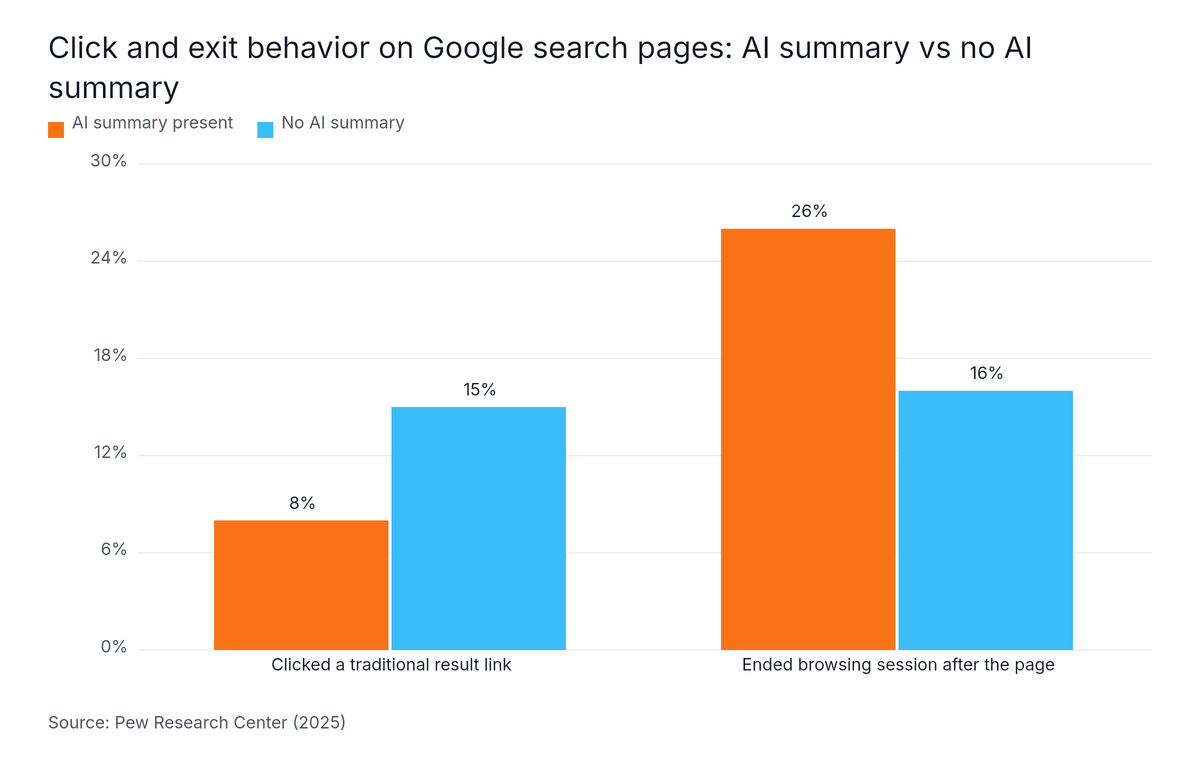
Independent measurements show that AI summaries change click behavior on Google. A randomized field experiment measured 38% fewer organic clicks on triggered queries, and zero-click searches rose from 54% to 72% (Search Engine Journal, 2026). Advanced Web Ranking found 74.3% of AI Overview SERPs end without an organic click (Advanced Web Ranking, 2026). Pew Research Center's browsing panel (2025) points the same way.
Source: Pew Research Center, 2025
Click-through rate (CTR) is the share of impressions or visits that end in a click on a result. Zero-click search is a search that ends without any click to a website. Both matter because AI summaries answer the query on the results page. Pew's headline finding reads: "Users who encountered an AI summary clicked on a traditional search result link in 8% of all visits." (Pew Research Center, 2025). The comparison figure for searches with no summary was 15% of visits. Users also ended their browsing session after 26% of pages with an AI summary, against 16% without.
| Study | Sample and method | Finding | Type |
|---|---|---|---|
| Pew Research Center (2025) | 900 US adults, 68,879 Google searches, March 2025 | Fewer traditional-result clicks with an AI summary; sessions ended more often (26% vs 16%) | Measured, methodology disputed by Google |
| Search Engine Journal on an ISB and Carnegie Mellon paper (2026, approximate date) | Randomized field experiment, two weeks per participant, January to February 2026 | 38% fewer organic clicks on triggered queries; zero-click searches rose from 54% to 72% | Measured, working paper, not yet peer reviewed |
| Advanced Web Ranking (July 2026) | Google US desktop, hundreds of millions of monthly impressions | 74.3% of AI Overview SERPs end without an organic click, against 53.6% of SERPs overall | Measured |
All three sources point the same way: fewer clicks when an AI summary appears. They do not agree on size, and they measure different things (visits, impressions, a controlled experiment). Advanced Web Ranking also calls AI Overviews the largest single variable in organic click-through in its 12-year dataset (Advanced Web Ranking, 2026). None of the sources says rankings stopped mattering.
AEO diverges from SEO in what counts as success. SEO rewards ranked positions and clicks. AEO rewards being cited and described correctly inside an answer, where clicks are rare: users clicked a source link inside the AI summary in about 1% of visits to pages with a summary (Pew Research Center, 2025). The scoreboard shifts from traffic alone to citations and accuracy.

A citation is therefore not the same as a visit. A brand can be named in an answer and still see no traffic from it.
For B2B SaaS, the shortlist point matters most. Buyers compare vendors before they talk to sales, so an assistant that names a competitor and not your company shapes the shortlist. See what answer engine optimization means for the basics.
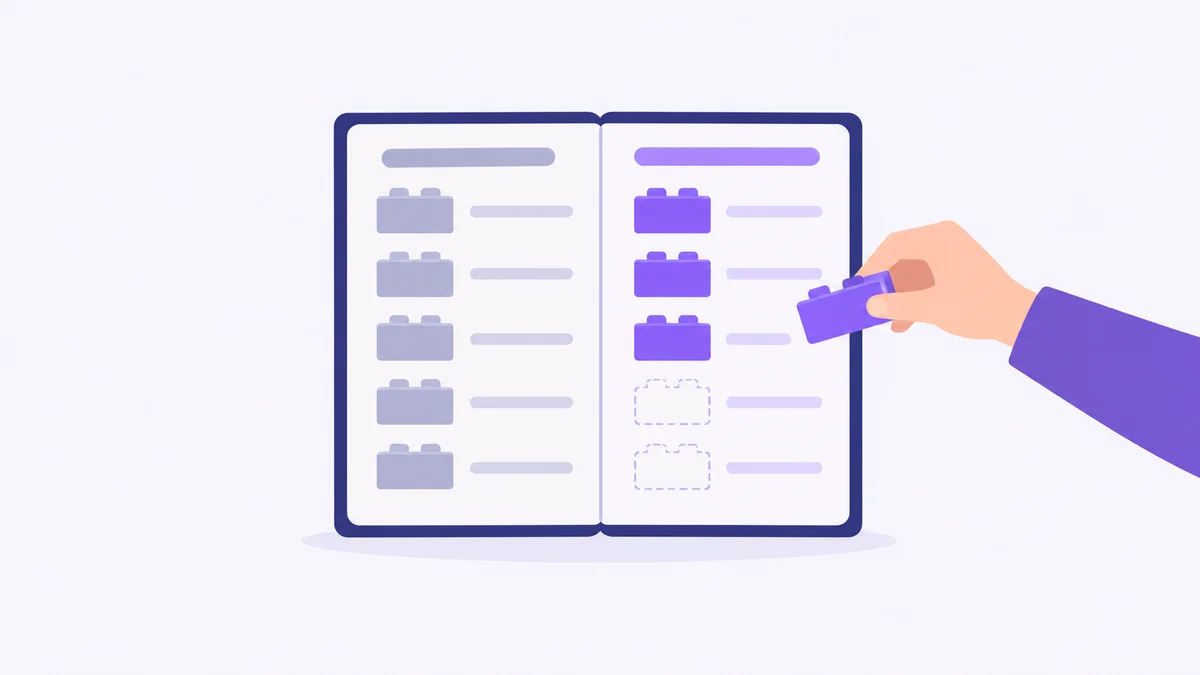
For most B2B SaaS teams, AEO is mostly shared SEO work plus a small incremental layer. Crawler access, content quality and authority already sit in the SEO budget, while citation monitoring, off-site mentions and AI referral measurement are new. The case for the increment is measurable: 74.3% of AI Overview SERPs end without an organic click, against 53.6% of SERPs overall (Advanced Web Ranking, 2026).
| Work item | Already in an SEO budget? | What is incremental |
|---|---|---|
| Crawlability and indexing | Yes | Check that AI crawlers are allowed on purpose in robots.txt |
| Content quality and answer-first structure | Largely | Direct answers, tables and FAQs for buyer questions |
| Authority and mentions | Partly (links) | Mentions in publications, reviews and forums engines read |
| Structured data | Often | Keep it matching the visible page; no special AI schema needed for Google |
| Citation monitoring | No | A fixed set of buyer questions checked across engines |
| AI referral analytics | No | Separate AI assistant referrers from other traffic |
Leadership usually wants a baseline before it funds more. A pilot gives it one: pick a fixed set of buyer questions, check them on a schedule, and record whether the brand is cited, how it is described and which competitors appear.
Proposed method: AEO for B2B SaaS proposes a monthly check of 20+ category questions across five engines as a measurement baseline. This is a proposal, not a measured result.
Tooling options are surveyed in AI search visibility tools for B2B SaaS.
The evidence on AI search and clicks is real but contested, so no single number should drive a budget decision. Google disputed the methodology of Pew's 2025 study of 900 US adults, and the 38% click-loss finding comes from a working paper that is not yet peer reviewed (Search Engine Journal, 2026). This page is not for readers who want a verdict that SEO is dead.
This page does not serve a reader looking for promised citations, a ranking guarantee, or proof that AEO replaces SEO. No source here supports those claims. It also does not cover B2C, e-commerce or local businesses, where buyer behavior and query types differ.
LLM optimization is the practice of making a B2B SaaS brand and its pages easy for large language models to find, read and cite when they answer buyer questions. It sits inside AI search optimization and builds on search engine optimization, because crawler access, content quality and authority still apply. The differences are in how pages are written and how results are measured.
LLM SEO, also called AI search optimization or AI SEO, is the work of earning citations and accurate brand mentions in AI-generated answers from tools such as ChatGPT, Perplexity and Google AI Overviews. It reuses SEO foundations like indexing and quality content, then adds answer-first writing, off-site mentions and monthly checks of whether engines cite the brand.
LLM search engine optimization means shaping a site so large language model assistants name and describe it correctly in answers. Standard SEO targets ranked links and clicks. LLM search engine optimization targets citations and brand descriptions, which can happen without a click. Both depend on crawlable, high-quality pages, so the technical base is shared.
LLM optimization in SEO is the part of an SEO program that aims to get pages cited inside AI answers, not only ranked in link lists. It covers answer-first page structure, clear named entities, crawler access and monitoring of AI citations. Google's documentation says no special optimizations are required for its AI features beyond standard SEO.
Generative engine optimization (GEO) is mostly SEO with a different goal and scoreboard, not a separate discipline. Google's 2026 guidance says AEO and GEO are still SEO. The evidence for something new is in outcomes: AI summaries change click behavior, and citations can occur without clicks. Treat GEO as a label for extra measurement and off-site work.
AEO, GEO, LLM optimization and AI SEO are mostly labels for one job: being cited, and described correctly, in AI answers on top of sound SEO. Five points to keep:
Keep exploring with how to get a B2B SaaS brand cited by AI assistants.
Next step: Meet with an expert. A free consultation. Bring the questions buyers ask about your category and brainstorm how to get cited.
Written by
Ishan Manchanda
Ishan Manchanda is co-founder of GrowthSpree, a B2B SaaS marketing consultancy founded in 2017 that has managed $60M+ in ad spend across 300+ B2B SaaS companies. He focuses on demand generation, go-to-market strategy and pipeline growth, and has been featured in Silicon Valley Times, SaaS Mag and the Unbounce podcast.