Request a quote and our experts will contact you within 24 hours with tailored solutions and pricing.
AI Overview Content Optimization for B2B SaaS
AI Overview content optimization for B2B SaaS is the practice of writing and structuring pages so Google's AI Overviews can find, understand and cite them, which Google says mostly means applying standard search engine optimization (SEO) well. Many teams meet the problem as a single number: still position one, but fewer clicks. Advanced Web Ranking measured a 52% cut in position one click-through rate (CTR) on US desktop when an AI Overview appeared (Advanced Web Ranking, 2026). This guide separates what Google documents from what practitioners only hypothesize. It also shows what independent studies report and offers a query-based way to size the effort. The topic sits within answer engine optimization (AEO), covered in AEO vs SEO for B2B SaaS.
Key Takeaways
Google's documentation says SEO best practices still apply to AI Overviews, and that no special markup or AI text file is needed (Google Search Central, 2025).
Pew Research Center measured clicks on a traditional result in 8% of visits with an AI summary versus 15% without (Pew Research Center, 2025).
Semrush found commercial-intent SERPs with an AI Overview grew 71% in six months, so AI Overviews now reach queries B2B SaaS buyers use (Semrush, 2026).
A B2B SaaS team should triage by query type, not by one traffic total.
No independent B2B SaaS-specific CTR study was found, so every benchmark is a range and each team should measure its own queries.
By AEO for B2B SaaS Editorial Team. Last updated: November 4, 2026.
How Should I Structure Content So Google AI Overviews Choose to Cite It?
Content that Google AI Overviews cite starts with a direct answer under each question heading, facts held in tables, and ordinary SEO standards. Position alone no longer secures clicks: Pew Research Center found 8% of visits included a click on a traditional result with an AI summary, versus 15% without (Pew Research Center, 2025).
A B2B SaaS comparison page laid out as a clean table beneath a short answer paragraph
An AI Overview is a Google Search feature that shows an AI-generated summary with links at the top of the results page. Google does not publish a formatting recipe for it. Its documentation says "The best practices for SEO remain relevant for AI features in Google Search (such as AI Overviews and AI Mode)." (Google Search Central, 2025)
Google's May 2026 guide adds one point on length: "There's no ideal page length, and in the end, make pages for your audience, not just for generative AI search." (Google Search Central, 2026) That rules out padding pages to look thorough.
Practices that fit a B2B SaaS site
These are editorial recommendations, not Google-confirmed factors. They follow the documented SEO baseline: make each page easy to read, easy to quote and accurate.
Answer first. Put a short answer of a few sentences directly under each heading, before any image or list.
Write headings as buyer questions. Use the words a buyer would type, such as "What does it cost?" or "Does it integrate with Salesforce?"
Hold comparisons in tables. Pricing tiers, integrations and feature differences belong in rows and columns.
Name things in full. Use the product, plan and standard names on first mention in every section.
Add specific, dated numbers. Cite the source and year beside each figure.
Keep key content in plain HTML. Pages should be readable without JavaScript and open to crawlers.
How Does Google Choose Which Sources to Cite in AI Overviews?
Google has not published a ranked list of source-selection factors for AI Overviews. Its May 2026 guide treats the work as ordinary SEO. A site must also be included in Search generative AI features in Search Console to be eligible for display (Google Search Central, 2026). AI Overviews appear on over 80% of Google searches (Search Engine Roundtable, 2026), so that eligibility check matters.
A magnifying glass over a stack of web page printouts, one highlighted with a sticky tab
Google's May 2026 optimization guide points site owners to a Generative AI performance report for measurement. Beyond that, most detail about source choice comes from third parties. It is observation, not documentation.
Do I need special schema markup or an llms.txt file?
No. Google's AI features documentation states "You don't need to create new machine readable files, AI text files, or markup to appear in these features." (Google Search Central, 2025)
Structured data is machine-readable markup, such as schema.org, that describes what a page contains. It stays useful for accuracy and standard search features, but Google lists no special type for AI Overviews. llms.txt is a proposed convention for a text file that points AI crawlers to a site's key content. Google's guidance does not ask for one.
What about query fan-out?
Query fan-out is the practitioner term for an AI search system splitting one question into several related sub-questions before building an answer. Third-party analysis likes the idea. Google has not confirmed specific content changes that follow from it.
A cautious use: list the likely sub-questions behind a core buyer question and answer each in its own self-contained section. That is sound page design either way.
What Is AI Overview Optimization and How Does It Affect B2B Site Traffic?
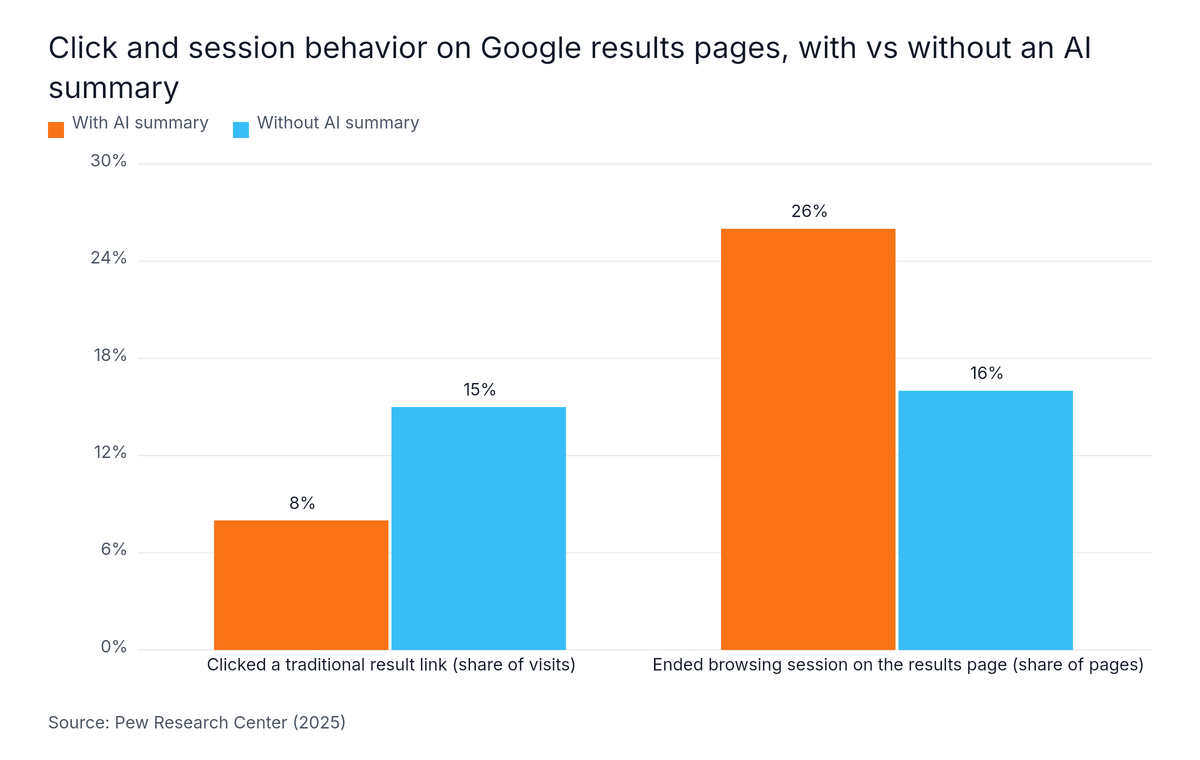
AI Overview optimization is the practice of structuring pages so Google's AI Overviews can cite them, and it matters for traffic because AI summaries lower clicks. Pew Research Center found users clicked a traditional result in 8% of visits with an AI summary versus 15% without (Pew Research Center, 2025).
Two tabletop bar blocks of different heights, the shorter one about half the taller
Click-through rate (CTR) is the share of impressions that result in a click. The studies below measure different things, so they should not be merged into one number.
Grouped Bar chart: Click and session behavior on Google results pages, with vs without an AI summary. Highest: Ended browsing session on the results page (share of pages) at 26%.
In the Pew panel, users ended their session on 26% of pages with an AI summary, versus 16% of pages with only traditional results (Pew Research Center, 2025).
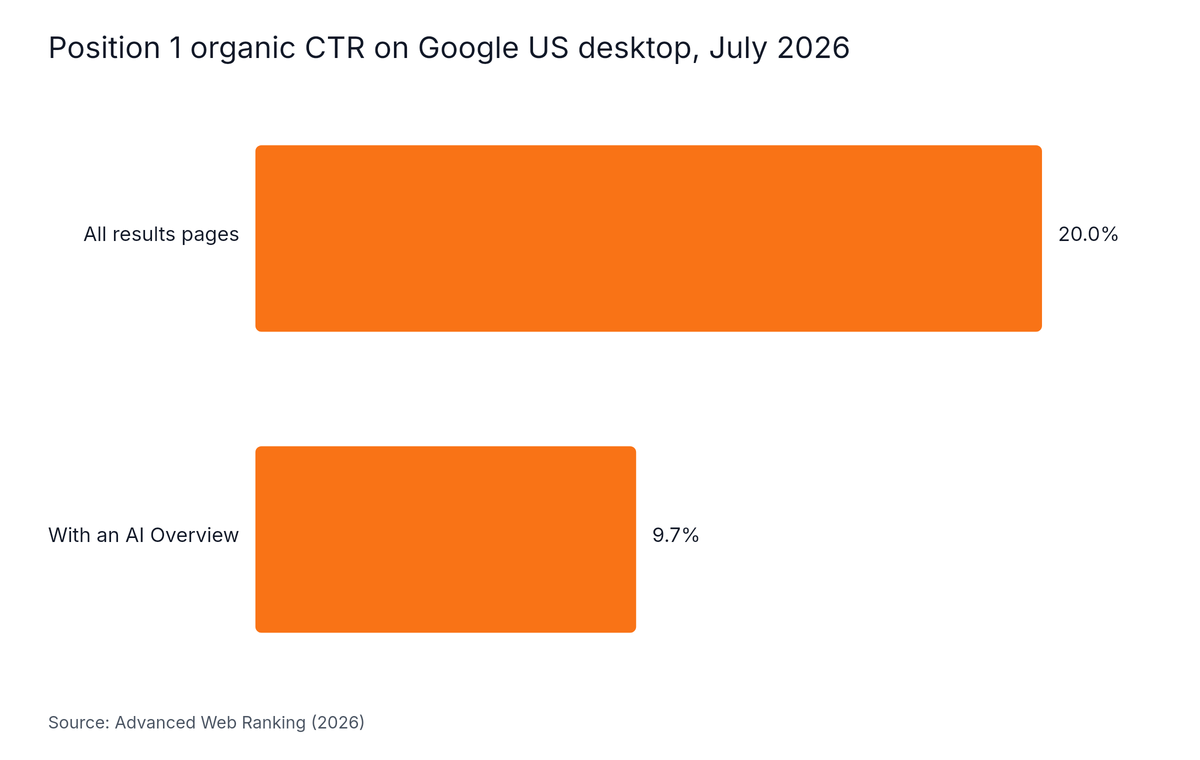
Horizontal Bar chart: Position 1 organic CTR on Google US desktop, July 2026. Highest: All results pages at 20.0%.
The Advanced Web Ranking chart shows the 52% cut: 20.02% on all results pages against 9.69% with an AI Overview present (Advanced Web Ranking, 2026).
How reliable are these numbers?
One small case study, reported by Search Engine Roundtable, estimated AI Overview and AI Mode impressions at about a 0.9% CTR after a site opted out of generative AI features (Search Engine Roundtable, 2026). It covers one site and is anecdotal, not a benchmark. No independent B2B SaaS-specific CTR study was found. Use these figures to set a range, then measure your own queries.
How Does AI Overview Optimization Work for B2B SaaS Companies Based in the US?
For US B2B SaaS companies, AI Overview optimization means applying standard SEO to answer-first pages and watching brand and commercial queries, where US exposure is highest. SE Ranking reported AI Overviews on 82.5% of US brand searches (Search Engine Roundtable, 2026). Semrush found commercial-intent SERPs with an AI Overview grew 71% in six months (Semrush, 2026).
Search query cards sorted into three groups on a table
Semrush analyzed more than 600,000 US desktop keywords from November 2025 to April 2026. Transactional SERPs with an AI Overview fell 5% over that period. Computers and electronics was one of two exceptions to the flat or falling transactional trend, with an 80.45% positive share change (Semrush, 2026). Semrush showed no B2B SaaS-specific cut in what was reviewed, so that sector is only the closest proxy.
Coverage numbers differ between trackers because keyword sets differ. Check your own query list before trusting any single share. The studies here are US-based and do not document availability in other countries, so confirm that in Google's documentation.
How Much Should a B2B SaaS Team Invest in AI Overview Optimization?
A B2B SaaS team should size its AI Overview effort by query type, not by one traffic number. Position one CTR fell 52% when an AI Overview appeared, from 20.02% to 9.69% (Advanced Web Ranking, July 2026). Informational queries justify citation-focused work. Comparison and branded pages need accurate, answer-first content.
A balance scale weighing two small stacks of paper cards on a desk
Nothing in Google's documentation promises a citation for any change. The triage below is an editorial recommendation built from the studies above.
A simple triage by query type
Query type
AI Overview exposure
Suggested priority
What to measure
Informational
High, low click value
Earn the citation, accept fewer clicks
Impressions, citations, assisted pipeline
Comparison and commercial
Rising
Keep pages accurate, answer-first, table-based
Clicks, demo requests
Branded
Very high in US brand searches
Make product, pricing and integration facts correct
Brand clicks, sales conversations
A measurement workflow
Export queries from Search Console and group them by the three types above.
Record a baseline: impressions, clicks and CTR for each group.
Watch for stable impressions with falling clicks, the AI Overview pattern.
Use the Generative AI performance report Google points to in its guide.
Compare pipeline, not only traffic, before and after changes.
Our data: AEO for B2B SaaS proposes a monthly check of 20+ category questions across five engines as a measurement baseline. This is a proposed method, not a measured result.
Limitations: Who Should Not Expect Much From AI Overview Optimization
AI Overview optimization has real limits. Google documents no guaranteed method, no special markup and no promised citation. The available CTR studies are mostly vendor or small-panel research. Teams hoping for a quick traffic recovery, or a B2B SaaS-specific benchmark, will not find one in the independent sources reviewed for this page.
Several caveats apply:
Methods differ. Pew used a browsing panel of 900 US adults, and Google disputed its methodology (Pew Research Center, 2025). Advanced Web Ranking is a vendor study.
Platforms change quickly. Google was reported on November 2, 2026 to be testing query refinement bubbles and removal of the citations card on AI Overviews (Search Engine Roundtable, 2026). Layouts and click paths may shift.
Not a replacement for SEO. Google describes the work as ordinary SEO, so weak core pages will not be rescued by reformatting.
Not a fit for every site. Pages with no informational or commercial buyer questions have little to gain.
What is AI Overview optimization and how does it affect B2B site traffic?
AI Overview optimization is the practice of structuring pages so Google's AI Overviews can find and cite them. For B2B sites it matters because AI summaries lower clicks: Pew Research Center measured clicks on a traditional result in 8% of visits with an AI summary versus 15% without in 2025, so citation visibility now sits beside traffic.
How does AI Overview optimization work for B2B SaaS companies based in the US?
For US B2B SaaS companies, AI Overview optimization means applying standard SEO to answer-first pages and tracking results in Search Console. Semrush analyzed more than 600,000 US desktop keywords from November 2025 to April 2026 and found commercial-intent AI Overview share rising. Prioritize brand, comparison and informational queries, then measure each group separately.
Are AI Overviews available outside the US?
The sources reviewed for this page report US data and do not document country-by-country availability of AI Overviews, so no availability claim is made here. Google's own AI features documentation is the place to confirm which countries and languages show AI Overviews before comparing US benchmarks to another market.
Do I need special schema markup or an llms.txt file to appear in Google AI Overviews?
No special schema markup or llms.txt file is needed to appear in Google AI Overviews. Google's documentation says "You don't need to create new machine readable files, AI text files, or markup to appear in these features." Accurate structured data matching visible text remains normal SEO practice, but it is not a documented requirement.
Is AI Overview optimization different from SEO?
For Google, AI Overview optimization is largely ordinary SEO, and Google's documentation says SEO best practices remain relevant for its AI features. What differs is emphasis: answer-first sections, tables and specific facts make pages easier to quote, and measurement adds impressions and citations beside clicks.
Why is organic traffic down when rankings have not changed?
Organic traffic can fall at a steady ranking because AI Overviews answer the query on the results page. Pew Research Center found users ended their browsing session on 26% of pages with an AI summary versus 16% with only traditional results in 2025. Stable impressions with falling clicks is the pattern to look for in Search Console.
Conclusion
AI Overview content optimization for B2B SaaS rests on a few points that hold across the evidence reviewed here.
Google says SEO best practices still apply, and that no special markup or AI file is needed.
Independent studies report lower clicks when an AI summary appears, though their methods and samples differ.
AI Overviews reach brand and commercial queries, so triage by query type.
No independent B2B SaaS CTR study was found, so measure your own baseline.
Answer-first sections, tables and accurate facts help readers and citations alike, though no citation is guaranteed.
For a related next read, see LLM optimization for B2B SaaS. To pressure-test a query plan, bring your buyer questions to a conversation.
A free consultation. Bring the questions buyers ask about your category and brainstorm how to get cited.
Meet with an expert
Written by
Ishan Manchanda
Ishan Manchanda is co-founder of GrowthSpree, a B2B SaaS marketing consultancy founded in 2017 that has managed $60M+ in ad spend across 300+ B2B SaaS companies. He focuses on demand generation, go-to-market strategy and pipeline growth, and has been featured in Silicon Valley Times, SaaS Mag and the Unbounce podcast.
 Ishan ManchandaNov 19, 2026