Blog
Generative Engine Optimization Budget for B2B SaaS: What to Fund and What to Skip
Build a generative engine optimization budget for B2B SaaS: split fixed SEO-overlap work from monitoring tools, with sourced price ranges and kill criteria.
Is there a structured answer engine optimization course for B2B SaaS teams? See the learning paths, a curriculum checklist and a 90-day in-house plan.
 Ishan ManchandaNov 20, 2026

Build a generative engine optimization budget for B2B SaaS: split fixed SEO-overlap work from monitoring tools, with sourced price ranges and kill criteria.

The six metrics that matter for AI search visibility in B2B SaaS, how to separate mentions from citations, set per-engine baselines and tie results to pipeline.
How B2B SaaS teams can structure pages for Google AI Overviews: what Google documents, what CTR studies show, and where to spend effort first.
Request a quote and our experts will contact you within 24 hours with tailored solutions and pricing.
Last updated: Nov 20, 2026
By AEO for B2B SaaS Editorial Team | Last updated: November 4, 2026
Editorial process: every figure is cited to a named source with its sample where stated, engine claims come from the engine's own documentation, and predictions are labeled as predictions.
An answer engine optimization (AEO) course is a structured program that teaches a B2B SaaS marketing team how to earn citations in AI-generated answers. In the research behind this page, no neutral, practitioner-led option covers the whole job. Most results are vendor or agency material that doubles as a sales pitch. Meanwhile, buyers have moved: G2's March 2026 survey found 51% of B2B software buyers start research in an AI chatbot (G2, 2026). This guide maps the learning paths that exist, sets out what a curriculum should cover, and gives an in-house team a 90-day plan it can run alone. It starts from what AEO means.
Key Takeaways
- No single neutral answer engine optimization course for B2B SaaS teams was found in the research behind this page, so teams build a curriculum from free lessons, official documentation and practice.
- G2's March 2026 survey of 1,076 B2B software buyers found 71% rely on AI chatbots at some point in software research (G2, 2026), so AEO skills now touch pipeline.
- Google Search Central says optimizing for generative AI search is still SEO, and that no new files or markup are needed for its AI features.
- Citation sources can shift within weeks, so a one-time course goes stale and monthly practice on a fixed set of buyer questions matters more.
- Checking who built a course, when it was updated and whether it fits B2B SaaS is the fastest way to filter the options.
No single structured answer engine optimization course currently teaches an in-house B2B SaaS marketing team the full job. Free vendor lessons cover basics, paid cohorts and agency courses go deeper but often sell a platform or service, and Google's documentation covers only Google's features. Teams get further by combining these sources into an internal curriculum with practice.

The table below sorts the learning paths by type. It is an editorial assessment of formats, not a ranking of providers.
| Learning path | Typical format | What it does well | What to check |
|---|---|---|---|
| Free vendor courses | Short recorded lessons | Fast vocabulary and tool basics | Tied to a platform; little B2B SaaS depth |
| Paid cohort courses | Live or cohort-based sessions | Set syllabus, peer discussion | Instructor's commercial ties; cohort dates; match to current engine documentation |
| Agency-led live courses | Instructor-led workshops | Practitioner examples | Can double as a sales funnel; may predate recent guidance |
| Official engine documentation | Public guidance pages | Source of truth for that engine | Covers one engine; silent on the others |
| Internal practice | Prompt set, audits, monthly review | Builds skill on the team's own category | Needs an owner and a calendar |
In the research behind this page, most listed courses were run by tool vendors or agencies. That is an observation, not a measured share.
Course titles use several overlapping labels, so it helps to know them.
Answer engine optimization (AEO) is the practice of structuring a B2B SaaS site and its content so AI assistants and AI search features cite it when buyers ask category and vendor questions. Generative engine optimization (GEO) is an overlapping term some researchers use for the same discipline. Search engine optimization (SEO) is the practice of earning ranked links in traditional search results. Large language model (LLM) optimization is a third label, covered in LLM optimization for B2B SaaS, and the guide to generative engine optimization explains the GEO label in depth.
Run any course through five checks before a team commits time or budget:
A course that fails three or more checks can still teach vocabulary. It should not set your strategy. For help judging software that sells measurement, see how to evaluate AEO tools.
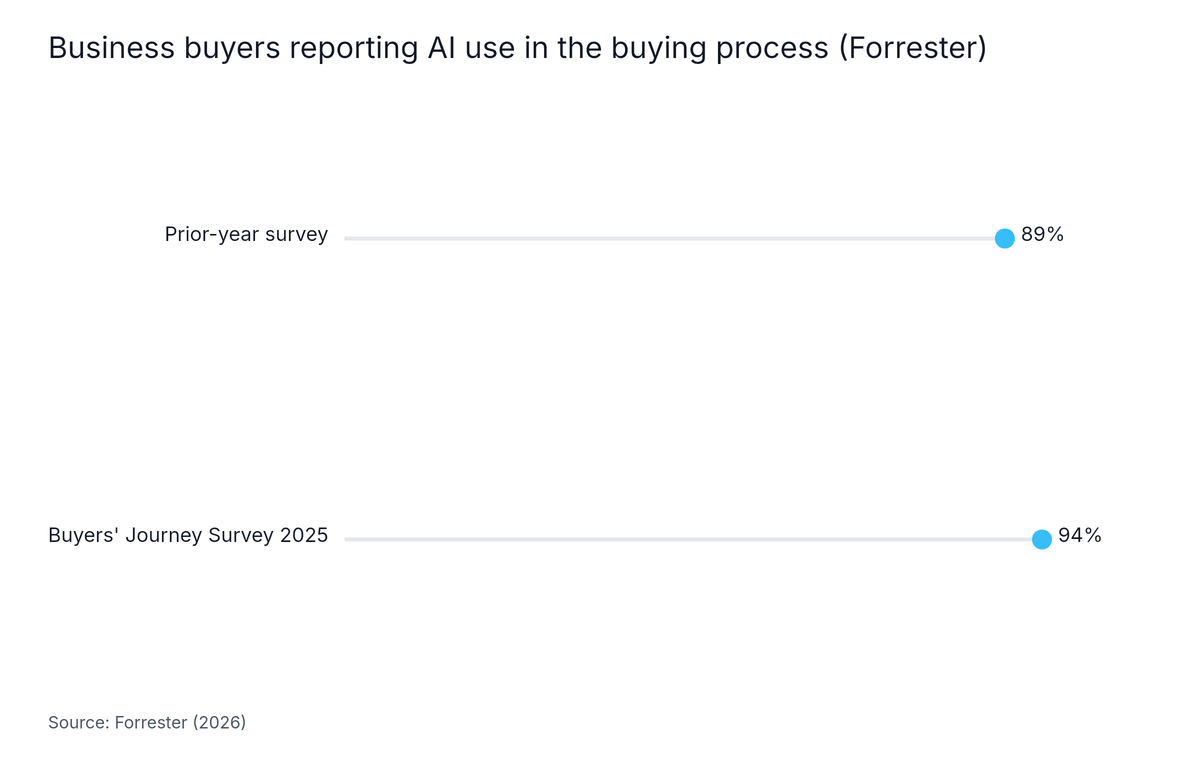
B2B SaaS teams need AEO skills now because buyers research with AI before they talk to sales. G2's March 2026 survey of 1,076 B2B software buyers found 51% start research in an AI chatbot (G2, 2026), and Forrester reports 94% of business buyers use AI in buying (Forrester, 2026). Being absent from those answers means being absent from the shortlist.
More survey numbers show how fast habits changed:
The Forrester figure comes from its Buyers' Journey Survey 2025, which put AI use in buying at 94%, up from 89% a year earlier (Forrester, 2026).
Source: Forrester, 2026
G2's own words capture the stakes: "the first impression of your brand is increasingly formed by what ChatGPT says about you" (G2, 2026). Forrester adds a caution: "generative AI has become a double-edged sword in the buying process" (Forrester, 2026).
Two limits apply. G2 sells AEO data products, so its survey is vendor research. And these are survey results, not proof that any course raises citations. They explain why the skill matters, not which training works. For the practical starting point, read how to get cited by AI assistants.
An AEO training curriculum for a B2B SaaS team should cover six areas: how answer engines choose sources, answer-first content structure, technical crawler access, buyer-question research, measurement, and ongoing review. Each area needs an exercise on the team's own site, because citation sources can shift within weeks and reading alone does not build the skill.

Semrush tracked more than 230,000 prompts weekly over 13 weeks and saw ChatGPT citation sources move sharply (Semrush, 2025). That is why every module below ends in a practice exercise. The matrix turns the six areas into a syllabus a team lead can assign.
| Module | What the team learns | Practice exercise | Likely owner |
|---|---|---|---|
| How engines choose sources | Each engine's documented behavior, separated from observation | Read each engine's guidance and note what is and is not documented | SEO lead |
| Answer-first content | Direct answers, tables, FAQs, named entities, specific numbers | Rewrite one category page so the answer opens the page | Content lead |
| Technical access | Content in raw HTML, crawler access, structured data matching visible text | Check that three key pages load without JavaScript and that crawlers are allowed on purpose | Web or engineering support |
| Buyer-question research | Which questions buyers ask about the category, comparisons, pricing and integrations | Draft the prompt set of 20 or more questions | Product marketer |
| Measurement | Citation checks per engine, AI referral traffic, accuracy of descriptions | Run the first baseline and record it | SEO or analytics lead |
| Ongoing review | Monthly rechecks and change logs | Compare this month with last month and list fixes | Program owner |
Engines differ, so one lesson cannot cover all of them. Semrush's study covered ChatGPT search, Google AI Mode and Perplexity, and found citation patterns moving week to week (Semrush, 2025). The guide to getting cited by Gemini shows how a single-engine module reads. A good rule: learn from each engine's own documentation first, and label everything else as observation.
Crawlability, structured data that matches visible text, and clear page writing carry over directly. The new skills are prompt-based measurement and writing for citation. AEO vs SEO for B2B SaaS sets out the split in detail.
Google's Search Central guidance, updated in May 2026, says optimizing for generative AI search is still SEO and that site owners do not need new machine readable files, AI text files or markup to appear in AI features. Courses that teach llms.txt or special schema as required Google tactics conflict with that documentation.

Google's guide says: "From Google Search's perspective, optimizing for generative AI search is optimizing for the search experience, and thus still SEO." (Google Search Central, 2026). A second Google page adds: "You don't need to create new machine readable files, AI text files, or markup to appear in these features." (Google Search Central, 2025).
llms.txt is a proposed convention, not a standard adopted by any major engine, that signals which site content is meant for AI ingestion. Google's May 2026 guide includes a mythbusting section that names llms.txt, content chunking, AI-specific rewrites and special schema as unnecessary for Google. It also points site owners to a Generative AI performance report in Search Console.
| Tactic taught in some courses | Google's documented position (May 2026) | Other engines |
|---|---|---|
| llms.txt | Not needed | Not confirmed in published engine documentation; treat as unproven |
| Content chunking | Not needed | Plausible, but unproven |
| AI-specific rewrites | Not needed | Plausible, but unproven |
| Special schema for AI | Not needed | Not confirmed in published documentation |
Prefer lessons that separate what Google documents from what may hold for other engines but is unproven. Skip any that present all four tactics as requirements. A fair counterpoint: Google speaks only for Google. Buyer research shows a distinct channel, and other engines publish less detail. A team can follow the Google guidance and still test other engines on its own prompt set.
An in-house team can learn AEO by running a 90-day practice cycle: build a prompt set of buyer questions, check citations on each engine, fix the pages that miss, and recheck monthly. Semrush's 13-week study found Wikipedia fell from roughly 55% of ChatGPT prompt responses to less than 20% (Semrush, 2025), so practice must repeat.

Semrush tracked weekly citations for more than 230,000 prompts across ChatGPT search, Google AI Mode and Perplexity. It is a vendor study, but it shows why a one-time course goes stale. A prompt set is a fixed list of buyer questions that a team checks across AI engines on a schedule.
This plan is editorial judgment, not a measured result.
| Phase | Weeks | Milestone | Output |
|---|---|---|---|
| Foundations | 1 to 4 | Read engine documentation; draft the prompt set; check crawler access | Written summary of documented vs observed behavior |
| Fix and baseline | 5 to 8 | Rewrite top pages answer-first; run first baseline across five engines | Baseline sheet with citation notes |
| Review | 9 to 12 | Recheck the prompt set; compare to baseline; list next fixes | Change log and next-quarter priorities |
The numbered steps behind it:
Learning from a worked example helps too. The guide to getting a B2B SaaS brand cited shows the steps in order.
Measuring AEO when clicks fall means counting citations, not only visits. A B2B SaaS team fixes a set of 20 or more buyer questions, checks each across five engines every month, and records whether the brand is cited, how it is described and which competitors appear. AI referral traffic is then separated in analytics.
Evidence note: AEO for B2B SaaS proposes a monthly check of 20+ category questions across five engines as a measurement baseline. For measured context on why clicks alone mislead: Ahrefs found that, across 300,000 keywords, an AI Overview correlated with a 58% lower average click-through rate (CTR) for the top-ranking page (December 2023 vs December 2025, published February 2026). Seer Interactive reported CTR on results with an AI Overview rebounded 85% in the first two months of 2026, and informational results without one rose from 2.93% to 3.97% CTR across 901 million impressions in 2025.
The baseline is a proposed method, not a dataset, so no result figure comes with it. The evidence on clicks points both ways, which is the point: a team needs its own numbers. Citation rate is the share of prompt-set questions where an engine cites the brand's site.
Track four items each month:
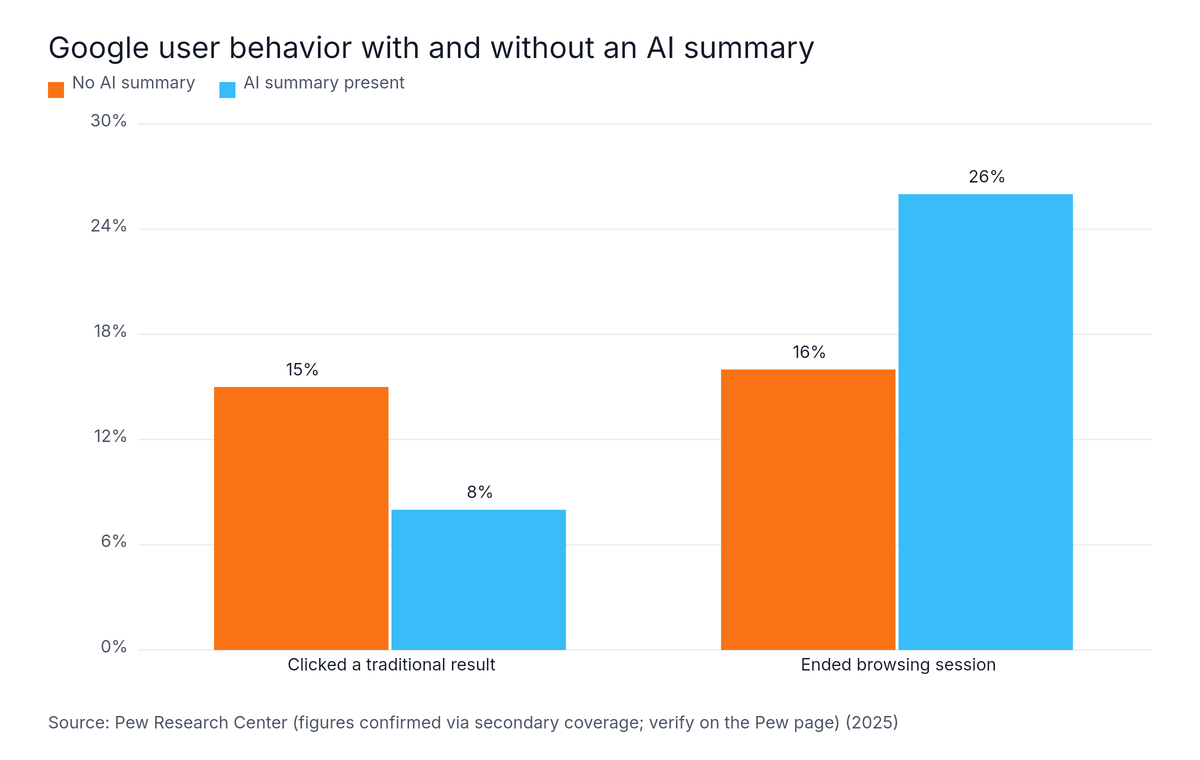
Zero-click behavior is the reason. Pew Research Center studied browsing data from 900 US adults and 68,879 Google searches in March 2025. Users clicked a traditional result in 8% of visits with an AI summary versus 15% without, and only about 1% clicked a link inside the summary (Pew Research Center, 2025). Sessions ended after the search 26% of the time with an AI Overview versus 16% with traditional results only (Pew Research Center, 2025). These figures were confirmed through secondary coverage of the study, and Google disputed its methodology, so treat them as one measurement.
Source: Pew Research Center (figures confirmed via secondary coverage; verify on the Pew page), 2025
In the chart, the traditional-results baseline is 15% clicking a result and 16% ending the session. Google's Search Console Generative AI performance report adds a first-party view for Google's features. Teams that want software for the checking can start with AEO tools for B2B SaaS compared. Clicks alone under-count influence, because answers can shape a shortlist without a visit.
Most in-house B2B SaaS teams with an existing SEO lead should train that team first, because Google's guidance treats AI search optimization as an extension of SEO. Hiring a specialist fits teams with heavy technical gaps, and an agency fits short-term capacity gaps. This is editorial judgment, not a measured result.

The skill belongs close to the people who write category pages. Forrester's Buyers' Journey Survey 2025 found AI use in buying had risen from 89% to 94% in a year (Forrester, 2026).
| Option | Best when | Trade-off | First step |
|---|---|---|---|
| Train the SEO team | A competent SEO lead exists and the site is crawlable | Slower start; needs protected time | Assign the 90-day plan to one owner |
| Hire an AEO specialist | Technical gaps are large and ongoing work is heavy | Cost and ramp-up; role may overlap with SEO | Define the role against the six curriculum modules |
| Use an agency | A launch or rebuild needs short-term capacity | Knowledge stays outside the team; sales incentives | Insist on a documented prompt set and a method you can reuse |
Whichever route a team picks, the prompt set and baseline should live inside the company. That keeps the learning and the data in-house.
A self-built AEO curriculum is not for teams that need a recognized certificate, a one-day fix, or a guaranteed outcome. It also does not fit B2C, e-commerce or local businesses. No course, vendor or method can promise a citation or a date by which one will appear, and this approach asks for steady monthly effort.
Honest limits to weigh:
A formal, vendor-neutral certification in answer engine optimization was not identified in the research behind this page. Individual course providers issue completion certificates, but these reflect that provider's own curriculum. Hiring managers and leaders are better served by evidence of work, such as a documented prompt set and citation tracking.
No single free AEO course is best for every B2B SaaS marketer, because free options are mostly built by tool vendors and aimed at broad audiences. Pick one for vocabulary, check who built it and when it was updated, then pair it with Google's official documentation and hands-on practice on your own category questions.
Google Search Central states that site owners do not need new machine readable files, AI text files or markup to appear in its generative AI features. Google's May 2026 guide also treats llms.txt, content chunking and special schema as unnecessary for Google. Other engines are not covered by that documentation.
The time an in-house team needs to learn answer engine optimization has no sourced figure. A practical planning assumption is a 90-day cycle: 30 days of foundations, 30 days of fixes and baseline, and 30 days of review. Skills then need monthly upkeep because citation sources can shift within weeks.
B2B software buyers do use AI chatbots in large numbers. G2's March 2026 survey of 1,076 buyers found 71% rely on AI chatbots at some point in software research (G2, 2026). Forrester reports 94% of business buyers use AI in the buying process (Forrester, 2026). Both figures come from surveys, not from click tracking.
Answer engine optimization and SEO overlap heavily in technical foundations, but they differ in what they measure. Google says optimizing for generative AI search is still SEO. Buyer research shows a distinct behavior: people ask AI assistants for shortlists. SEO targets ranked links, while AEO targets citations in AI-generated answers, so teams track both.
No neutral, structured answer engine optimization course for B2B SaaS teams turned up in this research, but a team can build its own path. Five points to carry forward:
For the next step in the cluster, read how to get cited by AI search engines.
A free consultation. Bring the questions buyers ask about your category and brainstorm how to get cited.
Meet with an expert
Written by
Ishan Manchanda
Ishan Manchanda is co-founder of GrowthSpree, a B2B SaaS marketing consultancy founded in 2017 that has managed $60M+ in ad spend across 300+ B2B SaaS companies. He focuses on demand generation, go-to-market strategy and pipeline growth, and has been featured in Silicon Valley Times, SaaS Mag and the Unbounce podcast.