
Blog
Generative Engine Optimization Budget for B2B SaaS: What to Fund and What to Skip
Build a generative engine optimization budget for B2B SaaS: split fixed SEO-overlap work from monitoring tools, with sourced price ranges and kill criteria.
Answer engine optimization examples for B2B SaaS pages: direct answers, robots.txt classes, JSON-LD and checks, plus what the evidence does and does not support.
 Ishan ManchandaNov 23, 2026

Build a generative engine optimization budget for B2B SaaS: split fixed SEO-overlap work from monitoring tools, with sourced price ranges and kill criteria.
The six metrics that matter for AI search visibility in B2B SaaS, how to separate mentions from citations, set per-engine baselines and tie results to pipeline.
How B2B SaaS teams can structure pages for Google AI Overviews: what Google documents, what CTR studies show, and where to spend effort first.
Request a quote and our experts will contact you within 24 hours with tailored solutions and pricing.
Last updated: Nov 23, 2026
By AEO for B2B SaaS Editorial Team. Last updated: November 4, 2026.
Answer engine optimization (AEO) examples for B2B SaaS are real page elements: a direct answer near the top, structured data that matches visible text, and a robots.txt file that allows AI crawlers on purpose. This guide shows each one.
Buyers already ask assistants for shortlists. In G2's 2026 survey of more than 1,000 B2B software buyers, 82% sourced software recommendations from an AI chatbot in the last 24 months (G2, 2026). Most explainers stop at concepts. This article shows what the elements look like in the page source, which ones the evidence supports, and how to check them. For the definition first, see what AEO means, or the wider cluster guide to getting cited.
Key Takeaways
- Answer engine optimization on a B2B SaaS page is five checkable elements: a direct answer, raw HTML, tables and FAQ, matching structured data, and deliberate crawler access.
- Google's documentation says no special schema markup is needed for generative AI search, so structured data should mirror visible text and promise nothing.
- AI crawlers fall into training, search and user-fetch classes, and robots.txt can treat each class differently.
- Among AI-using buyers, 72% use AI in early research and 62% when comparing vendors (Semrush, 2026), so product and comparison pages come first.
- No example guarantees a citation; each one is verified by server logs, a fixed question set and analytics.
Answer engine optimization (AEO) on a B2B SaaS page comes down to five visible, checkable elements: a direct answer in the first screen, content in raw HTML, tables and a matching FAQ, structured data that mirrors visible text, and a robots.txt file that allows AI crawlers. Each element can be verified in the page source.
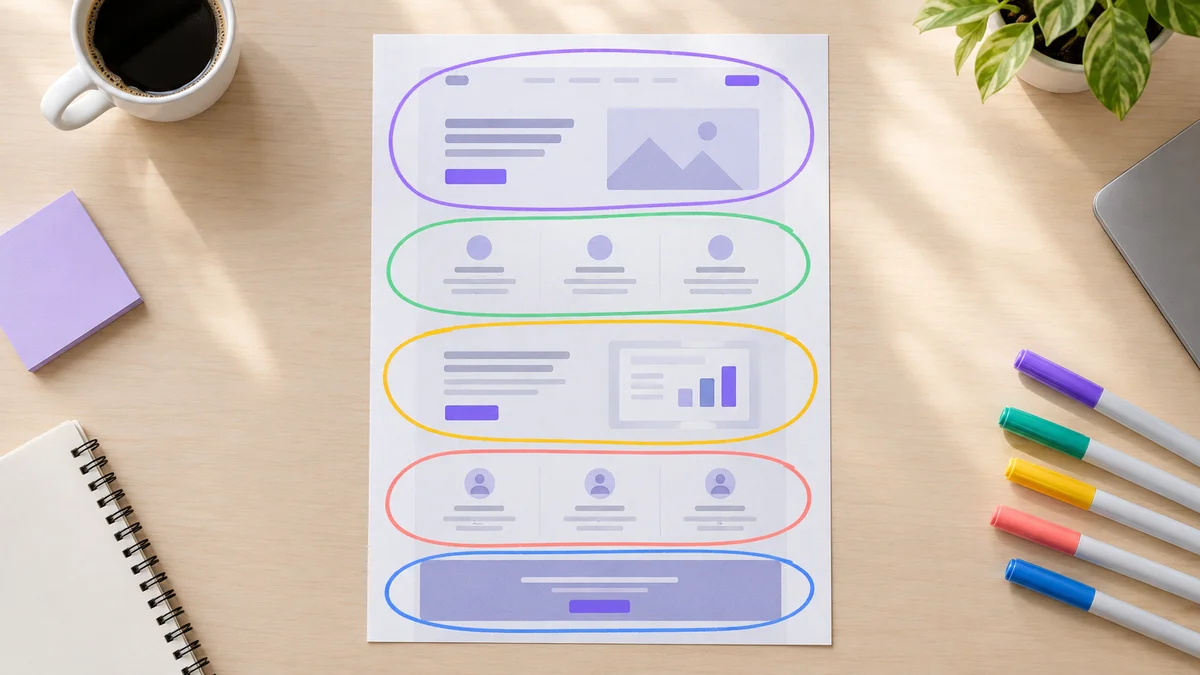
The table below pairs each element with a way to confirm it.
| Element | What it looks like | How to verify |
|---|---|---|
| Direct answer | One plain paragraph under the H1 | View the page with JavaScript off |
| Raw HTML | Text present in the fetched source | Fetch the URL and search for the answer text |
| Table and FAQ | A real table, FAQ questions as headings | Read the source for table and heading tags |
| Structured data | A JSON-LD block that repeats visible text | Compare each field with the page copy |
| Crawler access | Named user-agents with Allow or Disallow lines | Open /robots.txt and check bot names |
Raw HTML is the source a crawler receives before any JavaScript runs. If the answer only appears after scripts execute, an AI crawler may see an empty shell.
Answer engine optimization (AEO) is largely the same work as search engine optimization (SEO). Google's own guidance puts it bluntly: "From Google Search's perspective, optimizing for generative AI search is optimizing for the search experience, and thus still SEO." (Search Engine Journal, 2026). The comparison with classic practice is covered in AEO vs SEO for B2B SaaS.
Worked example: AEO for B2B SaaS applies a six-item technical checklist to its own pages as a practice: content in raw HTML, schema that matches visible text, an XML sitemap, an llms.txt file, explicit AI crawler access and Markdown copies. Its stated crawler policy is to allow AI crawlers on purpose. The public technical report is not yet published, so no results are claimed here.
Every example below therefore stands on its own evidence.
The direct answer on a B2B SaaS page belongs in the first screen, in raw HTML, as one plain paragraph of about 35 to 80 words directly under the H1 or the relevant H2. Pew Research Center found users who saw a Google AI summary clicked a traditional result in 8% of visits versus 15% without one (Pew Research Center, 2025), so the answer often has to work without a click.
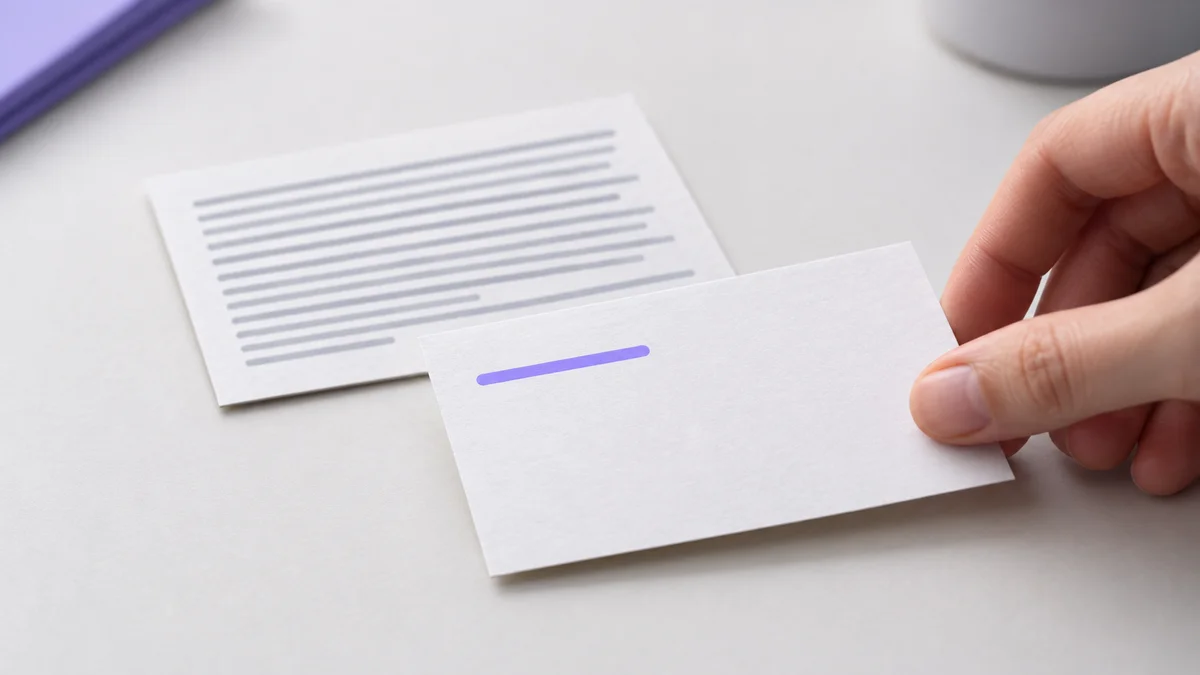
That length is an editorial convention, not a documented engine requirement. The Pew figure is measured browsing data from 900 US adults in March 2025. It is observational, and Google disputed the methodology.
The two openings below are for a fictional pricing page. The product is invented for illustration.
The second version names the product, the plan structure and two checkable facts. An assistant can lift it without the rest of the page.
Avoid placing it below a hero video, inside an accordion that loads on click, or in a script-rendered widget. Each of these pushes the answer out of the fetched source or far from the heading it answers.
A robots.txt file for a B2B SaaS site should treat AI crawlers as three classes: training bots such as GPTBot and ClaudeBot, search bots such as OAI-SearchBot and Claude-SearchBot, and user-fetch bots such as ChatGPT-User and Claude-User. Practitioner documentation from October 2026 describes blocking training bots while allowing search bots as a supported configuration (DataImpulse, 2026).

robots.txt is a plain-text file at the root of a site that tells crawlers which paths they may fetch. The example below is illustrative, not a copy of any live file. Review it against your own business trade-offs before shipping.
# Search and user-fetch bots: allowed so pages can be cited
User-agent: OAI-SearchBot
Allow: /

User-agent: ChatGPT-User
Allow: /

User-agent: Claude-SearchBot
Allow: /

User-agent: Claude-User
Allow: /

User-agent: PerplexityBot
Allow: /

# Training bots: a business decision, shown here as blocked
User-agent: GPTBot
Disallow: /

User-agent: ClaudeBot
Disallow: /
| Crawler class | OpenAI | Anthropic | Effect of blocking |
|---|---|---|---|
| Training | GPTBot | ClaudeBot | Keeps content out of model training |
| Search | OAI-SearchBot | Claude-SearchBot | Reduces chances of being cited in search answers |
| User-fetch | ChatGPT-User | Claude-User | Stops fetches triggered by a user's request |
PerplexityBot is named in the same practitioner guidance. Check Perplexity's own documentation for how it classifies that crawler. For the Google side, see the Gemini citation guide.
Blocking GPTBot does not remove a site from ChatGPT search, because OpenAI's training bot GPTBot is separate from its search bot OAI-SearchBot. Blocking only GPTBot is the supported "training blocked, search allowed" setup. Anthropic's ClaudeBot and Claude-SearchBot follow the same pattern.
A bot-protection or firewall rule can block crawlers that robots.txt allows, which is why the access check belongs in server logs, not only in the file. A real-world example appeared in July 2026. A GitHub audit of the gh-aw docs site flagged a missing robots.txt and scored it 0/18 for AI bot access. The repo-level file allowing 27 AI bots scored 15/18 (GitHub, 2026).
Google states that "Structured data isn't required for generative AI search, and there's no special schema.org markup you need to add." (Google Search Central, 2026). A single-site test by OtterlyAI found 6 of 7 AI platforms could not access raw schema data (OtterlyAI, 2026), so structured data is best treated as markup that matches visible text, not as a citation lever.
The OtterlyAI result is a vendor experiment on its own site, run as a direct fetch test across 7 platforms. It suggested schema's value flows mainly through traditional SEO. Treat it as indicative only.
JSON-LD is a structured data format that places machine-readable facts about a page in a script block in the page source. Ship it for conventional search features. Keep every field identical to visible copy, and make no claim that it earns citations. Here is an illustrative FAQPage block for the fictional page above:
<script type="application/ld+json">
{
  "@context": "https://schema.org",
  "@type": "FAQPage",
  "mainEntity": [{
    "@type": "Question",
    "name": "Does Acme Billing integrate with QuickBooks?",
    "acceptedAnswer": {
      "@type": "Answer",
      "text": "Yes. The QuickBooks integration is included on all plans."
    }
  }]
}
</script>
The question and answer text must also appear on the page, word for word. Markup that contradicts visible text is a risk, not an advantage.
llms.txt is a proposed convention, not a standard adopted by any major engine, that points AI crawlers to content intended for ingestion. Google's May 2026 guide says it is not needed. Shipping one is optional.
Comparison and product pages are the first candidates for answer engine optimization, because B2B SaaS buyers use AI most while researching and comparing vendors. Among buyers who use AI for vendor research, 72% use it in early research and 62% when comparing vendors (Semrush, 2026). Semrush also found 66% of B2B professionals regularly use AI to research products, vendors or solutions.
Semrush's 2026 survey covered 600+ US business professionals, and the figures are self-reported. The two stage percentages point to the same priority: comparison and technical-validation pages are worth structuring first. For the structure of such pages, see how content structure drives visibility.
It does. G2's 2026 report found review sites (38%) overtook AI chatbots (37%) as the top source shaping buyer shortlists for the first time (G2, 2026). Your own pages are one input among several.
One caveated aside. A practitioner blog, Michael Semer (2026), relays a Ten Speed sample of 7,387 citations from 170 evaluation-stage prompts. In it, product pages took 24.1% of citations and comparison pages 13.3%. The upstream report was not located, so treat the split as unverified and do not base priorities on it.
| Figure | Type | Sample | Caveat |
|---|---|---|---|
| 8% vs 15% clicks (Pew, 2025) | Measured | 900 US adults, March 2025 | Observational; Google disputed the method |
| 72% / 62% by buying stage (Semrush, 2026) | Survey | 600+ US business professionals | Self-reported use |
| 38% vs 37% shortlist source (G2, 2026) | Survey | 1,000+ B2B software buyers | Self-reported |
| 6 of 7 platforms (OtterlyAI, 2026) | Experiment | One site, 7 platforms | Vendor test, indicative only |
| 24.1% product pages (Ten Speed, 2026) | Relayed sample | 7,387 citations | Upstream report not located |
Checking an answer engine optimization change takes three tests: server-log hits from AI bots, a fixed set of 20 or more buyer questions asked monthly across engines, and referral analysis in analytics. Measurement matters because a TripleDart dataset of 28 companies, relayed by Michael Semer (2026), found the homepage produced 67 of 82 leads.
In that dataset, generic blog posts drew 12,135 AI-referred sessions and zero leads. The homepage leads came from just 5 of 28 companies. The upstream report was not located, so treat the figures as indicative.
Google also points site owners to a Generative AI performance report in Search Console (Google Search Central, 2026). Tool options are compared in this guide to AEO tools.
Answer engine optimization examples like these do not suit consumer or e-commerce sites, and none of them guarantees a citation. Google's documentation says "There are no additional requirements to appear in AI Overviews or AI Mode, nor other special optimizations necessary." (Google Search Central, 2025). The examples make pages readable and checkable, not ranked.
Several limits apply:
llms.txt is a proposed convention, and Google's May 2026 guide on generative AI features says it is not needed for Google's AI features. Shipping one is optional and low cost, but it should not replace readable raw HTML, deliberate crawler access and a clear direct answer near the top of each page.
Answer engine optimization (AEO) overlaps heavily with search engine optimization (SEO). Google's guidance says optimizing for generative AI search is optimizing for the search experience, and thus still SEO. The practical differences sit in how pages are written, with answer-first structure, and in how visibility is measured, through citations rather than rankings alone.
Blocking AI training bots while allowing search bots is a supported configuration, according to practitioner documentation published in October 2026. For OpenAI, GPTBot is separate from OAI-SearchBot. For Anthropic, ClaudeBot is separate from Claude-SearchBot. A firewall rule can still block the search bots, so confirm access in server logs.
AI-referred traffic can show up as direct in GA4 because some AI referrals arrive without a usable referrer, so a standard report undercounts them. A practical fix is to filter referrers such as chatgpt.com and perplexity.ai, then compare against server-log hits from AI crawlers and a fixed monthly set of buyer questions.
Answer engine optimization looks less mysterious in the page source. The takeaways:
For the broader plan, read how to get cited by AI search engines.
A free consultation. Bring the questions buyers ask about your category and brainstorm how to get cited. Meet with an expert
Written by
Ishan Manchanda
Ishan Manchanda is co-founder of GrowthSpree, a B2B SaaS marketing consultancy founded in 2017 that has managed $60M+ in ad spend across 300+ B2B SaaS companies. He focuses on demand generation, go-to-market strategy and pipeline growth, and has been featured in Silicon Valley Times, SaaS Mag and the Unbounce podcast.
© 2026 AEO for B2B SaaS All rights reserved.