Request a quote and our experts will contact you within 24 hours with tailored solutions and pricing.
Best Generative Engine Optimization (GEO) Tools for B2B SaaS: What to Look For
By AEO for B2B SaaS Editorial Team. Last updated: November 4, 2026.
Generative engine optimization (GEO) tools are software products that track whether AI assistants cite a B2B SaaS brand and, in some cases, recommend page changes intended to earn more citations. Choosing among the best generative engine optimization tools starts with knowing what they actually measure. A March 2026 G2 survey of 1,076 buyers found 51% of B2B software buyers start research in an AI chatbot (G2, via Morningstar, 2026). Teams feel that shift as missing shortlist slots, then meet a crowded tool market. This guide explains what the category measures and changes, where the numbers break, and how to test a platform before paying. It also connects to the AEO versus SEO overlap.
Key Takeaways
A generative engine optimization (GEO) tool either monitors AI citations or recommends changes, and many products blur the two.
Only about 17% of Google AI Overview sources also rank in the organic top 10 (BrightEdge, 2026), so a rank tracker cannot stand in for citation tracking.
AI tools gave different brand lists more than 99% of the time for the same prompt (Search Engine Journal, 2026), so visibility should be read as frequency across repeated runs.
Published AI referral shares run from 2.80% (Piperocket, 2026) to 6.4% (Pixis, 2026), so revenue claims need a stated sample and method.
A one-month pilot against your rank tracker is the simplest test for a relabeled SEO feature.
What Is Generative Engine Optimization and Which GEO Tools Support It?
Generative engine optimization (GEO) is the practice of shaping pages so AI assistants and AI search features cite and describe a brand inside generated answers. A GEO tool is software that either monitors that visibility across engines or recommends changes meant to improve it. For B2B SaaS teams, the useful tools say clearly which of those two jobs they do.
A marketer at a whiteboard covered with sticky notes of buyer questions in a bright office
GEO overlaps heavily with answer engine optimization (AEO), which is the practice of structuring a site so AI assistants and AI search cite it in answers to buyer questions. Some writers also use "large language model (LLM) optimization" for the same ground. The guide to GEO and the brands investing in it covers the terms in more depth.
Why a separate discipline at all?
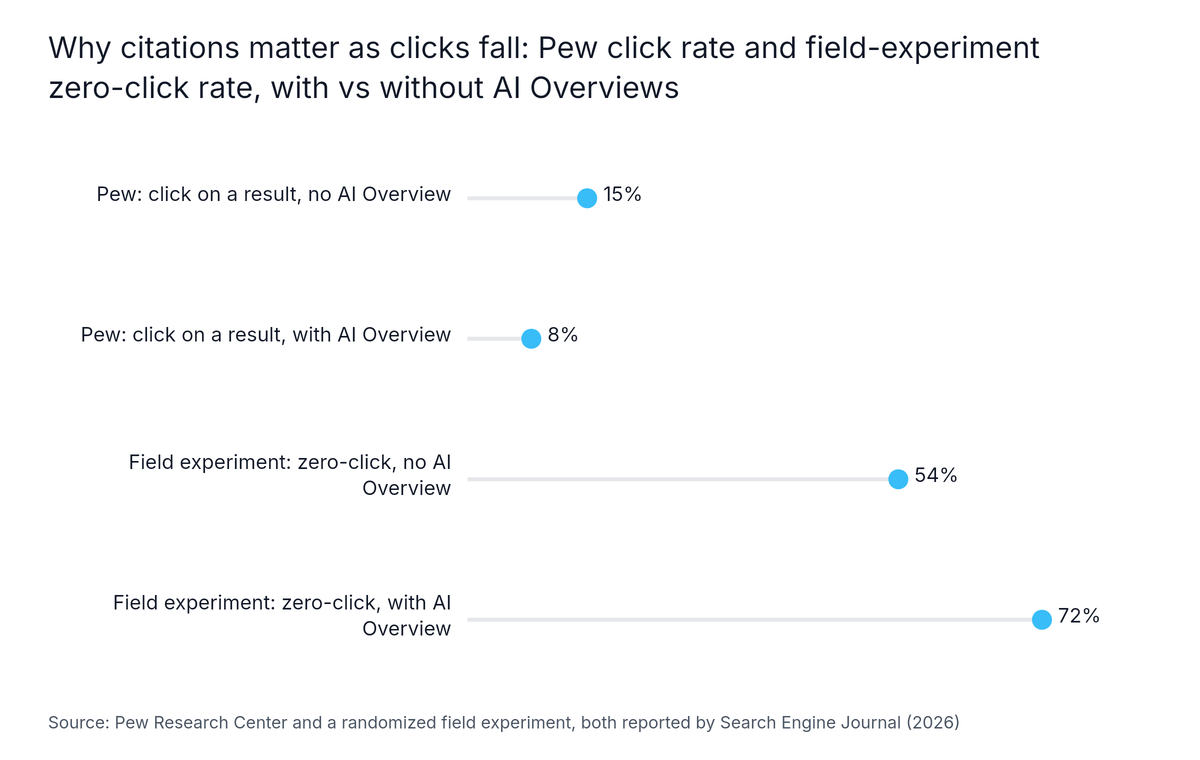
Clicks fall when an AI answer sits above the results. Pew Research Center found the click rate on a traditional result was 8% with a Google AI Overview and 15% without (Pew, via Search Engine Journal, 2025). A randomized field experiment found AI Overviews cut organic clicks on triggered queries by 38%, and zero-click searches rose from 54% to 72% (Search Engine Journal, 2026). When the click does not come, the citation is what remains.
Lollipop chart: Why citations matter as clicks fall: Pew click rate and field-experiment zero-click rate, with vs without AI Overviews. Highest: Field experiment: zero-click, with AI Overview at 72%.
Tool roundups often mix dashboards with "optimization" features. The two jobs are different, and each needs different proof.
Job
What the tool does
Evidence to ask for
Monitoring
Runs buyer questions through engines and records mentions, citations and sources
Run counts, engines covered, how often data refreshes
Recommending
Suggests content, structured data or page changes
Examples where a suggestion preceded a measured citation change
Changing
Publishes or serves pages, or generates content
Before-and-after citation frequency on a fixed question set
Attributing
Links AI referrals to sessions or pipeline
Sample, method and treatment of missing referrers
What Does a GEO Tool Measure That an SEO Rank Tracker Does Not?
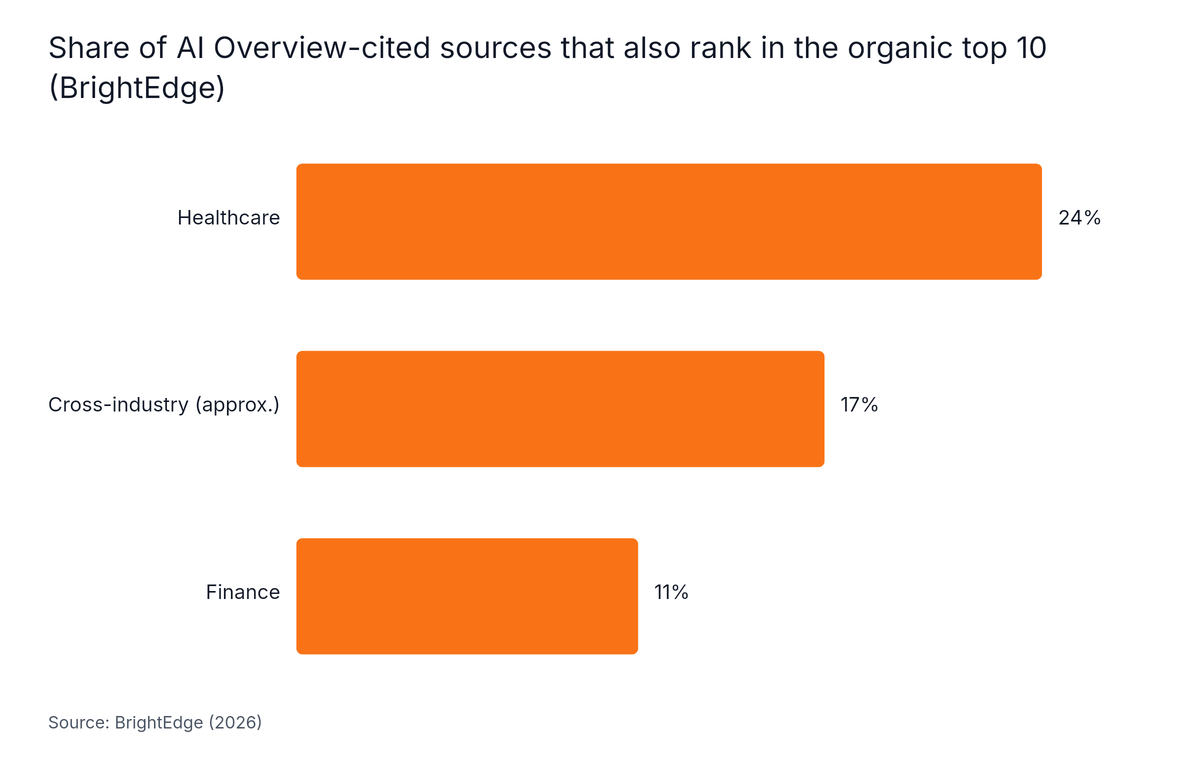
A GEO tool measures how often AI answers mention or cite a brand, which URLs they cite, and how the product is described. A search engine optimization (SEO) rank tracker measures ordered positions in search results. The gap matters because only about 17% of sources cited in Google AI Overviews also rank in the organic top 10 (BrightEdge, 2026).
Two colleagues comparing printed lists of cited web pages on a meeting table
BrightEdge tracked AI Overview keywords daily for 12 months and reported the 17% figure stayed flat. It also varies by vertical: 11% in finance and 24% in healthcare (BrightEdge, 2026). The report has no B2B SaaS figure, and BrightEdge concluded that the link between rankings and citations is specific to each vertical. The practical lesson: benchmark your own category.
Horizontal Bar chart: Share of AI Overview-cited sources that also rank in the organic top 10 (BrightEdge). Highest: Healthcare at 24%.
Vendors use the same words for different things. A citation is a URL that an AI engine lists as a source for an answer. Mention rate is the share of repeated answers that name a brand at all. Ask which definition a product applies.
Metric
What it counts
What to check
Mention rate
The share of repeated answers that name the brand
Whether it is a frequency across runs or one result
Citation
A URL the engine lists as a source
Whether it is tracked at URL level or domain level
Recommendation rate
How often the brand is suggested for a buyer question
Whether prompts are neutral or name the brand
Share of voice
Brand mentions as a share of all brands in the question set
Which competitors and questions form the denominator
Position
Order within one generated list
Treat as noise (see the next section)
Sentiment
Tone of the description
Whether the description is also checked for accuracy
A pilot test for relabeled SEO
A tool whose AI visibility only mirrors your rankings adds little, given the low overlap above. A simple pilot:
Fix a list of buyer questions covering category, comparison and alternative prompts.
Run them through the tool and your rank tracker for one month.
Compare cited URLs with ranking URLs, page by page.
Check whether the tool reports URL-level citations your rank tracker cannot see.
Can You Trust GEO Tool Metrics When AI Answers Change Every Time?
GEO tool metrics are only trustworthy when they report frequency across many repeated runs, not single-query positions. A SparkToro and Gumshoe.ai study found AI tools gave different brand-recommendation lists more than 99% of the time for the same prompt (Search Engine Journal, 2026). Treat any single snapshot as a sample, not a measurement.
A hand rolling a die beside a row of identical paper cards, suggesting varied results
The SparkToro and Gumshoe.ai study, as reported, had 600 volunteers run 12 brand-recommendation prompts through ChatGPT, Claude and Google AI 2,961 times in November and December 2025. Its author said it was not peer reviewed and used default settings, and Gumshoe.ai is itself an AI-tracking startup. Read it as strong evidence about variability, not a final word. Rand Fishkin, co-founder of SparkToro, put the consequence bluntly: "any tool that gives a ‘ranking position in AI’ is full of baloney." (Rand Fishkin, via Search Engine Journal, 2026)
Do different tools agree?
Not reliably. Digiday reported in June 2026 that marketers were questioning expensive AI visibility tools. Agency executives described them as a benchmark rather than a source of truth. In the words of one: "If you use three different tools and give them the same prompts, you get three different answers." (Paul Dyer, via Digiday, 2026)
A baseline that holds up
Repeated runs of a fixed question set are the remedy for variability. The publication's own proposed baseline follows that logic.
Our data: AEO for B2B SaaS proposes a monthly check of 20+ category questions across five engines as a measurement baseline, recording citation rate, accuracy of brand descriptions and which competitors appear. This is a proposed method, not a measured result.
Questions to put to a vendor
How many runs per prompt sit behind each reported number?
Are results shown as frequency, or as a single position?
Which AI Engines Should a B2B SaaS Team Track, and How Should It Attribute Traffic?
A B2B SaaS team should track the engines its buyers actually use and separate AI referral traffic in analytics. Published shares vary widely: Conductor data reported by Piperocket puts AI referrals at 2.80% of visits in IT and 3.37% in software and services (Piperocket, 2026), while Opollo data reported by Pixis shows 6.4% for B2B technology firms by January 2026 (Pixis, 2026).
A product marketer reviewing a printed referral report in a quiet office
What the attribution numbers say
Dataset
AI referral share
Sample and method
Conductor, IT (reported by Piperocket, April 2026)
6.4% of sessions in January 2026, up from under 1% a year earlier
GA4 referral and CRM data from 312 B2B technology firms
These figures use different bases and methods, so present them as a range, not a benchmark. Ask any vendor claiming revenue attribution for its sample and for how it handles visits that lose referrer data.
Matching engines to buyers
Coverage claims such as "10+ engines" matter less than covering the engines your buyers use. Include comparison, alternative and category prompts, since software buyers use chatbots to weigh vendors. The practical starting point for getting cited shows how to build that question set.
Who Is This Guide Not For?
AEO for B2B SaaS does not rank or review GEO tools, so this guide cannot tell a team which product to buy. It offers a way to evaluate any GEO tool against published evidence. Several figures come from secondary reports, so readers should check the original sources before relying on them.
Evidence on buyers and tools points in two directions. G2's March 2026 survey of 1,076 buyers found 51% of B2B software buyers start research in an AI chatbot (G2, via Morningstar, 2026). Yet Digiday's June 2026 reporting found agency executives treating AI visibility tools as a benchmark, not a source of truth (Digiday, 2026). Demand is real, and tool accuracy is unproven.
Three other limits apply:
Teams in consumer, e-commerce or local markets will find the B2B SaaS framing a poor fit.
Prices and prompt limits change quickly, so none are quoted here.
No tool or tactic can promise a citation or a date for one.
Frequently Asked Questions
How is a GEO tool different from an SEO rank tracker?
A generative engine optimization (GEO) tool records whether AI answers mention or cite a brand, which URLs they cite, and how the product is described. A search engine optimization (SEO) rank tracker records ordered positions in search results. The two overlap little, because only about 17% of Google AI Overview sources also rank in the organic top 10 (BrightEdge, 2026).
Are GEO tools accurate if AI answers change every time?
Generative engine optimization (GEO) tools are reliable only when they report frequency across many repeated runs of a fixed question set. SparkToro found AI tools gave different brand lists more than 99% of the time for the same prompt (Search Engine Journal, 2026), so a single snapshot or a per-query position is a sample, not a measurement.
If a B2B SaaS page ranks in Google's top 10, will AI assistants cite it?
A top-10 ranking does not predict a citation. BrightEdge reported in 2026 that only about 17% of sources cited in Google AI Overviews also rank in the organic top 10, and that the share runs from 11% in finance to 24% in healthcare (BrightEdge, 2026). Citation has to be measured directly, by URL, per engine.
Do GEO tools improve AI citations or only monitor them?
Most generative engine optimization (GEO) tools monitor, and some add recommendations or content workflows. Whether those recommendations raise citations is something the buyer has to verify. Ask the vendor for before-and-after citation frequency on a fixed question set, measured across repeated runs, rather than for a feature list.
Can an existing SEO platform replace a separate GEO tool?
Sometimes, if the platform reports URL-level citations and mention frequency across the engines a B2B SaaS buyer uses. Run the same fixed question set through both products for a month and compare the results with the rank tracker. If the output only mirrors rankings, it adds little.
Conclusion
The best generative engine optimization tools are the ones that prove what they measure. For a B2B SaaS team, five points carry the decision:
Separate monitoring from changing, and ask for evidence on each.
Expect little overlap with rankings: about 17% for Google AI Overviews (BrightEdge, 2026).
Read visibility as frequency across repeated runs, never as a single position.
Treat attribution shares of 2.80% (Piperocket, 2026) to 6.4% (Pixis, 2026) as a range, not a benchmark.
Run a one-month pilot against your rank tracker before committing budget.
For the wider question of what is new and what is not, start with what answer engine optimization means. Then take the buyer questions your category gets, and test them.
Meet with an expert. A free consultation. Bring the questions buyers ask about your category and brainstorm how to get cited.
Written by
Ishan Manchanda
Ishan Manchanda is co-founder of GrowthSpree, a B2B SaaS marketing consultancy founded in 2017 that has managed $60M+ in ad spend across 300+ B2B SaaS companies. He focuses on demand generation, go-to-market strategy and pipeline growth, and has been featured in Silicon Valley Times, SaaS Mag and the Unbounce podcast.
 Ishan ManchandaNov 14, 2026