
Blog
Generative Engine Optimization Budget for B2B SaaS: What to Fund and What to Skip
Build a generative engine optimization budget for B2B SaaS: split fixed SEO-overlap work from monitoring tools, with sourced price ranges and kill criteria.
A practical framework for choosing an answer engine optimization agency or consultant for B2B SaaS: a replicable pre-sign test, scoring rubric and red flags.
 Ishan ManchandaNov 9, 2026

Build a generative engine optimization budget for B2B SaaS: split fixed SEO-overlap work from monitoring tools, with sourced price ranges and kill criteria.

The six metrics that matter for AI search visibility in B2B SaaS, how to separate mentions from citations, set per-engine baselines and tie results to pipeline.

How B2B SaaS teams can structure pages for Google AI Overviews: what Google documents, what CTR studies show, and where to spend effort first.
Request a quote and our experts will contact you within 24 hours with tailored solutions and pricing.
AEO for B2B SaaS
Last updated: Nov 9, 2026
By AEO for B2B SaaS Editorial Team | Last updated: November 4, 2026
An answer engine optimization agency is a firm that helps B2B SaaS companies earn citations from AI assistants such as ChatGPT and Perplexity and from Google's AI Overviews, and the best way to judge one is a repeatable test, not a pitch.
Pitches in this market tend to sound alike, and the label on the door says little. In a 2026 survey, 66% of B2B professionals said they regularly use AI to research vendors and solutions (Semrush, 2026). This guide separates genuine answer engine optimization (AEO) depth from search engine optimization (SEO) rebranding. It covers what these firms do, how they differ from SEO shops, a pre-sign test and a commercial checklist. For the wider comparison, see AEO vs SEO for B2B SaaS.
Key Takeaways
- An answer engine optimization agency audits, restructures and measures a B2B SaaS site so AI assistants cite it for buyer questions.
- Google's May 2026 guide calls generative AI optimization "still SEO" for Google Search, so judge an agency's scope, not its label.
- The recommended pre-sign test for an answer engine optimization agency is the same 25 to 50 buyer-style prompts for every finalist, scored with one rubric.
- SparkToro found identical AI prompts returned the same brand list less than 1% of the time, so single-run "rankings" are unreliable.
- Commercial terms matter as much as method when hiring an AEO provider: who staffs the account, who implements changes, pilot scope and exit terms.
An answer engine optimization agency audits and restructures a B2B SaaS site so AI assistants cite it for buyer questions, then measures whether that happened. Answer engine optimization (AEO) is the practice of structuring pages so answer engines can find, trust and cite them. In a 2026 Semrush survey, 66% of B2B professionals regularly used AI to research vendors and solutions (Semrush, 2026).

Scope varies, but a credible engagement usually covers the work below. For the on-page side, see how to get a B2B SaaS site cited.
| Deliverable | What it covers | Evidence to ask for |
|---|---|---|
| Baseline measurement | A fixed set of buyer questions checked across several engines | Prompt list, run dates, engines, results |
| Technical access review | Crawler access, content in raw HTML, structured data | Before and after crawl checks |
| Page restructuring | Direct answers, tables, FAQs on category, pricing and comparison pages | Page-level change log |
| Third-party presence | Review sites, comparison and alternatives content | Source list and outreach plan |
| Reporting | Citation rate, brand accuracy, competitor presence | Repeat-run share of answer, not a single run |
A sensible floor for the baseline is 20 or more category questions, checked monthly across five engines. That is a recommendation, not a measured standard.
Our data: Ahrefs measured a 58% lower average click-through rate (CTR) for the top-ranking page when an AI Overview was present, across 300,000 keywords, comparing December 2023 with December 2025 (Ahrefs, February 2026). Seer Interactive then reported that CTR on results with an AI Overview rebounded 85% in the first two months of 2026, and that informational results without one rose from 2.93% to 3.97% CTR across 901 million impressions in 2025 (Seer Interactive, 2026). Both are measurements. The evidence points both ways, which is why a provider should report citations beside clicks.
An agency can change pages, structure and off-site presence. It cannot control what an AI assistant says on any given run. Any pitch that implies otherwise is a warning sign, and the final limits section returns to that point.
A generative engine optimization (GEO) agency focuses on earning citations inside AI-generated answers, while a search engine optimization (SEO) agency focuses on ranked links, and the two overlap heavily. Google's guidance puts it bluntly: "From Google Search's perspective, optimizing for generative AI search is optimizing for the search experience, and thus still SEO." (Search Engine Journal, 2026)

Generative engine optimization (GEO) is an overlapping term for earning citations inside AI-generated answers. LLM optimization (large language model optimization) is a third label for similar work. The labels matter less than the scope, because one firm may sell all three names for the same service.
The difference shows up in measurement. Pew Research Center tracked 900 US adults and 68,879 Google searches in March 2025. Users clicked a traditional result on about 8% of visits when an AI summary appeared, versus 15% without one (Pew Research Center, 2025). Google disputed that methodology. Still, it explains why a provider should track citations, not rankings alone.
Google's statement covers Google Search only. A specialist may add work for ChatGPT, Perplexity and Gemini. For a fuller comparison, read what generative engine optimization involves.
| Area | Traditional SEO agency | GEO or AEO specialist | What to test |
|---|---|---|---|
| Goal | Ranked links and clicks | Citations and accurate brand descriptions | Which metric leads the report |
| Measurement | Rankings, traffic | Share of answer across engines | Repeat runs, not one run |
| Engines | Mainly Google | ChatGPT, Gemini, Perplexity, Google AI | Engine-by-engine tactics |
| Off-site work | Links | Review sites and third-party mentions | Evidence it changed answers |
Before signing, every finalist should receive the same 25 to 50 buyer-style prompts, a required baseline run on ChatGPT, Gemini, Perplexity and Google AI Mode, and one scoring rubric. The prompt count is this guide's recommendation, not a finding. Single runs mislead: SparkToro found ChatGPT and Google's AI returned the same brand list less than 1% of the time (Search Engine Journal, 2026).

A pre-sign test is a fixed, identical exercise given to every finalist before a contract, so outputs can be compared instead of pitches.
Share of answer is the percentage of repeated runs of a buyer question in which a brand is named or cited. Rand Fishkin of SparkToro put the problem plainly: "If you ask an AI tool for brand/product recommendations a hundred times nearly every response will be unique." (Search Engine Journal, 2026) The study drew on 600 volunteers, so treat it as one measured sample.
| Test | Strong answer | Weak answer |
|---|---|---|
| Sampling | Reports share of answer over many runs | Reports a single-run "rank" |
| Prompt design | Prompts mapped to buying stages | Generic keyword list |
| Engine coverage | Separate results per engine | One blended score |
| Brand accuracy | Audits pricing and integration claims | Counts mentions only |
| Evidence | Dated before and after tracking | Screenshots without dates |
Among B2B professionals who use AI for vendor research, 72% use it in early research and 62% when comparing vendors. Another 48% use it to narrow the shortlist and 45% to support the final decision (Semrush, 2026). Semrush surveyed 600+ US business professionals, and it is a vendor survey.
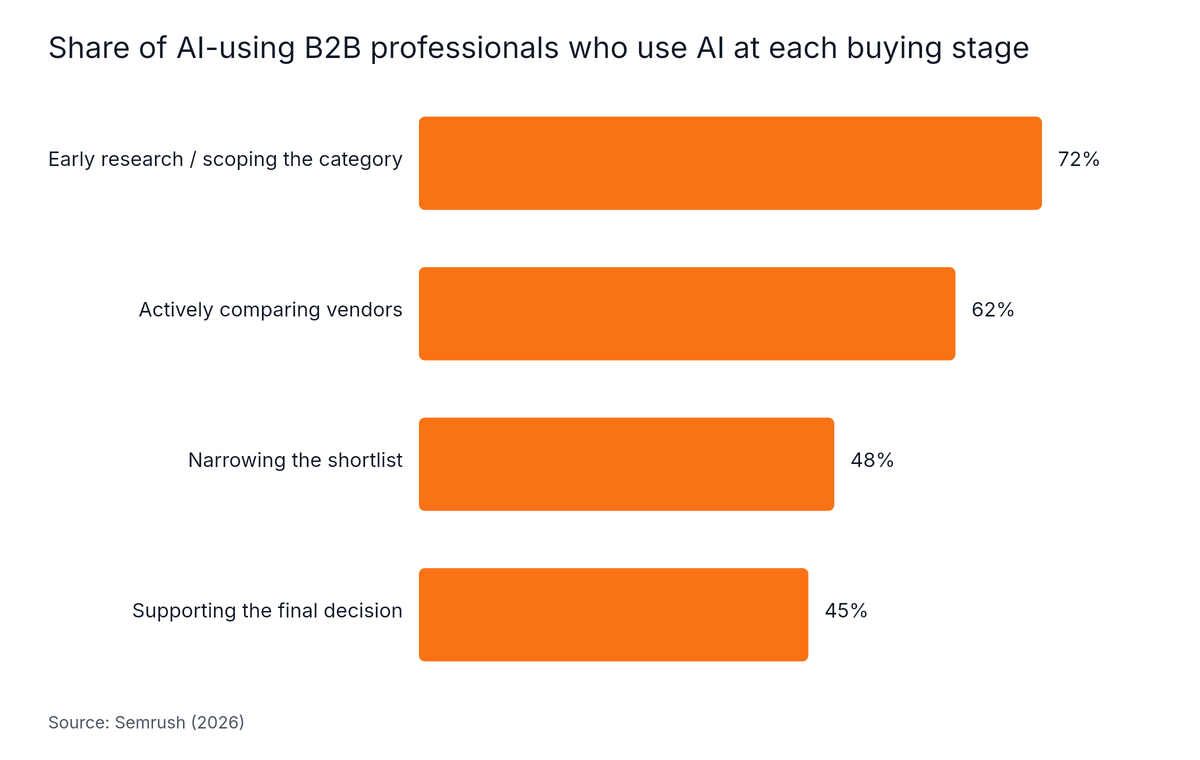
Source: Semrush, 2026
AI-built shortlists are hard to see in standard attribution. Gartner's survey of 645 B2B buyers, fielded in August and September 2025, found 69% prefer to validate AI-generated insights with sales reps (Gartner, 2026). Ask how a provider would use demo-request source questions and sales-call mentions. Tool options are covered in this comparison of AI visibility tools.
A B2B SaaS SEO agency that understands AI visibility can say which tactics apply to which engine and what remains unproven, while an SEO rebrand sells one package for everything. Google's May 2026 guide says "you can ignore tactics like "chunking" content, creating unnecessary AI text files (like llms.txt), or pursuing inauthentic mentions" (Google for Developers, 2026).

An SEO rebrand is a traditional SEO service relabelled as AEO or GEO with the same deliverables and a new price. That guidance applies to Google Search. Other engines may behave differently, so a specialist should separate documented behavior from observation. The table shows the signals to probe.
| Signal | Genuine depth | SEO rebrand |
|---|---|---|
| Tactic claims | Names the engine each tactic applies to | Same checklist for every engine |
| llms.txt and special schema | Explains the evidence and its limits | Sells them as essentials |
| Causation | Uses holdout or control pages, separates correlation | Reports gains without a comparison |
| Reporting | Share of answer with run counts | Proprietary score |
| Limits | States what cannot be controlled | Implies promised citations |
G2's 2026 Buyer Behavior Report found review sites (38%) overtook AI chatbots (37%) as the top shortlist influence (G2, 2026). A capable provider therefore works on review profiles, comparison and alternatives pages and category language, not only on your own site. The wider approach is in LLM optimization for B2B SaaS.
Answer engine optimization services come from specialist agencies, independent consultants, traditional SEO firms that added AI scope and in-house hires. For a Series A B2B SaaS company, fit depends on who implements changes, pilot scope and exit terms. This page names no providers and ranks none, because fit criteria matter more than a logo wall.

Demand is not niche. G2's 2026 report found 82% of buyers sourced software recommendations from an AI chatbot (G2, 2026), so any serious provider should show how it measures that channel.
| Option | Best suited to | Questions to ask |
|---|---|---|
| Specialist agency | Teams needing breadth: technical, content and off-site work | Who staffs the account day to day? |
| Independent consultant | Teams with developers and writers who need direction | Who implements the changes? |
| In-house hire | Teams ready for a long-term owner | What does the first 90 days produce? |
| Traditional SEO firm adding AI scope | Teams with a strong SEO base | Which engines and prompts are measured? |
Judge stage fit on commercial terms more than credentials:
For an expert who can help content get cited, the same test applies: dated before-and-after tracking and a clear line between documented engine behavior and guesses. For a plan you can run in-house, see how to get cited by AI assistants.
The framework for evaluating an answer engine optimization agency for B2B SaaS is not for buyers who want a ranked list of firms, a promised citation or a fixed timeline. No honest provider controls which sources an AI assistant names, and measurement is noisy: the SparkToro study drew on 600 volunteers running 12 prompts about 2,961 times (Search Engine Journal, 2026).
Other limits are worth stating:
Test every finalist on the same buyer-style prompts, run across ChatGPT, Gemini, Perplexity and Google AI Mode, and score the results with one rubric. Ask whether the agency reports share of answer over many runs, because SparkToro found identical prompts returned the same brand list less than 1% of the time (Search Engine Journal, 2026). Also check how it handles inaccurate brand descriptions.
A generative engine optimization agency aims to get a brand cited in AI-generated answers, while an SEO agency aims to rank links. The work overlaps: Google's May 2026 guide says optimizing for generative AI search is still SEO for Google Search (Google for Developers, 2026). Differences show up mainly in non-Google engines, citation measurement and third-party mentions.
The agencies that understand AI visibility can name which tactics apply to which engine, report share of answer across many runs, and tie work to pipeline. They also know B2B SaaS buyers lean on review sites: G2's 2026 report found review sites (38%) edged out AI chatbots (37%) as the top shortlist influence (G2, 2026).
No single page can fairly name the best agency for a post-Series A company, but the fit criteria are clear: a named person doing the work, a paid pilot with defined scope, reference calls with current B2B SaaS clients, clear exit terms, and clarity on who implements site changes. Judge stage fit on those points, not on a logo wall.
Specialist agencies, independent consultants and traditional SEO firms that have added AI visibility to their scope all provide answer engine optimization services, and some in-house teams do the work themselves. The label matters less than scope: ask for the prompt set, the engines tested, the deliverables, and who implements the changes on your site.
Run the same pre-sign test on every consultant: identical prompts, baseline runs on several engines, a scoring rubric and a request for repeat-run share of answer. Pitches converge, but outputs diverge. Ask which of their tactics Google's May 2026 guide calls unnecessary (Google for Developers, 2026), and why they would still use them elsewhere.
Look for an expert who can explain what makes a page citable, show dated before-and-after prompt tracking, and separate documented engine behavior from guesses. G2 describes the goal as "whether AI includes you in the shortlist, represents you accurately, and gives buyers enough proof to keep you in the evaluation" (G2, 2026).
Choosing an answer engine optimization agency for B2B SaaS comes down to five checks: scope over label, one shared test, repeat-run share of answer, B2B SaaS specifics, and clear commercial terms. Run them in that order, and let outputs, not pitches, decide the shortlist.
Be the answer, not the tenth blue link. For the in-house starting point, read how to get your B2B SaaS brand cited by AI assistants.
Meet with an expert
A free consultation. Bring the questions buyers ask about your category and brainstorm how to get cited.
Written by
Ishan Manchanda
Ishan Manchanda is co-founder of GrowthSpree, a B2B SaaS marketing consultancy founded in 2017 that has managed $60M+ in ad spend across 300+ B2B SaaS companies. He focuses on demand generation, go-to-market strategy and pipeline growth, and has been featured in Silicon Valley Times, SaaS Mag and the Unbounce podcast.