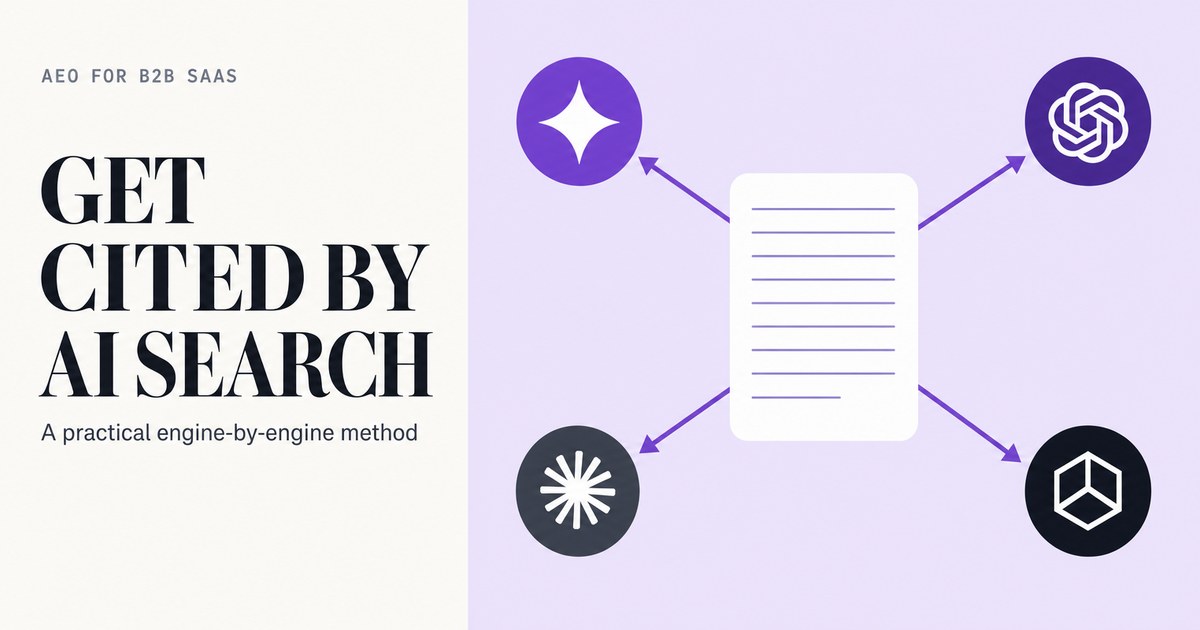
how to get company cited by ai search toolshow to get brand cited by ai chatbotsbrand visibility solutions for ai search
How to Get Your B2B SaaS Brand Cited by AI Assistants: A Practical Starting Point
ChatGPT lists four vendors in your category and you are not one of them. Here is what content, structural, and technical factors determine AI citation for B2B SaaS.
Request a quote and our experts will contact you within 24 hours with tailored solutions and pricing.
How to Get Your B2B SaaS Brand Cited by AI Assistants: A Practical Starting Point
By AEO for B2B SaaS Editorial Team
Answer engine optimization (AEO) for B2B SaaS is the practice of structuring a site so AI assistants name your brand in vendor shortlists, covering content structure, third-party signal, and technical crawler access. Getting cited is not a rankings problem. It is a pipeline problem, and it starts before a buyer visits your website.
"If AI chatbots don't name you in their recommendations, you're not even in the running," as G2 noted in The Answer Economy report (2026). That report surveyed 1,076 B2B software buyers in March 2026 and found AI chatbots now top the list of shortlist influences. The problem is concrete: 69% of buyers in that survey chose a different vendor than they initially planned, guided by AI chatbot answers (G2, 2026).
This page covers the content, structural, and technical factors behind AI citation for B2B SaaS companies. Every figure states whether it is measured or predicted.
Key Takeaways
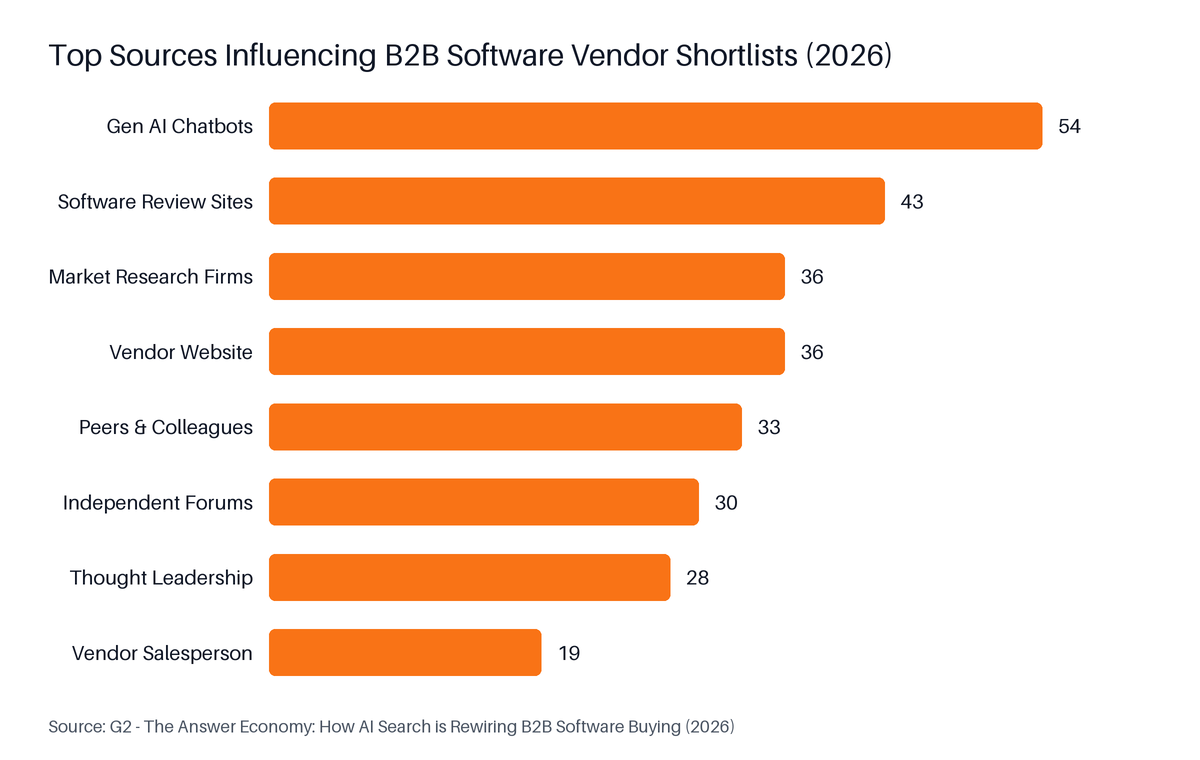
AI chatbots are the number one source influencing B2B software vendor shortlists, cited by 54% of buyers - ahead of review sites and vendor websites (G2, 2026).
69% of B2B software buyers chose a different vendor than initially planned based on AI chatbot guidance; 33% bought from a vendor they had never heard of before (G2, 2026).
Structural formatting changes alone produce a 17.3% improvement in AI citation rates across six generative engines, independent of content quality (University of Tokyo et al., March 2026).
82% of AI citations come from third-party sources, not from a brand's own site (Muck Rack, reported in OmniBound, December 2025).
Only 14% of marketers track AI and large language model citation visibility, despite 43% naming it a core 2026 strategy (GoodFirms, 2026).
How Do I Get My Business Cited by AI Assistants?
Getting a B2B SaaS business cited by AI assistants requires three things: pages that open with a direct answer to a specific buyer question, third-party coverage from sources those engines already draw on, and a technically accessible site AI crawlers can read. AI chatbots are now the number one source influencing B2B software vendor shortlists, cited by 54% of buyers - ahead of review sites and vendor websites - per G2's survey of 1,076 buyers in March 2026 (G2, 2026).
B2B SaaS marketer reviewing AI chatbot vendor shortlist on laptop
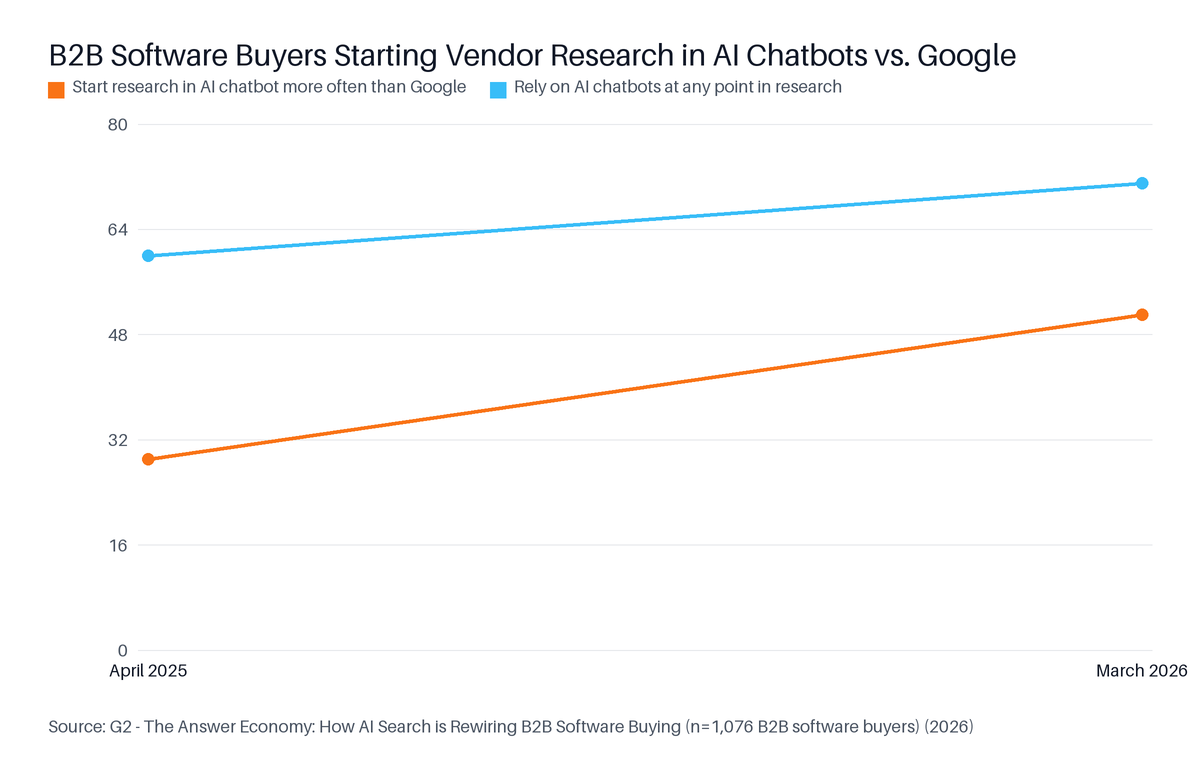
B2B software buyers starting vendor research in AI chatbots rose from 29% in April 2025 to 51% by March 2026-a 22-point swing in eleven months (G2, 2026).
Line chart: B2B Software Buyers Starting Vendor Research in AI Chatbots vs. Google. Highest: March 2026 at 51.
"The shortlist is now built inside AI, before buyers visit your site, where standard marketing attribution cannot see it." (IvrisTech, April 2026). That framing matters for how a B2B SaaS team should think about the problem. Citation absence is not a search ranking issue. It is a pipeline issue.
Why citation absence costs pipeline directly
The pipeline consequence is concrete. In G2's March 2026 survey, 69% of B2B software buyers chose a different vendor than they initially planned, based on AI chatbot guidance (G2, 2026). A brand absent from AI answers is not losing a touchpoint. It is filtered out of the consideration set before a buyer reaches the website.
Horizontal Bar chart: Top Sources Influencing B2B Software Vendor Shortlists (2026). Highest: Gen AI Chatbots at 54.
The factors that determine whether an AI assistant names a B2B SaaS vendor fall into three groups:
Content eligibility: Does the page answer a specific buyer question directly, near the top, in plain text?
Third-party signal: Does the brand appear on sources the engine already cites - review platforms, industry publications, press coverage?
Technical accessibility: Can AI crawlers read the page's content without executing JavaScript?
All three must be present. A technically perfect site with no third-party coverage will still miss citations. A well-mentioned brand with pages that bury answers after long introductions faces the same problem.
How to Get a Company Cited by AI?
Getting a company cited by AI engines starts with structuring content to answer specific buyer questions directly, near the top of every key page. Answer engine optimization (AEO) is the practice of structuring a B2B SaaS site so that AI assistants - ChatGPT, Perplexity, Gemini, Claude, Microsoft Copilot - and Google's AI features cite it when a buyer asks a category question. Structural changes alone produce a consistent 17.3% improvement in AI citation rates across six engines, independent of content quality, per a peer-reviewed study by researchers at the University of Tokyo, University of Tsukuba, Hiroshima University, and the National Institute of Informatics (University of Tokyo et al., March 2026).
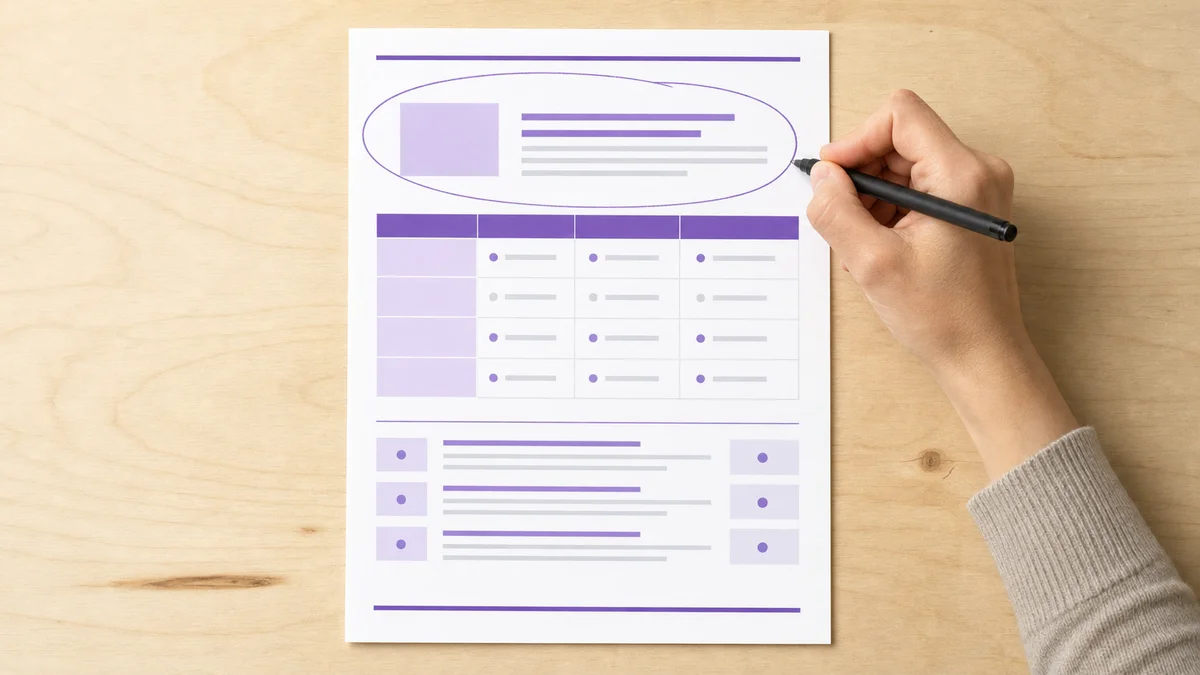
Structured content page with answer block and FAQ table visible on a desk
A page with good answers but poor structure leaves measurable citation opportunity behind. Position within the page also matters. Large language model (LLM) citations cluster in the opening section of an article. A B2B SaaS page that opens with company background before answering the question is structurally disadvantaged from the start.
Page-level content checklist
Every key B2B SaaS page - category pages, comparison pages, pricing pages, integration pages - should meet these criteria:
Page element
What AI-eligible looks like
Common failure mode
Opening answer
Direct 40-80 word answer to the page's heading question
Page opens with company background or context
Specific facts
Named figures with stated sources and dates
Vague claims: "powerful", "leading", "trusted by thousands"
Page structure
H2 and H3 headings that match buyer questions
Heading hierarchy used for navigation, not questions
Tables
Comparison or specification table in the first third
Specs buried in paragraphs
FAQ section
4-8 questions answered in 40-80 words each
FAQ absent or answered with one-line redirects
Entity clarity
Brand name, category, and use case named explicitly
Brand name alone, no category context
Plain text content
Content readable in raw HTML without JavaScript
Content dependent on JavaScript rendering
Freshness
Updated within 30 days for time-sensitive queries
Last updated date absent or stale
Content updated within 30 days receives 3.2x more AI citations than stale content, according to ConvertMate's GEO Benchmark Study 2026 across 12,500+ queries and 8,000 domains (ConvertMate, reported in OmniBound, 2026).
Entity disambiguation for B2B SaaS
One challenge specific to B2B SaaS brands: AI engines must map a brand name to a specific category without ambiguity. If a brand name is also a common English word, a competitor's product name, or a term used in unrelated industries, the engine may conflate them. Every key page should name the product, its category, the problem it solves, and the buyer it serves - in plain text.
A 10-day practitioner study tracking 90 days of AI responses for seven B2B software brands (October 2026) found that product pages naming integrations, pricing, and use cases in plain text earn disproportionately more citations (The Search Spot, October 2026). The same study found pages with five or more top-10 Google rankings are 7x more likely to be cited by AI - suggesting search authority and AI citation are correlated, even if they are not identical.
How to Get Brand Cited by AI Like ChatGPT?
Getting a B2B SaaS brand cited by AI assistants like ChatGPT depends heavily on third-party signal density: 82% of AI citations come from earned media - third-party sources - rather than owned or paid content, according to Muck Rack's proprietary citation dataset analysis (Muck Rack, reported in OmniBound, December 2025). ChatGPT recommends brands primarily through authoritative list mentions, which account for 41% of its recommendations, alongside third-party credibility signals like awards and reviews, per Onely's citation analysis (Onely, 2025).
Content marketer checking brand citations across multiple AI engines on two monitors
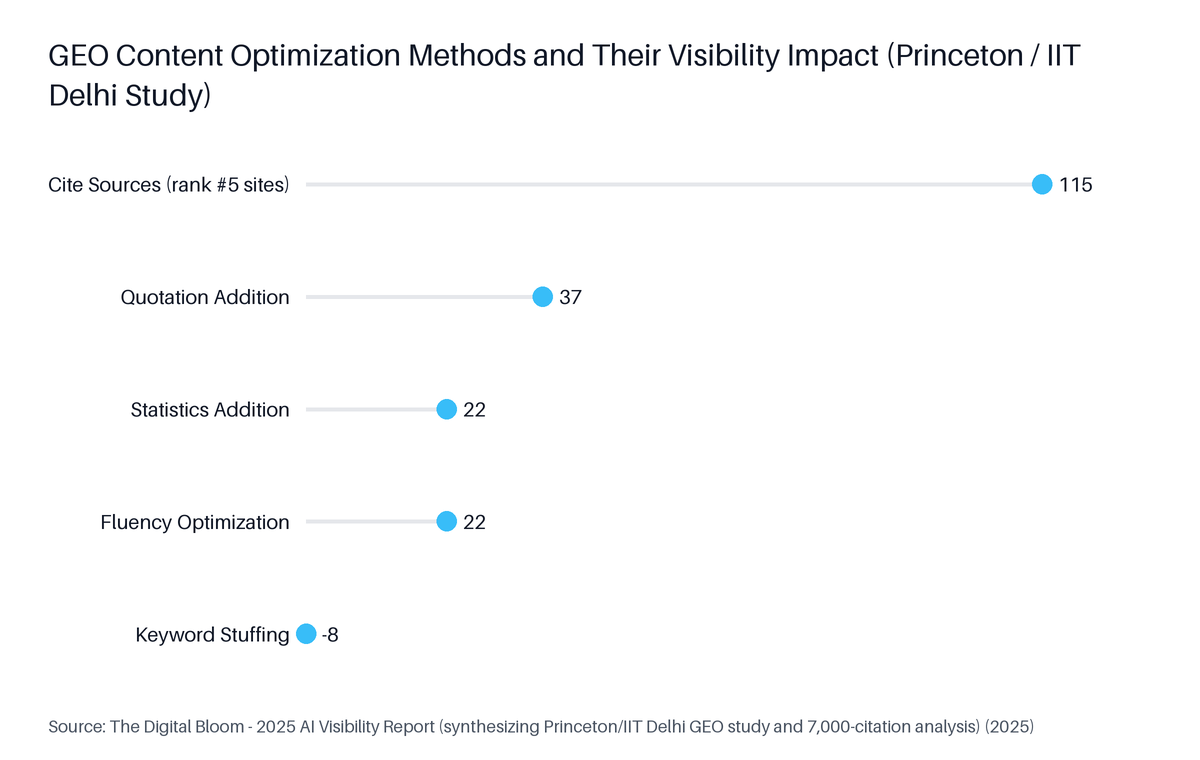
Lollipop chart: GEO Content Optimization Methods and Their Visibility Impact (Princeton / IIT Delhi Study). Highest: Cite Sources (rank #5 sites) at 115.
Among generative engine optimization (GEO) content methods tested in research synthesized from the Princeton/IIT Delhi GEO framework, citing authoritative sources produces the largest AI visibility lift at 115%; adding quotations contributes a 37% improvement; adding statistics adds 22%. Keyword stuffing is the only intervention with a negative result, reducing AI visibility by 8% (The Digital Bloom, reported in OmniBound, 2025). Writing for clarity and specificity outperforms writing for keyword frequency.
The third-party citation advantage over owned content is large. Brands are 6.5x more likely to be cited in AI answers through third-party sources than through their own domains, according to AirOps' citation source analysis (AirOps, reported in GoodFirms, 2025). Brand web mentions also correlate with AI Overview visibility at r=0.664-three times more strongly than backlinks at r=0.218-in Ahrefs' correlation study of 75,000 brands (Ahrefs, reported in OmniBound, August 2025).
The third-party platforms that matter most for B2B SaaS
For B2B SaaS companies, the third-party platforms with the highest citation relevance fall into four groups:
Platform type
Examples
Citation role
Software review platforms
G2, Capterra, TrustRadius
Engines draw on review-site content as category authority sources
Named-source coverage that builds brand-entity recognition
Press and analyst coverage
PR Newswire, analyst reports with brand mentions
High-authority citations that transfer credibility to the brand
Thought leadership placements
Contributed articles, expert quotes in roundups
Authoritative list mentions-41% of ChatGPT recommendations (Onely, 2025)
Our SaaS Brand Does Not Appear in AI Vendor Shortlists - What Solutions Address That Gap?
A B2B SaaS brand absent from AI vendor shortlists must address three gaps in sequence: content that answers buyer questions in plain crawlable text, third-party presence on platforms AI engines trust, and technical accessibility so AI crawlers can read the site. Only 14% of marketers currently track AI and large language model (LLM) citation visibility, despite 43% naming AI optimization a core 2026 strategy - a 29-point execution gap - per GoodFirms' 2026 survey of marketing professionals (GoodFirms, 2026).
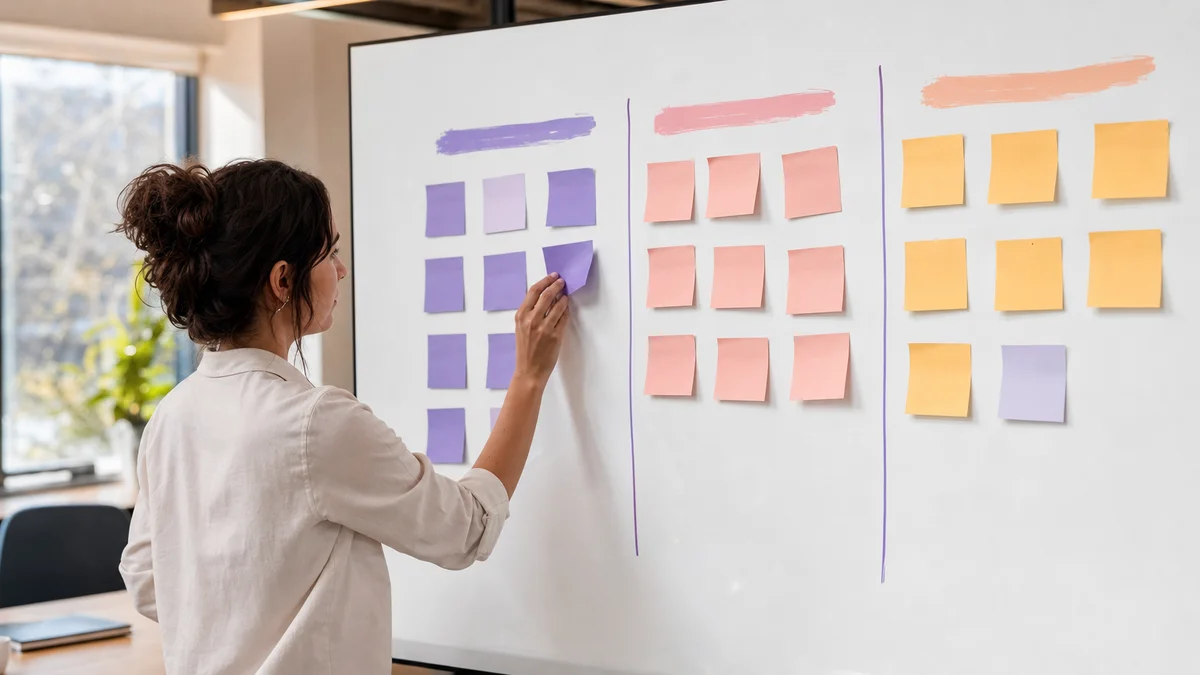
PR and review platform labels on a planning whiteboard for AI citation strategy
The technical accessibility layer
A site that looks correct in a browser may be invisible to an AI crawler if its content renders via JavaScript. An AI crawler that cannot read the page cannot cite it. The technical checklist for AI citation eligibility covers:
Content in raw HTML: Key page content must be present in the page's source HTML, not loaded by a JavaScript framework after the initial document is served.
AI crawler access in robots.txt: Blocking AI crawlers removes citation opportunity. If a page is already public and indexed by traditional search engines, there is no corresponding benefit to blocking AI crawlers.
Schema markup: Structured data that matches what is visible on the page - including FAQPage, HowTo, Article, and Product schemas where relevant - is documented by Google as a factor in structured content processing.
llms.txt:llms.txt is a proposed convention - not a standard adopted by any major engine as of October 2026-that signals to AI crawlers which content on a site is intended for ingestion. Whether engines act on it is unconfirmed in published engine documentation.
Sitemap and freshness signals: An up-to-date XML sitemap helps engines discover when pages change. Content freshness is a documented citation signal: content updated within 30 days receives 3.2x more AI citations than stale content (ConvertMate, reported in OmniBound, 2026).
SaaS team reviewing technical site checklist for AI crawler accessibility
Measuring citation presence - the execution gap
The gap between knowing AI citation matters and being able to measure it is where most B2B SaaS teams stall. A practical measurement baseline involves selecting 20 or more category and buyer questions, checking each across five engines monthly, and recording whether the brand is cited, how the product is described, and which competitors appear alongside it. AI referral traffic can be separated in analytics by filtering for referrers including chatgpt.com, perplexity.ai, and similar domains.
AEO for B2B SaaS recommends: A monthly check of 20+ category questions across five engines - recording citation rate, brand description accuracy, and which competitors appear - as the baseline measurement method for AI citation visibility.
The table below summarizes the three workstreams, what each addresses, and the starting action:
Workstream
What it addresses
Starting action
Content structure
Pages that do not answer buyer questions directly
Rewrite the opening paragraph of each key page to answer its heading question in 40-80 words
Third-party presence
Brand absent from platforms engines cite
Audit and complete G2 and Capterra profiles; identify three relevant industry publications for coverage
Technical accessibility
AI crawlers cannot read the page
Check raw HTML for key content; review robots.txt for AI crawler rules; add schema markup
Measurement
No visibility into whether citations are occurring
Set a fixed list of 20+ buyer questions; check each across five engines monthly
What to Expect - and What Not to Promise
Citation improvements from content, structural, and technical changes are documented in peer-reviewed research and large-scale studies, but no published source establishes a causal link between a specific page change and a citation outcome. Answer engine optimization (AEO) creates citation eligibility, not guaranteed results. Ahrefs measured a 58% lower average click-through rate (CTR) for top-ranking pages on queries with an AI Overview across 300,000 keywords; Seer Interactive found those CTRs rebounded 85% in the first two months of 2026. The direction of effort is supported; a guaranteed timeline is not.
AEO for B2B SaaS tracks: Ahrefs measured a 58% lower average CTR for top-ranking pages on queries with an AI Overview across 300,000 keywords, comparing December 2023 against December 2025 (Ahrefs, reported in GoodFirms AI SEO Statistics 2026, February 2026). Seer Interactive found those CTRs rebounded 85% in the first two months of 2026 across 901 million impressions (Seer Interactive, reported in GoodFirms AI SEO Statistics 2026, April 2026). The signal is real; the direction is not yet settled.
This matters for internal planning. If a team is asked to produce a citation outcome by a specific date, the honest answer is that the work creates eligibility, not a guaranteed result. The same holds for search engine optimization (SEO): publishing a well-structured page does not guarantee a first-page ranking.
Who this is not for
This approach is not the right fit for teams whose primary goal is finding a shortcut to appear in AI answers. No documented manipulation tactics produce durable citations. The one approach that has been tested - keyword stuffing for AI - makes citation rates worse, cutting visibility by 8% in the research cited above. The work here is editorial: answer real buyer questions clearly, get coverage from sources engines already trust, and keep the site technically open to crawlers.
Frequently Asked Questions
How to get brand cited by ai chatbots?
Getting a B2B SaaS brand cited by AI chatbots requires three things working together: pages that open with a direct answer to a buyer question, third-party mentions from sources AI engines trust (review platforms, industry publications, press coverage), and a technically accessible site where AI crawlers can read content in raw HTML. Structural formatting changes alone produce a consistent 17.3% improvement in AI citation rates across six generative engines (University of Tokyo et al., March 2026).
How do i get my brand cited by ai engines?
To get a B2B SaaS brand cited by AI engines, write pages that answer specific buyer questions directly in the first paragraph, earn mentions on third-party sources the engines already cite (G2, Capterra, industry publications), and ensure pages are readable without JavaScript execution. Brand web mentions correlate with AI Overview visibility at r=0.664-three times more strongly than backlinks at r=0.218-according to Ahrefs' analysis of 75,000 brands (Ahrefs, reported in OmniBound, August 2025).
How do i get my brand cited by ai search engines?
Getting cited by AI search engines like Perplexity, ChatGPT, and Google AI Overviews requires pages with specific, factual answers near the top, brand presence on third-party platforms these engines draw from, and technical setup that allows AI crawlers access. Content updated within 30 days receives 3.2x more AI citations than stale content, according to ConvertMate's GEO Benchmark Study 2026 across 12,500+ queries and 8,000 domains (ConvertMate, reported in OmniBound, 2026).
Our SaaS product is in the AI category - how do we get AI assistants to cite us specifically?
For a B2B SaaS product in the AI category, the same citation factors apply: answer-first content, third-party coverage, and technical accessibility. The added challenge is entity disambiguation - ensuring AI engines map the brand name unambiguously to the specific product and category rather than to a competing or unrelated entity. Name the category, integrations, pricing, and use cases in plain crawlable text on every key page. A practitioner study (October 2026) found product pages doing this earn disproportionately more citations (The Search Spot, 2026).
Which large language model optimization approaches are generating real AI citation results for SaaS?
The large language model (LLM) optimization approaches with the strongest documented results for B2B SaaS are: answer-first page structure, earning third-party coverage from authoritative sources (82% of AI citations come from third-party sources, per Muck Rack, December 2025, reported in OmniBound), keeping content fresh (3.2x citation advantage for content updated within 30 days, ConvertMate 2026), and structural formatting changes, which alone produce a 17.3% improvement in citation rates across six engines (University of Tokyo et al., March 2026).
Where to Start
The B2B SaaS citation gap is real. As of March 2026, 51% of B2B software buyers start vendor research in an AI chatbot, and 69% end up choosing a different vendor than they planned (G2, 2026). A brand absent from those answers is absent from the shortlist.
Three starting points are clear: rewrite key pages to answer buyer questions directly at the top; build presence on the review platforms and publications AI engines draw from; and confirm that AI crawlers can actually read the site. None of these require a large budget or a new tool. They require a clear picture of which buyer questions to answer, and a methodical review of what the site currently delivers when an engine tries to read it.
Be the answer, not the tenth blue link.
Meet with an expert. A free consultation. Bring the questions buyers ask about your category and brainstorm how to get cited. Book a free consultation