How Competitive Is Answer Engine Optimization for B2B SaaS in 2026?
how competitive is answer engine optimizationanswer engine optimization for B2B SaaSAI citation competition
How Competitive Is Answer Engine Optimization for B2B SaaS in 2026?
Measured data on how competitive answer engine optimization is for B2B SaaS: citation concentration, new-category openings, and what is still only predicted.
Request a quote and our experts will contact you within 24 hours with tailored solutions and pricing.
How Competitive Is Answer Engine Optimization for B2B SaaS in 2026?
By the AEO for B2B SaaS Editorial Team. Last updated November 4, 2026.
Answer engine optimization (AEO) for B2B SaaS is moderately competitive: many high-demand topics have no clear brand owner, yet category leaders already hold a sizable share of brand mentions in AI answers. Both facts are measured, and both carry limits.
Teams ask how competitive answer engine optimization really is before they fund it. For a new category with no search volume, AI citation may be the main discovery path. This page separates measured, simulated and predicted evidence, and flags every sample. For a plain definition first, see what AEO means for B2B SaaS.
Key Takeaways
Category leaders in six B2B software categories held a sizable share of brand mentions in AI answers, so B2B SaaS leaders exist but do not own everything (Klarivo, 2026).
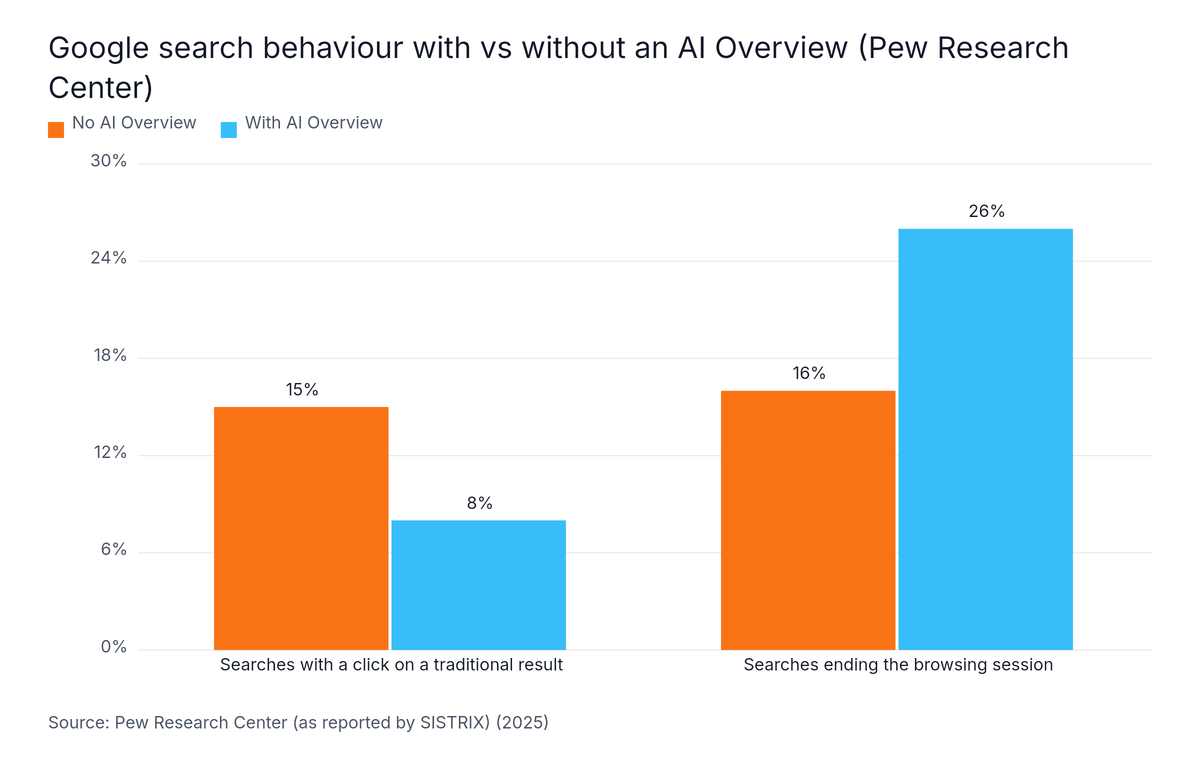
Google users clicked a traditional result on about 8% of searches with an AI Overview, against about 15% without one (Pew Research Center, via SISTRIX, 2025).
The recommended brand changed in 14.6% of repeat runs, far less than cited sources, so B2B SaaS teams should track both (AIVO Journal, 2026).
The claim that early answer engine optimization compounds is asserted more than measured; no longitudinal study supports it yet.
How competitive is answer engine optimization for B2B SaaS?
Answer engine optimization for B2B SaaS is competitive but not settled. A Semrush study of 1,094 ChatGPT categories found only 11.3% of the most-asked topics had a clear brand owner (Semrush, 2026), while a Klarivo benchmark found category leaders already hold a median 31.0% of brand mentions (Klarivo, 2026). Open space exists, and leaders exist too.
A single white chess pawn at the front of a half-filled chessboard
Answer engine optimization (AEO) is the practice of structuring a B2B SaaS site and its content so AI assistants and AI search features choose to cite it. Some researchers call the same discipline generative engine optimization (GEO). The table lays out the measured competition figures with their samples.
Measure
Value
Sample and method
Source
Topics with a clear brand owner in ChatGPT
11.3%
1,094 US categories, Jan to Jun 2026, ChatGPT only
The Klarivo report states it directly: "Across six B2B software categories measured in August 2026, the category leader took a median 31.0% of all brand mentions in AI answers." (Klarivo, 2026). That share is large but not total, so rivals still have room.
Klarivo is a software vendor, and Semrush covers ChatGPT only. Neither is a full census of B2B SaaS. Read them as the best measured signals available, not as a market map.
How concentrated are AI citations and brand mentions?
AI citations and brand mentions are concentrated at the top but split between two separate contests. Semrush found only 21% of the most-cited domains in a category were also the most-mentioned brand (Semrush, 2026). Winning citations and winning recommendations are different jobs, so each needs its own measurement.
A tall stack of coins beside a few scattered coins on a flat surface
A citation is a source link an AI assistant shows or uses to support an answer. The two measures also correlated slightly negatively (-0.229) in the Semrush data. The study authors of one arXiv preprint describe the setting this way: "AI answer engines generate answers from retrieved pages but cite only a few sources." (Vishwakarma, Kumar and Jamidar, arXiv, 2026).
What does the long tail look like?
Share of voice is the percentage of brand mentions in AI answers that go to one brand within a category. In the Klarivo panel the leader held a median 31.0%, so the remaining mentions are spread across other brands. Academic audits posted to arXiv between March and September 2026 describe heavy concentration plus a long tail of rarely cited domains. They also caution that displayed citations are not a complete retrieval trace (arXiv, 2026).
Why does the gap between citing and recommending matter?
A page can earn a citation while a rival wins the recommendation. AIVO Journal ran more than 20,000 multi-turn probes covering over 200 brands. AI systems dropped a brand they had already cited in 87.3% of cases before reaching a recommendation (AIVO Journal, 2026). This is single-vendor research, so it is directional. The practical point stands: first-prompt visibility is not the win.
Why does AI citation matter for a new category with no search volume?
AI citation matters for a new category because buyers already use AI assistants to form shortlists before any organic ranking exists. G2's March 2026 survey of B2B software buyers found 69% said an AI chatbot led them to pick a different vendor than planned, and 33% bought from a vendor they had never heard of (G2, 2026).
A blank wooden signpost at a fork in a dirt path at sunrise
A new category has no keyword demand to rank for. Buyers describe the problem to an AI assistant instead, and the assistant names vendors. The G2 figures suggest unknown vendors can still win. Secondary summaries report the sample as n=1,076, but the G2 page does not state it, so read the numbers as survey signals.
What do clicks add?
Click-through rate (CTR) is the share of searches that end in a click. Pew Research Center analysed nearly 70,000 Google searches from about 900 users. Google disputed the methodology.
The chart plots the same Pew comparison. The figure to hold on to is the gap: about 8% of searches with an AI Overview ended in a click on a traditional result, against about 15% without one.
What we found: Two measured signals on clicks point in different directions. Ahrefs reported in February 2026 that, across 300,000 keywords, the presence of an AI Overview correlated with a 58% lower average click-through rate for the top-ranking page, comparing December 2023 with December 2025. Seer Interactive reported in 2026 that click-through rates on results with an AI Overview rebounded 85% in the first two months of 2026, and that informational results without an AI Overview rose from 2.93% to 3.97% CTR across 901 million impressions in 2025. Both are measurements with stated samples.
Ranking alone therefore no longer guarantees discovery. When the click does not come, a citation inside the answer is the remaining route to the buyer.
What do trust and validation add?
Trust is the counterweight. Forrester reported that 36% of business buyers felt more confident in a better-informed decision because they used generative AI, while 20% felt less confident after meeting unreliable or inaccurate information (Digital Commerce 360, reporting Forrester, 2026). The page does not state the sample size. A citation opens a door, and proof on the page has to hold up once the buyer arrives. For a first plan, see how to get a B2B SaaS brand cited by AI assistants.
Does early investment in AEO compound the way SEO did?
Early investment in answer engine optimization may compound, but no longitudinal study has shown it. The indirect evidence points both ways: SE Ranking found sites with over 24,000 referring domains averaged 6.8 citations in Google AI Mode against 2.5 for sites under 300 (SE Ranking, 2026), yet zero-traffic pages were still cited 11% of the time (Position Digital, 2026).
A young sapling growing beside a thick established tree trunk
The case for compounding rests on indirect signals. Here is what each side shows.
What favors an early head start?
Authority gap: the SE Ranking comparison (129,000 domains, 100,000 prompts, vendor research) shows established sites get cited more often in AI Mode.
Owned content: Klarivo found share of voice correlated at Spearman rho +0.72 with a brand's own-domain citations, against +0.47 with Domain Rating (Klarivo, 2026). A Spearman correlation is a rank-based measure of how two variables move together. This is correlation, not causation.
What favors newcomers?
Citations without traffic: Position Digital's study of 278 ChatGPT answers across 95 tracked brands found 66% of brand recommendations in ChatGPT happened without the brand's own website being cited (Position Digital, 2026). It is a small agency sample, so it is directional.
Instability: citation sets shift between identical runs. That volatility can let challengers in, but a gain can also disappear.
Content factors: a controlled test of 252,000 paired trials across six large language models (LLMs) found topic match, price, recency and position dominated, and formatting-only edits had little impact (arXiv, 2026). It is a simulation and a preprint, not live-engine measurement.
Which claims are measured and which are predicted?
Claim
Type
Evidence
Limit
Category leaders hold a median 31.0% of mentions
Measured
Klarivo, 16,000+ answers
Vendor report, six categories
Own-domain citations track share of voice (+0.72)
Measured correlation
Klarivo
Correlation only
Authority gives a head start (6.8 vs 2.5 citations)
Measured
SE Ranking, 129,000 domains
Vendor research, AI Mode only
Clicks fall with an AI Overview (8% vs 15%)
Measured
Pew, nearly 70,000 searches
Method disputed by Google
Formatting-only edits have little effect
Simulated
arXiv, 252,000 trials
Preprint, not live engines
Early adopters will compound their lead
Predicted
No longitudinal study
Asserted, not measured
How can a B2B SaaS team measure its own position in AI answers?
A B2B SaaS team can measure its position by fixing a set of 20 or more buyer questions, checking them across five engines each month, and reporting ranges instead of single numbers. AIVO Journal found cited sources changed in 95.8% of repeat runs (AIVO Journal, 2026), so one snapshot misleads.
A printed checklist with pencil ticks lying on an office desk
In the AIVO Journal testing, the recommended brand moved far less than the cited sources. In its words: "In our data, final decisions were far more stable than citations." (AIVO Journal, 2026). The publisher has a competing thesis and says its evidence is not proof. Treat it as a reason to repeat checks, not as a verdict.
The 20-question, five-engine baseline is a practical method proposed for measurement. It is not a measured finding. A defensible version follows these steps:
List 20 or more buyer questions about the category, comparisons, pricing and integrations.
Run each question several times on each of five engines, and record the range.
Log citations and mentions separately, because the two measure different contests.
Record how the product is described and which competitors appear beside it.
Separate AI referral traffic in analytics by filtering referrers such as chatgpt.com and perplexity.ai.
Repeat monthly and compare ranges, not single readings.
Answer engine optimization (AEO) evidence for B2B SaaS is a poor guide for teams that need exact market-share numbers, engine-specific rules, or proof that a tactic causes citations. The Semrush study covers only ChatGPT across 1,094 categories (Semrush, 2026), and most other figures come from vendor or agency research with limited samples.
Several limits apply:
Vendor or agency research: Klarivo, SE Ranking and Position Digital publish vendor or agency research, and AIVO Journal publishes work from a company with a competing thesis.
Single-engine data: the Semrush study covers ChatGPT only, and engines cite different sources.
Disputed method: Google disputed the Pew methodology on AI Overview clicks.
No tactic guarantees: none of these studies shows that a given change will produce a citation, or by when.
Predictions: the widely quoted forecast of falling search volume is a prediction, not a measurement, and is not used here.
Overlap with SEO: John Mueller of Google said in January 2026, "There is no such thing as GEO or AEO without doing SEO fundamentals." (John Mueller, via getfancy.ai, 2026). The original post was not retrieved. For the overlap, see AEO vs SEO for B2B SaaS.
Frequently Asked Questions
Is answer engine optimization competitive for B2B SaaS companies?
Answer engine optimization is competitive in some categories and open in others. Semrush's 2026 study of 1,094 ChatGPT categories found only 11.3% of the most-asked topics had a clear brand owner (Semrush, 2026). Klarivo's August 2026 benchmark of six B2B software categories shows leaders already hold a large share. Both are measured, with stated samples.
Can a new company with no domain authority get cited by AI assistants?
A new company can be cited without strong domain authority, though authority helps. Position Digital's 2026 study of 278 ChatGPT answers found pages with zero traffic were still cited 11% of the time (Position Digital, 2026). SE Ranking found sites with more than 24,000 referring domains averaged 6.8 citations in Google AI Mode, against 2.5 for sites under 300 (SE Ranking, 2026).
How often do AI citations change for the same prompt?
AI citations change often between identical runs. AIVO Journal's 2026 testing of 1,800 brand-level groups, each run three times, found cited sources changed in 95.8% of repeat runs, while the recommended brand changed in 14.6% (AIVO Journal, 2026). This is vendor research from a company with a competing thesis, so read it as directional.
Does schema markup or llms.txt increase AI citations?
No source in this review shows that schema markup or llms.txt reliably increases AI citations. llms.txt is a proposed convention, not a standard adopted by any major engine. A 2026 arXiv simulation of 252,000 trials found formatting-only edits had little impact, though it is a preprint, not live-engine measurement (arXiv, 2026). Treat both as low-cost hygiene, not a promise.
Do I need to rank in Google first to get cited in AI answers?
Ranking in Google is not proven to be a prerequisite for AI citation, and the evidence conflicts. Position Digital's 2026 study found zero-traffic pages were still cited 11% of the time (Position Digital, 2026). Google's John Mueller said in January 2026 that GEO and AEO do not exist without SEO fundamentals, so crawlable, useful pages remain the base.
Is a citation the same as a brand recommendation?
A citation and a brand recommendation are different outcomes. Semrush's 2026 ChatGPT study found the most-cited domains and the most-mentioned brands overlapped little, and the two correlated slightly negatively (-0.229) (Semrush, 2026). A page can be cited without its brand being named, so measurement should track citations and mentions separately.
Conclusion
Competition for AI citations in B2B SaaS is real but uneven. Leaders hold a measurable share, many topics remain unowned, and the evidence that early work compounds is still indirect.
Treat leader share and owned-topic figures as measured, with vendor and single-engine limits.
Track citations and brand mentions separately.
Repeat checks and report ranges, since citations shift between runs.
Keep predictions, including "early adopters compound", in their own labeled column.
Back every citation with proof on the page, because buyers still validate what an assistant tells them.
Next step: bring the questions buyers ask about the category and test them against a real baseline. A free consultation covers it. Meet with an expert. For adjacent reading, see LLM optimization for B2B SaaS.
Written by
Ishan Manchanda
Ishan Manchanda is co-founder of GrowthSpree, a B2B SaaS marketing consultancy founded in 2017 that has managed $60M+ in ad spend across 300+ B2B SaaS companies. He focuses on demand generation, go-to-market strategy and pipeline growth, and has been featured in Silicon Valley Times, SaaS Mag and the Unbounce podcast.
 Ishan ManchandaNov 22, 2026