
Blog
Generative Engine Optimization Budget for B2B SaaS: What to Fund and What to Skip
Build a generative engine optimization budget for B2B SaaS: split fixed SEO-overlap work from monitoring tools, with sourced price ranges and kill criteria.
A sequenced plan to improve generative engine optimization for B2B SaaS: fix crawler access, write answer-first, earn citations, and measure, with sourced data.
 Ishan ManchandaNov 21, 2026

Build a generative engine optimization budget for B2B SaaS: split fixed SEO-overlap work from monitoring tools, with sourced price ranges and kill criteria.

The six metrics that matter for AI search visibility in B2B SaaS, how to separate mentions from citations, set per-engine baselines and tie results to pipeline.

How B2B SaaS teams can structure pages for Google AI Overviews: what Google documents, what CTR studies show, and where to spend effort first.
Request a quote and our experts will contact you within 24 hours with tailored solutions and pricing.
Last updated: Nov 21, 2026
By AEO for B2B SaaS Editorial Team. Last updated: November 4, 2026.
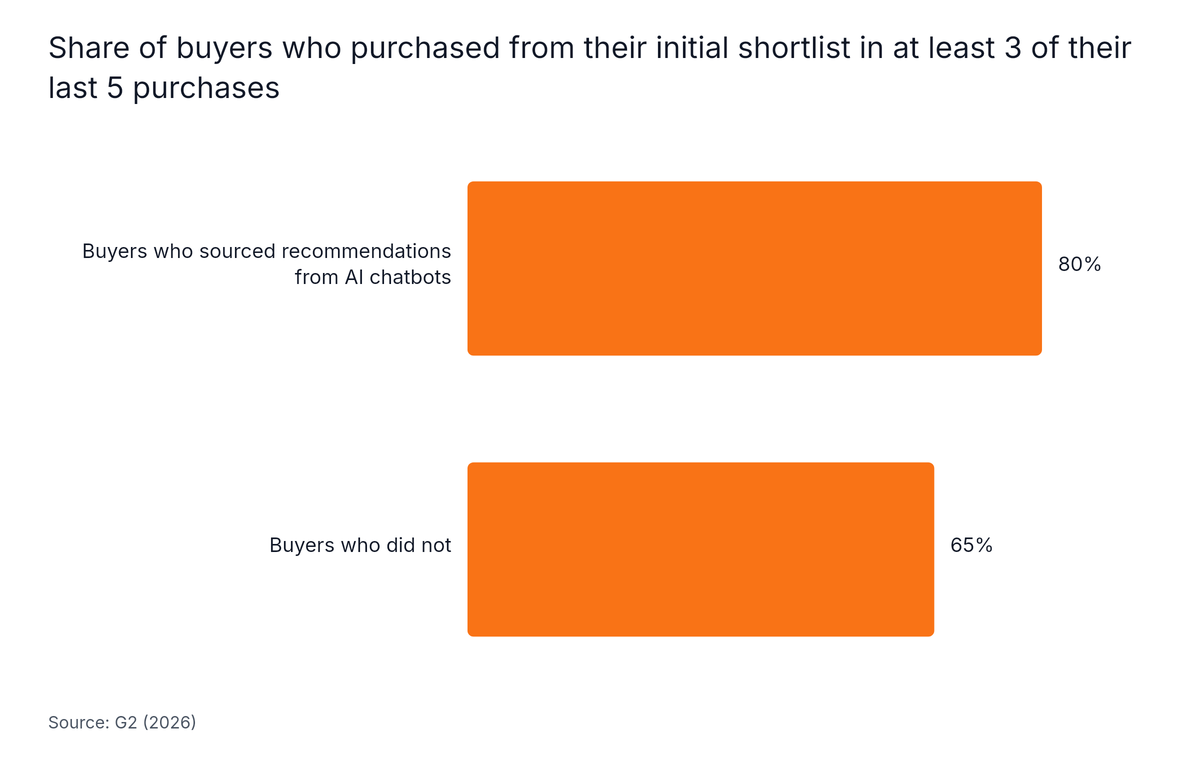
Improving generative engine optimization (GEO) for B2B SaaS means making your pages easy for AI assistants to read, extract and cite, while keeping the search engine optimization (SEO) fundamentals that still decide what they retrieve. The stakes are practical. In G2's 2026 survey, 80% of buyers who sourced software from an AI chatbot bought from their initial shortlist in at least three of their last five purchases, versus 65% of those who did not (G2, 2026). If your company is absent from the answer, it is often absent from the shortlist. This guide gives a sequenced plan, the evidence behind it, and the limits of that evidence. For background on the terms, see what answer engine optimization means.
Key Takeaways
- Generative engine optimization for B2B SaaS builds on SEO: Google's May 2026 guide says optimizing for generative AI search is still SEO (Search Engine Journal, 2026).
- Buyers reward cited vendors: 85% of surveyed software buyers think more highly of a vendor cited by AI (G2, 2026).
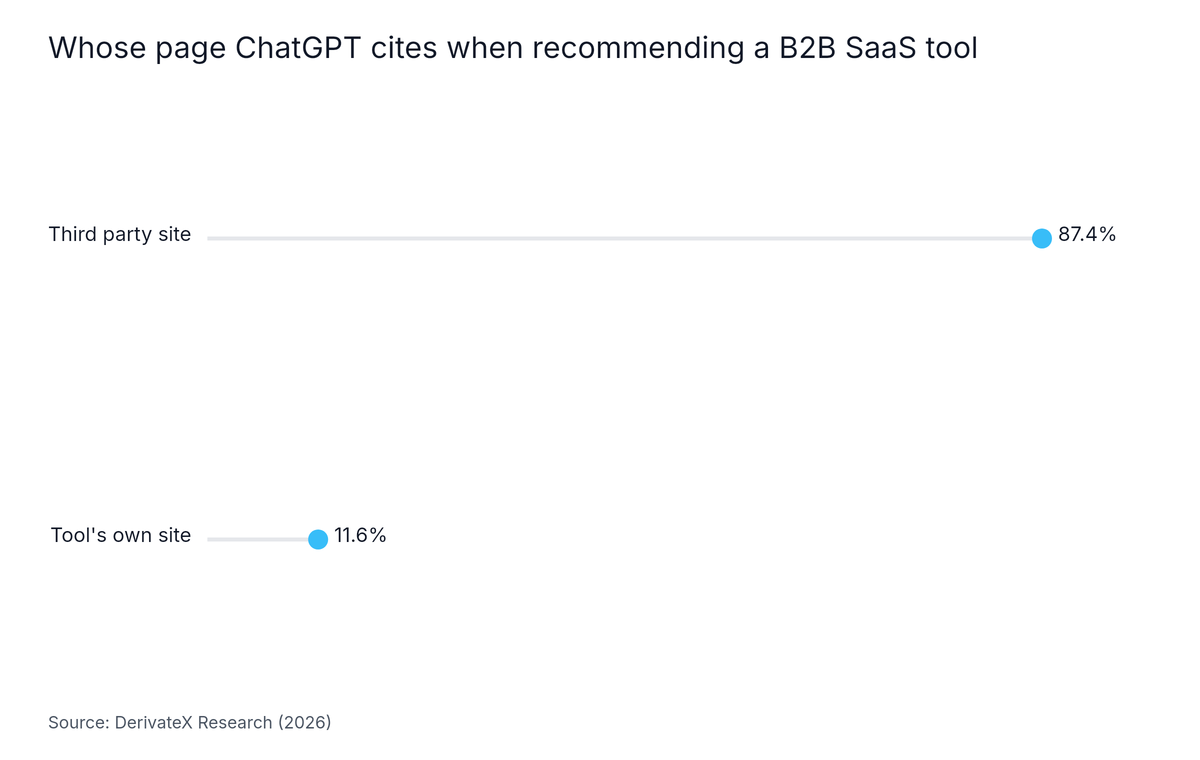
- In one ChatGPT study of B2B SaaS tools, 87.4% of recommendations credited a third-party site and 11.6% the tool's own site (DerivateX Research, 2026), so earned mentions matter.
- A lean B2B SaaS team should fix crawler access first, rewrite answer-first second, earn third-party presence third, and measure monthly.
- Body-only rewrites can backfire in controlled tests, so test changes on a few pages before scaling (arXiv, 2026).
Generative engine optimization (GEO) is the practice of structuring pages so AI assistants and AI search features cite them in generated answers. It overlaps heavily with search engine optimization: Google's May 2026 guide says optimizing for generative AI search is "still SEO" (Search Engine Journal, 2026), though other assistants retrieve and cite differently.

Three labels circulate for closely related work. The table shows how they differ in target and emphasis.
| Term | Full name | What it targets | Typical emphasis |
|---|---|---|---|
| SEO | Search engine optimization | Ranked links in traditional results | Rankings, clicks, links |
| AEO | Answer engine optimization | Citations in AI-generated answers | Answer-first pages, structured data |
| GEO | Generative engine optimization | Citations in responses written by a large language model (LLM) | Extractable content, earned mentions |
Answer engine optimization (AEO) is the same goal under a practitioner's label, and a large language model (LLM) is the AI system that writes the generated answer. For a deeper comparison, see the AEO vs SEO pillar guide.
Google's documentation is direct. It states: "From Google Search's perspective, optimizing for generative AI search is optimizing for the search experience, and thus still SEO." (Search Engine Journal, 2026). It also says "You don't need to create new machine readable files, AI text files, markup, or Markdown to appear in generative AI search." (DemandSphere, 2026).
One practitioner told Digiday that "success in AI visibility is 80 percent good fundamental SEO" (Digiday, 2026). That is a view, not a measurement. The plan below treats Google's guidance as the baseline for Google's features and tests everything else per engine. A fuller definition lives in what generative engine optimization is.
Generative engine optimization works on a pipeline: an AI engine retrieves candidate documents, reranks them, and writes an answer that cites a few. A 2026 preprint survey reporting Kim et al. tested 171,003 documents and 2,700 queries, and measured effects at three stages: top-20 retrieval, reranking and final citation (arXiv, 2026).

The pipeline view explains why one trick rarely works. A page must be readable enough to be retrieved, strong enough to survive reranking, and clear enough to be quoted. Each stage can fail on its own. The survey is a preprint and is not yet peer-reviewed, so treat its numbers as early evidence.
Generative engine optimization matters for B2B SaaS because buyers now build shortlists with AI assistants. In G2's 2026 poll of more than 1,000 software buyers, 85% think more highly of a vendor cited by AI, and 71% rely on AI chatbots for software research (G2, 2026).

Reliance is growing. The same G2 report puts chatbot reliance at 71%, up from roughly 60% seven months earlier. The shortlist effect is measurable too: 80% of buyers who used AI chatbots to source software bought from their initial shortlist in at least three of their last five purchases, against 65% of buyers who did not (G2, 2026). These are survey results from more than 1,000 B2B software buyers.
Source: G2, 2026
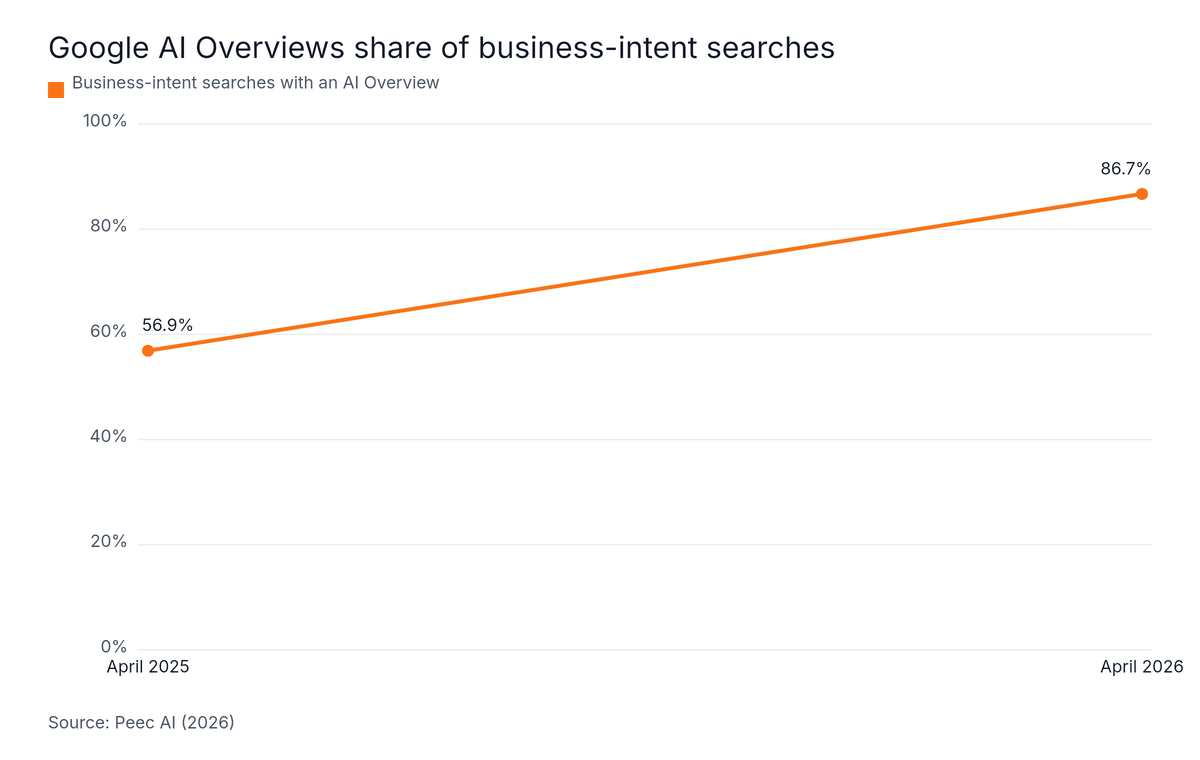
Peec AI's vendor tracking data shows Google AI Overviews on 86.7% of business-intent searches in April 2026, up from 56.9% in April 2025 (Peec AI, 2026). The sample size was not stated, so treat it as a directional signal.
Source: Peec AI, 2026
A Gartner survey of 645 B2B buyers, published in May 2026, found 69% validate AI-generated insights with sales reps (Gartner, 2026). An AI citation starts the conversation. It rarely ends it.
To improve generative engine optimization, work in this order: confirm crawler access, rewrite key pages answer-first, build third-party presence, add specific proof, refresh on a schedule, then measure. The urgency is real: Google AI Overviews appeared on 86.7% of business-intent searches in April 2026, up from 56.9% a year earlier (Peec AI, 2026).

Fix access first, because an assistant cannot cite a page it cannot read. Test each change on a few pages before scaling it.
| Step | Action | How to verify it worked |
|---|---|---|
| 1 | Confirm crawler access | Key pages load in raw HTML; robots.txt rules are intentional |
| 2 | Rewrite pages answer-first | A 40 to 80 word answer sits under every heading |
| 3 | Build third-party presence | Reviews, listicles and communities describe you correctly |
| 4 | Add specific proof | Pages carry named entities, figures with sources and tables |
| 5 | Refresh on a schedule | Last-updated dates and facts are current |
| 6 | Measure monthly | A fixed question set shows mention and citation changes |
Make sure AI crawlers can read your key pages without running JavaScript. Check that content appears in raw HTML, that robots.txt does not block crawlers by accident, and that a bot-protection rule is not turning them away. Blocking crawlers on a public, indexed page reduces citation chances with no matching benefit. Verify by fetching the page without JavaScript and reading what remains.
Put the direct answer first, under a heading phrased as the buyer question. Write one paragraph of 40 to 80 words that names the subject in full and carries a figure. Follow it with a table or list for any set of options. Start with the twenty pages closest to revenue: category, comparison, pricing and integration pages. Verify by pasting one section alone into a chat window and checking that it still makes sense.
Earn accurate descriptions on pages you do not own. In the DerivateX Research study of ChatGPT, 87.4% of recommendations credited a third party (DerivateX Research, 2026). Academic authors likewise urge brands to "dominate earned media to build AI-perceived authority" (arXiv, 2025). Start with review-site profiles, analyst and industry roundups, and the communities where your buyers ask questions. Verify by searching your category questions and noting which outside pages appear.
Replace brochure language with named entities, figures and sources. State what the product does, for whom, and with what measured outcome. Label each figure as measured or predicted and give its date. Original data, where you have it, gives engines something no competitor page repeats.
Review priority pages on a fixed cadence and show the last-updated date. Update facts, pricing and integrations when they change, and keep structured data matching what is visible. Google's guidance says special markup is not required, so treat schema as accuracy support, not a trick.
Fix a question set and check it on the same day each month. For every question and engine, record whether the brand is mentioned, whether a page is cited, and how the product is described. Save the results in one sheet so month-on-month change is visible.
Want a second opinion on your order of work? Meet with an expert. A free consultation. Bring the questions buyers ask about your category and brainstorm how to get cited. For a broader starting point, see how to get cited by AI assistants and the guide to AI search engines and Google AI Overviews.
In one ChatGPT study, most B2B SaaS recommendations credited third-party pages, not vendor sites. A 2026 DerivateX Research study of 233 ChatGPT recommendations across 40 B2B SaaS categories found 87.4% credited a third party and 11.6% cited the tool's own website (DerivateX Research, 2026).

The study ran each of 40 categories ten times through ChatGPT with web search, covering 219 distinct tools. DerivateX is an agency, so read the result as one sample, not a law. It covers ChatGPT only. It fits the earned-media point: your own site is necessary but not enough.
Source: DerivateX Research, 2026
List-format content is cited often. Peec AI's 2026 analysis found 52% of listicles on ChatGPT achieved high (2.0+) citation rates (Peec AI, 2026). The same vendor analysis found roughly 1 in 10 citations came from a self-promotional listicle. That figure covers a 12-week study of 232,000 citations, and the study saw no sign that engines correct for it. It is a risk to monitor, not a tactic to copy.
| Signal | Source | What it suggests | Caution |
|---|---|---|---|
| Google says special files and markup are not needed | Google guide, May 2026 | Fundamentals decide Google AI features | Covers Google only |
| Third parties carry 87.4% of ChatGPT recommendations | DerivateX, 2026 | Earned mentions matter for ChatGPT | Agency study, 233 recommendations |
| Listicles are cited disproportionately | Peec AI, 2026 | Structured lists help | Vendor analysis |
The practical answer is to test per engine, not assume one rule fits all. Related guidance is in how to get cited by Gemini.
Measure generative engine optimization by checking a fixed set of buyer questions monthly across several AI engines, then recording mentions, citations, product descriptions and competitors. Track AI referral traffic from domains such as chatgpt.com and perplexity.ai too. The effort is worthwhile because 71% of surveyed software buyers rely on AI chatbots for research (G2, 2026).
A proposed baseline is a monthly check of 20+ category questions across five engines. It is a method, not a dataset, so use it as a starting template and adjust it to your category. Pair that template with the metrics below.
| Metric | What it counts | How to record it |
|---|---|---|
| Mention rate | Questions where an answer names your brand | Yes or no per question, per engine |
| Citation rate | Questions where an answer links to your page | Yes or no, with the cited URL |
| Description accuracy | Whether the product is described correctly | Note errors in pricing, features, category |
| Competitor presence | Which rivals appear beside you | List per question |
| AI referral traffic | Visits from assistant domains | Filter referrers in analytics |
Mention rate is the share of tracked buyer questions where an AI answer names your brand, and citation rate is the share where it links to or credits your page. Keep them apart: a brand can be mentioned without a link.
Visibility scores built from synthetic prompts are imperfect, because answers vary between runs. Repeat each question and track trends, not single results. Tools for this exist; the tools comparison guide explains what to look for.
Generative engine optimization has limits: naive rewrites can backfire, and no engine guarantees a citation. A 2026 preprint survey reporting Kim et al. found body-only optimization cut average top-20 presence by about 9% and final citation by 6% (arXiv, 2026). It is not for teams wanting guaranteed results.
The same survey reports body-only optimization reduced top-10 presence after reranking by about 16% (arXiv, 2026). It covered 171,003 documents and 2,700 queries, and it is not yet peer-reviewed. The lesson is to test before scaling, not to stop. Rewriting only the body text, with no change to access, off-site presence or accuracy, is the pattern that failed.
This approach is not for consumer or local brands, since it targets B2B SaaS buyers who research categories before talking to sales. It is also not for teams that need a promised citation date. No source in the research supports one.
No verified, independently sampled timeline exists for generative engine optimization results. Timelines quoted online come from vendor blogs and are unconfirmed. Changes also reach engines at different speeds, so no one can promise a citation or a date. Set a monthly baseline, change one thing at a time, and compare each engine separately.
For Google's AI features, no. Google's May 2026 guide says "You don't need to create new machine readable files, AI text files, markup, or Markdown to appear in generative AI search." Structured data that matches visible page content is still good practice, and other assistants have not published matching guidance.
No source in the research shows that a top Google ranking guarantees citations in ChatGPT or Perplexity. Assistants retrieve and cite differently, and a 2026 DerivateX Research study of ChatGPT found 87.4% of recommendations credited a third-party site rather than the tool's own (DerivateX Research, 2026). Strong rankings help, but earned mentions elsewhere carry weight too.
Generative engine optimization (GEO) and answer engine optimization (AEO) are overlapping terms for the same goal: getting a site cited in AI-generated answers. GEO is the term used by many researchers, while AEO is common among practitioners. Both sit on top of search engine optimization fundamentals such as crawler access and clear, useful content.
Measure generative engine optimization with a fixed set of buyer questions checked on a schedule across several engines. Record whether your brand is mentioned, whether your page is cited, how the product is described and which competitors appear. Separate AI referral traffic in analytics, because clicks alone understate how often answers name you.
Generative engine optimization services are outside help with the work in this guide: crawler checks, answer-first rewrites, earned mentions and measurement. Quality varies, and no provider can guarantee a citation. Before hiring anyone, ask for their buyer question set, their measurement method and results reported separately for each engine.
Improving generative engine optimization for B2B SaaS is mostly disciplined SEO plus a few additions that engines reward. The evidence supports caution as much as action.
Your next step is to pick twenty buyer questions and record today's answers as a baseline. For related reading, see LLM optimization for B2B SaaS.
Written by
Ishan Manchanda
Ishan Manchanda is co-founder of GrowthSpree, a B2B SaaS marketing consultancy founded in 2017 that has managed $60M+ in ad spend across 300+ B2B SaaS companies. He focuses on demand generation, go-to-market strategy and pipeline growth, and has been featured in Silicon Valley Times, SaaS Mag and the Unbounce podcast.