What Is LLM Optimization for Publishers? A B2B SaaS Guide
what is llm optimization for publishersLLM optimizationLLM optimization for websites
What Is LLM Optimization for Publishers? A B2B SaaS Guide
LLM optimization for publishers explained for B2B SaaS content teams: what it means, what Google says, which technical checks matter and how to measure it.
Request a quote and our experts will contact you within 24 hours with tailored solutions and pricing.
What Is LLM Optimization for Publishers? A B2B SaaS Guide
LLM optimization for publishers is the practice of structuring pages so a large language model (LLM) assistant can read, understand and cite them, and for B2B SaaS content teams it overlaps heavily with answer engine optimization (AEO). The stakes are visible in browsing data. Pew Research Center found that Google users clicked a traditional result in 8% of visits with an AI summary, versus 15% without (Pew Research Center, 2025). Teams that publish guides, comparisons and documentation now compete to be the cited source, not only the top link. This guide defines the term, separates the two meanings of "publisher", lists the technical checks, and routes readers to engine-specific detail.
Key Takeaways
LLM optimization for publishers means making content retrievable and citable by AI assistants. For B2B SaaS companies that publish content, it is largely the same discipline as answer engine optimization (AEO).
"Publisher" has two meanings: news or media organizations, and B2B SaaS companies that publish. Their evidence and metrics differ.
Google's 2026 guidance describes AI features as still SEO and says special markup, AI text files and llms.txt are not needed.
Technical eligibility comes first: crawler access, indexing, server-side rendering and no gate in front of the answer.
Measurement should track citations, brand descriptions and AI referrals beside clicks, using a fixed question set.
By AEO for B2B SaaS Editorial Team. Last updated: November 4, 2026.
In this guide
What is LLM optimization for publishers?
Which kind of publisher are you?
Why does it matter for B2B SaaS buyers?
Do AI answers reduce clicks?
What technical and structural factors decide citation?
How does each AI engine select sources?
How do you measure it beyond clicks?
Who is it not for?
What Is LLM Optimization for Publishers?
LLM optimization for publishers is the work of making a site's content easy for a large language model (LLM) assistant to retrieve, interpret and cite. For B2B SaaS content teams it matters because 66% of 600+ surveyed US business professionals regularly use AI to research vendors (Semrush, 2026). Google describes its own version of this work as still search engine optimization (SEO).
Abstract sculptural glass blocks funnelling toward a single glowing sphere on a violet backdrop
A large language model (LLM) is an AI system trained on large volumes of text that generates answers to questions in natural language. LLM optimization is the practice of shaping a site so those systems can find its pages, understand what they say and name them as a source. The term is new, and several neighbours compete with it.
How does LLM optimization relate to AEO and GEO?
Answer engine optimization (AEO) is the practice of structuring a site and its content so AI assistants and AI search features choose to cite it when a buyer asks a category or vendor question. Generative engine optimization (GEO) is an overlapping term used by some researchers for the same discipline. LLM optimization is a third label for the same territory. No formal standard separates the three, so treat them as near-synonyms and judge any advice on its evidence, not its label. The site's guide to AEO for B2B SaaS covers the definition in more depth.
How is LLM optimization different from SEO?
Search engine optimization targets ranked links. LLM optimization targets whether a passage is retrieved and named inside a generated answer. Google's May 2026 guide frames AI features as still SEO, so the overlap is large. The differences sit in the unit of competition and the measure of success.
Dimension
Traditional SEO
LLM optimization
Unit of competition
A page ranked in a list of links
A passage or fact used inside a generated answer
Primary success signal
Ranking position and click-through rate (CTR)
Citation, brand mention and accuracy of description
Shared foundation
Crawlability, indexing, quality content
Crawlability, indexing, quality content
Typical risk
Falling rankings
Rankings hold while clicks fall and the brand goes unnamed
Which Kind of Publisher Are You: News Media or B2B SaaS?
In the phrase LLM optimization for publishers, a publisher can be a news or media organization, or a B2B SaaS company that publishes guides and documentation. The evidence differs by group: Chartbeat's network, which skews toward news and media, saw Google Search referrals fall 40.2% year over year to July 2026 (Search Engine Journal, 2026). Software buyer surveys describe a different situation.
Two distinct sculptural forms side by side, one tall and layered, one compact and geometric
The difference matters. A news publisher sells attention, so lost clicks cut revenue directly. A B2B SaaS publisher sells software, so content works as the first step in a buyer's research, and a lost click can matter less than a lost mention.
Question
News or media publisher
B2B SaaS publisher
What does the content earn?
Advertising and subscriptions tied to visits
Pipeline from buyers who compare vendors
Which evidence applies most?
Chartbeat referral data, Reuters Institute expectations
Gartner, G2 and Semrush buyer research
Main risk from AI answers
Fewer visits to monetise
Absence from the shortlist, or a wrong product description
Metric to watch first
Search referrals and AI referrals
Citation rate, description accuracy, AI referrals
This guide uses the second frame and draws on the first only where it clarifies the click evidence.
Why Does LLM Optimization Matter for B2B SaaS Buyers?
LLM optimization matters for B2B SaaS because buyers use AI assistants during vendor research. Semrush's survey of 600+ US business professionals found 66% regularly use AI to research vendors (Semrush, 2026), and Gartner's survey of 645 B2B buyers found 45% used generative AI in a recent purchase (Gartner reprint, 2026). Absence from the answer can mean absence from the shortlist.
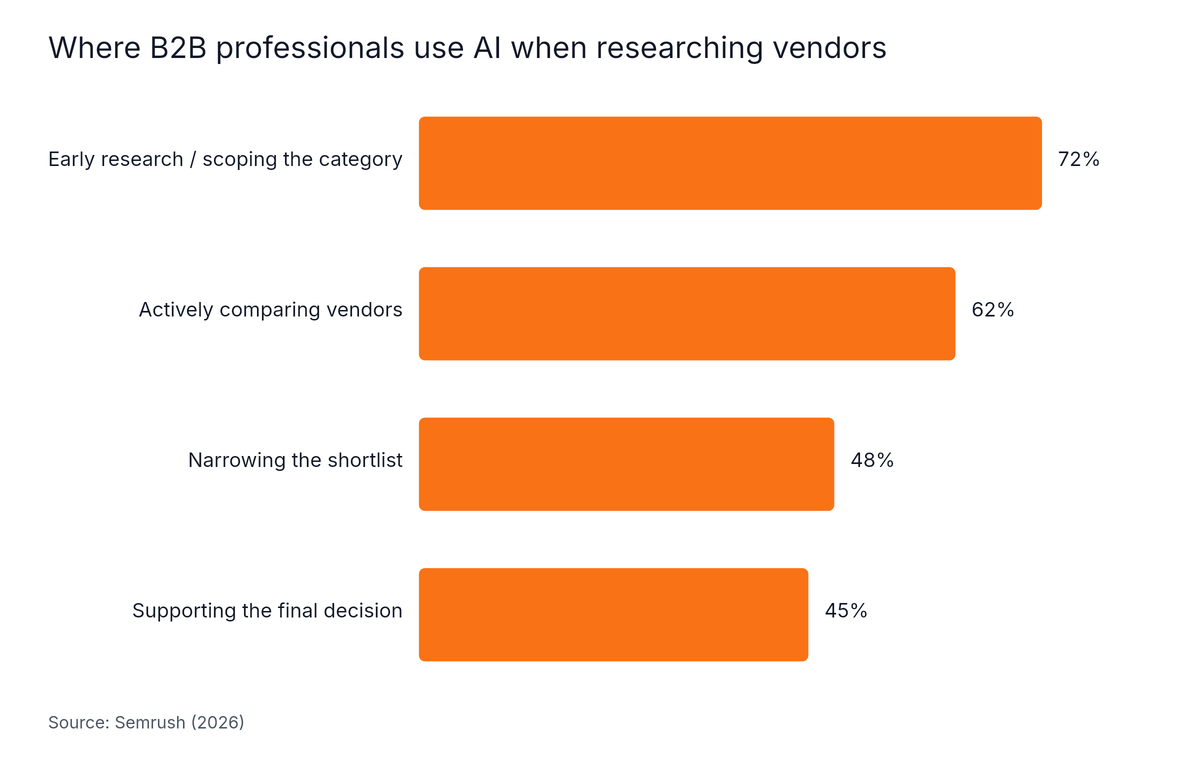
The Semrush survey also reports where in the journey buyers use AI. Early research and scoping the category leads at 72%, actively comparing vendors follows at 62%, narrowing the shortlist reaches 48%, and supporting the final decision reaches 45% (Semrush, 2026).
Horizontal Bar chart: Where B2B professionals use AI when researching vendors. Highest: Early research / scoping the category at 72%.
The Gartner survey ran in August and September 2025 and covered 645 B2B buyers. Respondents used an average of seven information sources, mainly to gather vendor and product information. AI sits inside a wider research mix, not in place of it.
G2 summarises the change this way: "The discovery phase has compressed from hours of website browsing and report reviewing to a single prompt in an AI chatbot." (G2, 2026)
AI answers reduce clicks on some queries, but how far is mixed. Pew Research Center's March 2025 browsing data from 900 U.S. adults showed a click on a traditional result in 8% of visits with an AI summary versus 15% without (Pew Research Center, 2025). Chartbeat reported Google Search referrals to its publisher network fell 40.2% year over year to July 2026.
A wide glossy funnel narrowing so that only a small ring passes through
Pew states the pattern plainly: "Google users who encounter an AI summary are less likely to click on links to other websites than users who do not see one." (Pew Research Center, 2025) Users clicked a link inside the AI summary in only 1% of visits. That is why citation and mention, not clicks, become the goal.
What do the other measurements say?
Click-through rate (CTR) is the share of impressions or visits that end in a click. Measured CTR evidence points in two directions.
Finding
Type
Sample
Source and date
Top result CTR 58% lower with an AI Overview
Measured
300,000 keywords, December 2023 vs December 2025
Ahrefs, published February 4, 2026
CTR on results with an AI Overview rebounded 85%
Measured
First two months of 2026
Seer Interactive, 2026
Informational results without an AI Overview rose from 2.93% to 3.97% CTR
Measured
901 million impressions, 2025
Seer Interactive, 2026
Google Search referrals down 40.2% year over year
Measured
Chartbeat network, skews to news and media, July 2025 to July 2026
The Chartbeat data skews toward news and media, so B2B SaaS teams should not read it as their own traffic forecast. Both the 58% drop and the 85% rebound are measurements with stated samples, which is why neither alone settles the question. The 43 percent figure is an expectation, not a measurement. The site's guide to getting cited by AI search engines covers the response.
What Technical and Structural Factors Decide Whether a Page Gets Cited?
A page can be cited by an AI assistant only if its content can be fetched and read, so the baseline is crawler access, indexing, server-side rendering and no gate in front of the answer. Google's May 2026 guide says structured data is not required for generative AI search (Google Search Central, 2026), so technical eligibility comes before any AI-specific markup.
A row of open matte archways in a line with a thin light path running through all of them
What is the technical eligibility checklist?
Crawler access means a bot is allowed to request a page. Check each item below before changing any copy. Each one is a precondition, not a ranking trick, and none promises a citation.
Check
What to verify
Why it matters
Crawler access in robots.txt
AI crawlers are allowed on purpose, using the crawler names each engine documents
A blocked crawler cannot read or cite the page
CDN and bot protection
Firewall or bot rules do not silently block AI crawlers
Default bot-protection rules are often never reviewed
Indexing
Key pages are indexed in search
Google's AI features draw on pages in its index
Server-side rendering
Core content appears in the raw HTML, not only after JavaScript runs
A page that looks full to a person can look empty to a crawler
No gate
The answer is readable without a login or form
Gated text cannot be retrieved
Visible answer
The direct answer sits near the top of the page
Answers buried under long introductions give engines little to lift
No engine documentation in this guide's sources covers JavaScript rendering, so treat the rendering check as a safe-practice baseline, not confirmed engine logic.
Our data: AEO for B2B SaaS runs the technical baseline it recommends: content in raw HTML, schema, sitemap, llms.txt, crawler access and Markdown copies. It also proposes a monthly check of 20+ category questions across five engines as a measurement baseline.
Are llms.txt, schema and chunking required?
For Google's AI features, no. Google's guidance states: "Structured data isn't required for generative AI search, and there's no special schema.org markup you need to add." (Google Search Central, 2026) An earlier Google page says: "You don't need to create new machine readable files, AI text files, or markup to appear in these features." (Google Search Central, 2025)
llms.txt is a proposed convention, not a standard adopted by any major engine as of this page's date, that points AI crawlers to content intended for ingestion. Practitioner evidence is sceptical. A six-month test by GO MO Group across four clients found no measurable AI visibility impact (2026). That is a small practitioner test, not a controlled study.
Structured data is code that labels page content in a machine-readable form. It is worth keeping accurate and matching what is visible, but it is not a switch for citation.
Each AI engine selects sources through its own retrieval system, and only the engine's published documentation confirms how. ChatGPT, Gemini, Perplexity, Claude, Microsoft Copilot and Google AI Overviews each need separate reading, and anything beyond documentation is observation. Google's documentation states that no new machine readable files or AI text files are needed for its AI features (Google Search Central, 2025).
Six different sculptural gateways of varied shapes arranged in a loose arc
The honest approach is to keep three labels apart: what the engine documents, what independent studies measure, and what practitioners observe. The table shows where each belongs.
Engine
Source of truth
What to label as observation
Google AI Overviews and AI Mode
Google Search Central documentation
Any claim about ranking weights not in the documentation
ChatGPT
OpenAI's published guidance
Claims about internal ranking logic
Gemini
Google's Gemini documentation
Source preferences inferred from outputs
Perplexity
Perplexity's published documentation
Citation patterns seen in sampled answers
Claude and Microsoft Copilot
Anthropic and Microsoft documentation
Any pattern not stated by the vendor
One independent practitioner dataset of 13,184 citations across ChatGPT, Claude, Gemini and Perplexity, published in September 2026, shows brand mentions and citations can diverge sharply. That is an observation, not documentation, and it explains why a brand can be mentioned without being linked.
How Do You Measure LLM Optimization Beyond Clicks?
LLM optimization is measured by fixing a list of buyer questions, checking each across the main engines on a schedule, and recording whether the brand is cited, how it is described and which competitors appear. Clicks miss most activity: Pew found users clicked a link inside an AI summary in only 1% of visits (Pew Research Center, 2025).
A practical baseline looks like this:
List 20 or more buyer questions about the category, comparisons, pricing and integrations.
Run each question across five engines every month, using the same wording.
Record whether the brand is cited, whether the product is described accurately, and which competitors appear alongside it.
Separate AI referral traffic in analytics, meaning visits that arrive from AI assistants, by filtering referrers such as chatgpt.com and perplexity.ai.
Compare month to month, and keep the question set stable so changes mean something.
This is a proposed method, not a measured benchmark. Answers can vary between prompts and sessions, so treat one check as indicative and the trend as the signal. Chartbeat's 2026 playbook also noted that AI referral volume to publishers was tiny, though Search Engine Journal (2026) reported that the figure is not fully explained. Small referrals do not mean small influence, because buyers read answers without clicking.
Who Is LLM Optimization for Publishers Not For?
LLM optimization is not for readers who want a guaranteed citation, a tool ranking or a formatting trick. No source in this guide supports a promise that a change will produce a citation, and publishers expect search-driven traffic to news sites to fall by as much as 43 percent over three years (Newsweek citing the Reuters Institute, 2026), an expectation, not a measurement.
It is also a poor fit in these cases:
Teams hoping one file fixes visibility. Google says special files and markup are not needed, and a practitioner test of llms.txt found no measurable effect.
Companies outside B2B. The buyer evidence here covers B2B software purchasing, not consumer or e-commerce buying.
Anyone treating predictions as facts. Every figure in this guide is labeled as a measurement, a survey or an expectation.
Readers needing vendor rankings. This publication does not rank tools or agencies.
Evidence quality also varies. Controlled studies and official documentation sit at the top. Survey data comes next. Vendor correlations and single-client case studies sit lowest. The original Chartbeat and Reuters Institute pages were not retrieved for this guide, so figures from them are cited through the outlets that reported them.
Frequently Asked Questions
What is LLM optimization (LLMO) and how is it different from SEO?
LLM optimization is the practice of making content easy for AI assistants to read, understand and cite. Search engine optimization targets ranked links in search results, while LLM optimization targets citations in generated answers. The two share technical foundations such as crawlability, but differ in how pages are written and how success is measured.
Are LLM optimization, GEO and AEO the same thing?
LLM optimization, generative engine optimization (GEO) and answer engine optimization (AEO) are overlapping names for the work of earning citations in AI-generated answers. Writers use them differently, and no formal standard separates them. For B2B SaaS content teams, the practical work is the same: technical access, answer-first pages and measurement.
Does llms.txt help AI assistants cite my website?
llms.txt is a proposed convention, not a standard adopted by any major engine as of this page's last update, and its effect is unconfirmed in published engine documentation. Google states that no new machine readable files are needed for its AI features. A practitioner test across four clients found no measurable impact.
Do I need schema markup or structured data to appear in Google AI Overviews?
No. Google's May 2026 guidance says structured data is not required for generative AI search and that no special schema.org markup is needed. Structured data that matches visible page content still helps Google understand a page in general, so keep it accurate, but do not expect it to guarantee a citation.
Should AI crawlers be allowed in robots.txt?
Blocking AI crawlers in robots.txt prevents those engines from reading, and therefore potentially citing, a page. If a page is already public and indexed, blocking reduces citation opportunity without a matching benefit. Review robots.txt and any bot-protection rule on purpose, and check the crawler names each engine documents.
How do you measure whether AI assistants cite your brand?
Choose 20 or more buyer questions, check each across the main engines monthly, and record whether the brand is cited, how it is described and which competitors appear. Separate AI referral traffic in analytics by filtering referrers such as chatgpt.com and perplexity.ai. Treat results as indicative, because answers vary between prompts and sessions.
Conclusion
LLM optimization for publishers is the same question as AEO, asked from a content-team frame. The evidence supports a measured, unhyped approach, and these points carry the guide.
Define the term plainly: making content retrievable and citable by AI assistants.
Decide which "publisher" you are, because news and B2B SaaS evidence differ.
Next step: Meet with an expert. A free consultation. Bring the questions buyers ask about your category and brainstorm how to get cited.
Written by
Ishan Manchanda
Ishan Manchanda is co-founder of GrowthSpree, a B2B SaaS marketing consultancy founded in 2017 that has managed $60M+ in ad spend across 300+ B2B SaaS companies. He focuses on demand generation, go-to-market strategy and pipeline growth, and has been featured in Silicon Valley Times, SaaS Mag and the Unbounce podcast.
 Ishan ManchandaNov 21, 2026