
Blog
AEO vs SEO for B2B SaaS: What Overlaps and What Does Not
Answer engine optimization vs traditional SEO for B2B SaaS: shared technical foundations, where they diverge on content structure and measurement, and what the evidence shows.
LLM search optimization targets AI citation in ChatGPT, Perplexity and Google AI Overviews. Learn how it differs from SEO and what B2B SaaS teams should do first.
Answer engine optimization vs traditional SEO for B2B SaaS: shared technical foundations, where they diverge on content structure and measurement, and what the evidence shows.

The structural, technical, and content factors that determine whether AI assistants cite a B2B SaaS brand - grounded in engine documentation.
Request a quote and our experts will contact you within 24 hours with tailored solutions and pricing.
aeoforb2bsaas.com
Last updated: Oct 15, 2026
By the AEO for B2B SaaS Editorial Team. Every figure in this article states whether it is measured or predicted, with its sample size and source. Unverified figures are not used. Published: 13 October 2026.
LLM search optimization is the practice of structuring a B2B SaaS site so that large language models (LLMs) select it as a cited source when a buyer asks a category or vendor question. It overlaps with search engine optimization (SEO) in technical foundations but differs in writing style, success metrics, and the signals that determine whether a page gets cited at all.
That distinction matters now. Forrester's State of Business Buying, 2026, drawing on a survey of nearly 18,000 global business buyers, confirmed that 94% of B2B buyers used AI during their most recent purchase process (Forrester, via Endatasite, 2026). A company that ranks at position one in Google and still appears nowhere in an AI-generated vendor shortlist is not facing a search problem. It is facing a structurally different problem.
This guide defines LLM search optimization plainly. It maps the term against answer engine optimization (AEO), generative engine optimization (GEO), and traditional SEO. It explains the mechanism behind shortlist invisibility and sets out a practical starting protocol for B2B SaaS content teams.
Key Takeaways
- LLM search optimization (LLMO) targets citations in AI-generated answers, not ranked positions in traditional search. The success metric is citation rate, not position.
- 51% of B2B software buyers now start their research with an AI chatbot more often than with Google, up from 29% eleven months prior (G2, April 2026, survey of 1,076 buyers).
- The overlap between Google AI Overview citations and the organic top 10 fell from approximately 76% in mid-2024 to just 17-38% by early 2026 (BrightEdge / ALM Corp / Ahrefs, via Omnibound, multiple independent studies, 2025-2026). Ranking first no longer predicts AI citation.
- Approximately 85% of measurable AI visibility for B2B SaaS brands comes from third-party sources - review sites, editorial coverage, community content - not the brand's own website (Nobori, 2026, 200,000+ commercial prompt runs).
- Only 14% of B2B marketers are tracking AI citations, despite 43% reporting they actively optimise for AI search (Goodfirms, 2026, Goodfirms 2026 SEO research survey of marketers).
LLM search optimization (LLMO) is the practice of structuring a B2B SaaS site so that large language models - the AI systems behind ChatGPT, Perplexity, Gemini, Claude, and Google AI Overviews - select it as a cited source when a buyer asks a category or vendor question. It overlaps with search engine optimization (SEO) in technical foundations but differs in writing style, success metrics, and the signals that determine whether a page is cited at all.
A large language model (LLM) is an AI system trained on large text datasets that generates natural-language responses. When a buyer types "what is the best project management software for a 50-person SaaS team?" into ChatGPT or Perplexity, the LLM behind that interface generates an answer. It selects sources to cite. LLM search optimization is the discipline of making a site legible and credible to that selection process.
The term matters for B2B SaaS specifically because buyers in this category research vendors before talking to sales. That research now increasingly happens inside AI assistants. Generative AI ranked as the single most cited meaningful research interaction type in Forrester's 2026 survey, surpassing vendor websites and sales representatives (Forrester, via Endatasite, 2026).
The term LLMO is used interchangeably by practitioners with answer engine optimization (AEO) and, in academic contexts, with generative engine optimization (GEO). Answer engine optimization (AEO) is the practice of earning citations in AI-generated answers. Generative engine optimization (GEO) is an academic term introduced in a KDD 2024 paper for shaping how a brand is represented across AI-mediated visibility. All three point to the same structural and editorial decisions. This guide uses each term where it helps readers find the content they are searching for.
LLM optimization is a distinct discipline for B2B SaaS because AI assistants now directly influence vendor shortlists, and the signals those assistants use differ from traditional search ranking signals. G2's April 2026 survey of 1,076 B2B software buyers found 51% now start their research with an AI chatbot more often than with Google, up from 29% eleven months prior (G2, 2026). A site that ranks at position one can still be absent from every AI-generated vendor list.

The pipeline consequences are concrete. The same G2 survey found that 69% of B2B software buyers chose a different vendor than they initially planned based on AI chatbot guidance. A further 33% purchased from a vendor they had never previously heard of (G2, 2026). AI citation is not a traffic metric. It is a pipeline metric.
Brand perception moves alongside discovery. G2 found that 85% of B2B buyers think more highly of a software vendor when an AI chatbot includes that vendor in a recommendation (G2, 2026). Appearing in an AI answer is both a discovery mechanism and a credibility signal.
The structural shift is already at scale. BrightEdge's February 2026 tracking data showed that Google AI Overviews now appear on approximately 48% of Google queries, up from 31% in February 2025 (BrightEdge, via Omnibound, February 2026, BrightEdge Generative Parser tracking). For B2B Technology queries specifically, AI Overviews appear 82% of the time (BrightEdge, via Omnibound, February 2026). A B2B SaaS content team that treats LLM optimization as optional is declining to compete for the majority of its category's AI-mediated search surface.
"SEO drives traffic. AEO influences answers. GEO shapes how your company is understood and represented in AI-mediated visibility." (First Line Software, 2025)
Search engine optimization (SEO) is the practice of improving a site's visibility in ranked link results on traditional search engines. LLM optimization (LLMO), answer engine optimization (AEO), generative engine optimization (GEO), and SEO target different platforms and measure different outcomes. SEO targets ranked links. AEO and LLMO target citations in AI-generated answers. GEO focuses on brand representation across AI-mediated visibility. The success metric that separates all three from SEO is citation rate, not ranked position.
The table below maps all four disciplines across the dimensions that matter most for B2B SaaS content teams.
| Dimension | SEO | AEO | GEO | LLMO |
|---|---|---|---|---|
| Platform target | Google, Bing ranked results | ChatGPT, Perplexity, Gemini, Claude, AI Overviews | AI-mediated visibility broadly | LLM-powered answer engines |
| Primary goal | Earn a ranked link position | Earn a citation in an AI answer | Shape brand representation in AI outputs | Be selected as a source by an LLM |
| Success metric | Position, organic click-through rate (CTR) | Citation rate, share of AI voice | Brand accuracy in AI outputs | Citation frequency per prompt set |
| Key content signal | Keyword relevance, backlinks | Direct answer structure, entity clarity | Entity coverage, third-party corroboration | Answer-first writing, structured data |
| Key technical signal | Crawlability, Core Web Vitals | Raw HTML access, AI crawler permissions | Structured data, entity graphs | Raw HTML, schema, llms.txt |
| Third-party signals | Backlinks to owned site |
A KDD 2024 peer-reviewed study by researchers at Princeton, Georgia Tech, and IIT Delhi found that adding statistics to content boosts AI visibility by up to 41% (Princeton / Georgia Tech / IIT Delhi, ACM, 2024). That finding has no direct parallel in traditional SEO. It illustrates why the disciplines require separate editorial decisions.
As one practitioner guide captures the core competitive difference: "In AI answers, citation is less winner-take-all - an answer may cite three to five sources, and being one of them is the win." (DevCommX, 2026). In traditional SEO, position one captures a disproportionate share of clicks. In AI answers, multiple vendors appear in a single response.
The overlap zone is real. Technical SEO foundations transfer directly. A page that AI crawlers cannot reach cannot be cited. Structured data is schema markup that labels page content in a machine-readable format, helping both search engines and AI crawlers understand what a page contains. FAQPage, HowTo, Article, and Product schemas each apply to common B2B SaaS page patterns. Topical authority - a site that answers the category's questions thoroughly and consistently - also correlates with AI citation.
Keyword density, anchor text profiles, and position tracking do not predict AI citation. Content written to satisfy a ranking algorithm often buries the direct answer below a long introduction. That direct answer is what LLMs need near the top of a response to use a page as a source. The ranking-centric mindset is the most common transfer error.
A B2B SaaS company can hold position one in Google and still be absent from every AI-generated vendor shortlist. Ahrefs' December 2025 analysis of 300,000 keywords found that position-one click-through rate (CTR) drops 58% when a Google AI Overview is present (Ahrefs, via Omnibound, December 2025). The overlap between AI Overview citations and the organic top 10 fell from approximately 76% in mid-2024 to just 17-38% by early 2026 (BrightEdge / ALM Corp / Ahrefs, via Omnibound, multiple independent studies, 2026).

Four independent measurements confirm the direction of CTR impact when AI Overviews are present. Seer Interactive found a 65% organic CTR drop on AI Overview queries (Seer Interactive, 2025). Seer Interactive also measured a 68% paid CTR drop over the same query set (Seer Interactive, 2025). Ahrefs confirmed a 58% position-one CTR drop across 300,000 keywords in December 2025 (Ahrefs, via Omnibound, December 2025). Pew Research Center measured a 47% relative CTR drop on queries with an AI Overview versus those without, in July 2025. The chart below shows all four measurements.
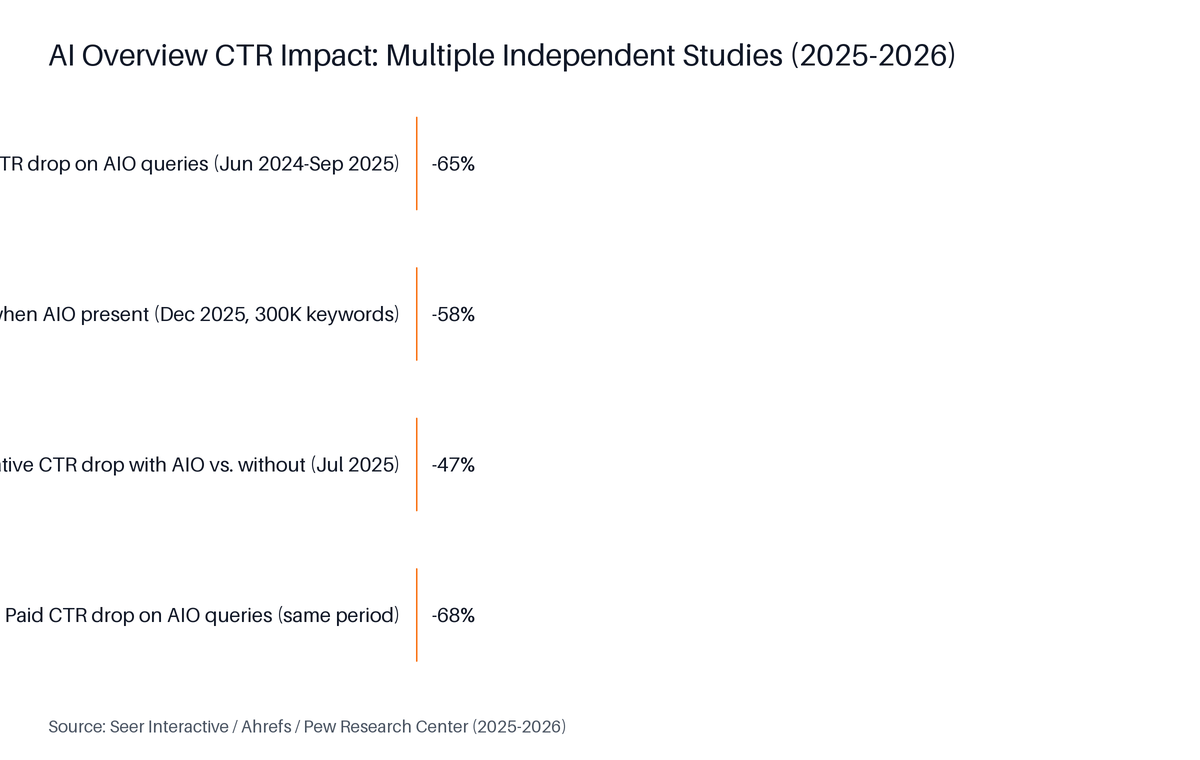
Source: Seer Interactive / Ahrefs / Pew Research Center, 2025-2026
Seer Interactive's 2026 research found a partial rebound: CTRs on results with an AI Overview recovered 85% in the first two months of 2026 (Seer Interactive, 2026). Both the drop and the rebound carry stated samples. The evidence points in two directions, and both are worth holding.
What CTR data does not capture is the more significant gap. A page absent from the AI answer is invisible at the moment of evaluation, regardless of what happens to clicks beneath it.
An AI assistant generating a vendor shortlist draws on training data and, where web retrieval is active, on pages it can access and read. A page is invisible to that process if it meets any of these conditions:
Ranking at position one in Google provides no protection against any of those four conditions.
Large language models draw heavily on third-party sources rather than a brand's own website. Nobori's internal analysis across 200,000 commercial prompt runs found approximately 85% of measurable AI visibility for B2B SaaS brands comes from third-party sources - review sites, editorial coverage, community content - not owned pages (Nobori, 2026). This differs structurally from SEO, where a well-optimised brand site can rank independently of third-party mentions.

Share of AI voice is the proportion of relevant AI-generated answers in a category that cite a given brand, measured across a defined set of buyer questions and engines. For most B2B SaaS companies at early stages, share of AI voice is a more useful leading indicator than CTR. CTR does not surface whether the brand was cited at all.
The third-party signals large language models weight for B2B SaaS vendor recommendations include:
A B2B SaaS company investing only in owned-content optimisation is optimising for the minority of AI visibility signals. The majority of the signal pool sits off-site.
Recommended LLM optimization for B2B SaaS combines structural page changes, technical access, and third-party authority building. Pages must open with a direct answer in the first paragraph and use tables and FAQ sections so content can be extracted cleanly. AI crawler access must be confirmed in robots.txt, and content must be available in raw HTML. Third-party citations on review sites and in editorial coverage are the highest-leverage signal for most B2B SaaS brands.
The Nobori finding that approximately 85% of measurable AI visibility comes from third-party sources (Nobori, 2026, 200,000+ commercial prompt runs) means that page-level optimisation alone is not sufficient. Off-site authority building belongs in the same programme as on-site structural changes.
| Change | What it does for LLM visibility | Also helps SEO? |
|---|---|---|
| Direct answer in first 40-80 words | Gives the LLM a liftable response without reading the full page | Partially (featured snippets) |
| Tables with labelled rows and columns | Enables structured extraction of comparison data | Yes |
| FAQ section with complete answers | Covers specific buyer questions; matches chatbot query patterns | Yes (FAQPage schema) |
| Named entity precision | Prevents the LLM from conflating the product with a competitor | Partially |
| Non-promotional register | Matches the neutral tone LLMs prefer for factual answers | Neutral |
| Cited statistics with sample sizes | Increases credibility and extractability of factual claims | Yes |
Crawler access means explicitly permitting AI crawlers in robots.txt rather than relying on default settings. Common AI crawler names to check include GPTBot (OpenAI), PerplexityBot, GoogleOther, and ClaudeBot (Anthropic). A page accessible to Googlebot but blocked to GPTBot will rank in traditional search and be invisible to ChatGPT's web retrieval.
Key technical requirements for LLM visibility:
The highest-leverage activity for most early-stage B2B SaaS companies is not improving their own site. It is generating third-party mentions in the sources AI assistants draw on most. That means:
Measuring LLM optimization requires a fixed question set checked monthly across the main AI assistants, because standard analytics do not surface citation rate or share of AI voice. Select 20 or more category and buyer questions, run each across ChatGPT, Perplexity, Gemini, Claude, and Google AI Overviews, and record whether the brand is cited, how the product is described, and which competitors appear alongside it.
Only 14% of B2B marketers are currently tracking AI citations, despite 43% reporting they actively optimise for AI search (Goodfirms, 2026, Goodfirms 2026 SEO research survey of marketers). That gap between optimisation intent and measurement execution is the single largest competitive opportunity available to B2B SaaS teams right now.
AEO for B2B SaaS runs this protocol on its own site. The technical checklist - raw HTML delivery, schema markup matching visible content, an XML sitemap, AI crawler permissions in robots.txt for GPTBot, PerplexityBot, GoogleOther, and ClaudeBot, and an llms.txt file - is the same one described on these pages. A monthly prompt audit across five engines tracks citation rate, brand description accuracy, and competitor co-citation. A public technical report documenting the results is planned for publication.
The measurement protocol below was described in GrowthSpree's 2026 AEO guide and is the baseline framework referenced throughout this article.
| Metric | Definition | How to measure |
|---|---|---|
| Citation rate | % of prompt runs in which the brand is cited | Manual or tool-assisted monthly prompt audit |
| Share of AI voice | Brand citations as % of all citations in category answers | Divide brand citations by total vendor citations across the prompt set |
| Brand description accuracy | Whether the AI describes the product correctly | Qualitative review per engine per month |
| Competitor citation frequency | Which competitors appear alongside or instead of the brand | Log per prompt, per engine |
| AI referral traffic | Sessions arriving from chatgpt.com, perplexity.ai, etc. | Analytics filter on referrer domain |
AI referral traffic can be separated in standard analytics platforms. Filter sessions where the referrer domain includes chatgpt.com, perplexity.ai, gemini.google.com, claude.ai, or copilot.microsoft.com. This traffic is currently small for most B2B SaaS sites. It provides the only direct measurement of whether AI citations are generating page visits.
Run the same question set each month without alteration. Changes in citation rate are only comparable over time if the question set stays fixed.
Technical SEO foundations - crawlability, page speed, structured data, clear sitemaps - transfer directly to LLM optimization because AI assistants cannot cite pages they cannot read. What does not transfer is the ranking-centric mindset. Keyword density, anchor text profiles, and position tracking are not proxies for AI citation. Content written to satisfy a ranking algorithm often buries the direct answer that large language models need near the top of a response.
BrightEdge's February 2026 data confirmed that B2B Technology queries trigger Google AI Overviews 82% of the time (BrightEdge, via Omnibound, February 2026). Technical accessibility is not optional for B2B SaaS. A page that AI crawlers cannot read is absent from that 82% of the category's AI-mediated search surface.
Content and technical elements that serve both SEO and LLM visibility:
Elements that matter for LLM visibility but are not direct SEO ranking factors:
LLM optimization as a distinct investment is not the right priority for every B2B SaaS company right now. Teams whose buyers do not yet use AI chatbots as a primary research tool, whose category has low AI Overview coverage, or who lack basic technical SEO foundations will see a greater return from fixing crawlability and content structure first. Those improvements benefit both SEO and LLM visibility simultaneously.
The Goodfirms 2026 survey found that 43% of B2B marketers report actively optimising for AI search while only 14% are tracking results (Goodfirms, 2026). Teams optimising without a measurement baseline are spending without a signal. In those cases, establishing the measurement protocol - a fixed question set and a monthly engine check - is the correct first step. It is not further content production.
LLM optimization as a standalone programme is lower priority if:
In these cases, the first investment is in the foundations that benefit both disciplines. A site that cannot be crawled cannot be cited. A brand with no third-party mentions cannot be corroborated. These are prerequisites, not advanced optimisation steps.
LLM optimization is also not a shortcut to named AI recommendations. No published source establishes a causal relationship between any specific content or technical change and a guaranteed citation outcome. The aim is to be a legible, credible, answer-ready source - and to track whether that produces citations month on month.
Large language model (LLM) optimization is the practice of structuring content so that AI assistants - ChatGPT, Perplexity, Gemini, Claude - choose to cite it when answering a buyer's question. It matters because 94% of B2B buyers used AI in their most recent purchase process (Forrester, via Endatasite, 2026, nearly 18,000 global business buyers). Content that AI assistants ignore is invisible at the moment of evaluation, not just in search results.
Recommended LLM optimization approaches for B2B SaaS AI visibility include: writing direct answers in the first paragraph of every page; using tables, numbered lists, and FAQ sections so content can be extracted cleanly; earning third-party citations on review sites and in editorial coverage; confirming AI crawler access in robots.txt; and adding schema markup that matches visible page content. Measurement requires a fixed monthly question set checked across at least five engines.
Answer engine optimization (AEO) is the practice of earning citations in AI-generated answers. Generative engine optimization (GEO) is an overlapping academic term, introduced in a KDD 2024 paper, for shaping how a brand is represented across AI-mediated visibility. LLM optimization (LLMO) is a practitioner shorthand for the same discipline. For B2B SaaS content teams, all three point to the same structural and editorial practices: answer-first writing, structured data, AI crawler access, and third-party authority building.
Yes. The overlap between Google AI Overview citations and the organic top 10 fell from approximately 76% in mid-2024 to just 17-38% by early 2026, based on multiple independent studies including Ahrefs' December 2025 analysis across 300,000 keywords (Ahrefs, via Omnibound, December 2025). A page that AI crawlers cannot read, or that lacks third-party corroboration, will not be cited regardless of its Google ranking. Ranking and citation are now separate outcomes, measured differently.
AI assistants draw on training data and, where web retrieval is active, on pages they can access and read. For B2B SaaS vendor recommendations, third-party sources carry the most weight. Nobori's analysis across 200,000 commercial prompt runs found approximately 85% of measurable AI visibility for B2B SaaS brands comes from review sites, editorial coverage, and community content rather than the brand's own website (Nobori, 2026). Brand site quality and technical accessibility are entry-level requirements. Third-party presence determines the ceiling.
LLM search optimization and search engine optimization (SEO) share technical foundations but are not the same discipline. SEO targets a ranked link position. LLM optimization targets a citation in an AI-generated answer. The signals, writing style, success metrics, and competitive dynamics differ. The buyer-behaviour evidence shows the gap is already affecting B2B SaaS vendor discovery.
Three conclusions follow from the evidence:
The work is structural and editorial. It begins with pages that AI crawlers can read, answers that large language models can extract, and a third-party presence that corroborates what those pages say. Be the answer, not the tenth blue link.
Meet with an expert. A free consultation with AEO for B2B SaaS. Bring the questions buyers ask about your category and brainstorm how to get cited. Book a free consultation
Published: 13 October 2026. By the AEO for B2B SaaS Editorial Team. Every figure in this article states whether it is measured or predicted, with its sample size and source. Engine behavior claims are drawn from engine documentation, dated at point of reading. Unverified figures are not used.
| Review sites, editorial mentions |
| Analyst coverage, community UGC |
| G2, editorial, community (primary signal) |
| Origin | 1990s practitioner discipline | Practitioner term, ~2023 onwards | KDD 2024 academic paper | Practitioner shorthand, ~2024 onwards |