AI Search Visibility and Answer Engine Optimization Tools for B2B SaaS: What Exists and How to Evaluate Them
What LLM SEO optimization software actually does for B2B SaaS - citation monitoring, crawler auditing, structured data checks, and how to evaluate platforms.
Request a quote and our experts will contact you within 24 hours with tailored solutions and pricing.
Last updated: Oct 20, 2026
AI Search Visibility and Answer Engine Optimization Tools for B2B SaaS: What Exists and How to Evaluate Them
By AEO for B2B SaaS Editorial Team | Updated October 13, 2026
The AEO for B2B SaaS Editorial Team applies documented evidence standards to every page. Engine claims come from engine documentation; every figure states whether it is measured or predicted.
Large language model (LLM) search engine optimization (SEO) software for B2B SaaS is a nascent tool category as of October 2026. Platforms exist that monitor AI citations, audit crawler access, and check structured data. No single platform covers all three with documented methodology. None can guarantee a page will be cited.
The situation is real. A B2B SaaS site can rank at the top of traditional search and still be invisible to every AI assistant a buyer consults. The gap may be technical: AI crawlers blocked, or reading an empty JavaScript shell. It may be structural: answers buried below long introductions. Or it may mean no one has checked systematically. The tool category promising to fix this is growing fast. Claims outrun evidence. This page maps what current answer engine optimization (AEO) and generative engine optimization (GEO) platforms actually do, what they cannot do, and how to evaluate them before spending budget.
Key Takeaways
No single LLM SEO optimization software platform covers citation monitoring, technical crawl auditing, and content structure analysis with equal depth and documented methodology as of October 2026.
Citation monitoring is the practice of querying AI engines on a schedule and recording whether a brand appears in the answer. It detects citation presence; it does not cause it.
Technical accessibility tools check whether AI crawlers can read raw HTML, find structured data matching visible content, and confirm robots.txt permits crawler access.
Ahrefs measured a 58% lower average click-through rate (CTR) for top-ranking pages on queries with an AI Overview, across 300,000 keywords (Ahrefs, February 2026). Seer Interactive found CTR on those results rebounded 85% in early 2026 (Seer Interactive, April 2026). The picture is genuinely mixed.
A free measurement baseline of 20 or more category questions checked monthly across five engines produces actionable data before any paid platform is purchased.
What Is the Top Software for Generative Engine Optimization?
No single platform has established a clear, independently verified lead in generative engine optimization (GEO) software as of October 2026. The right platform for a B2B SaaS team depends on which capability gap is largest: technical crawl auditing, structured data validation, or multi-engine citation monitoring. Three factors complicate any ranking: engine coverage varies by platform, methodology is rarely published, and the category is evolving too quickly for any snapshot to hold.
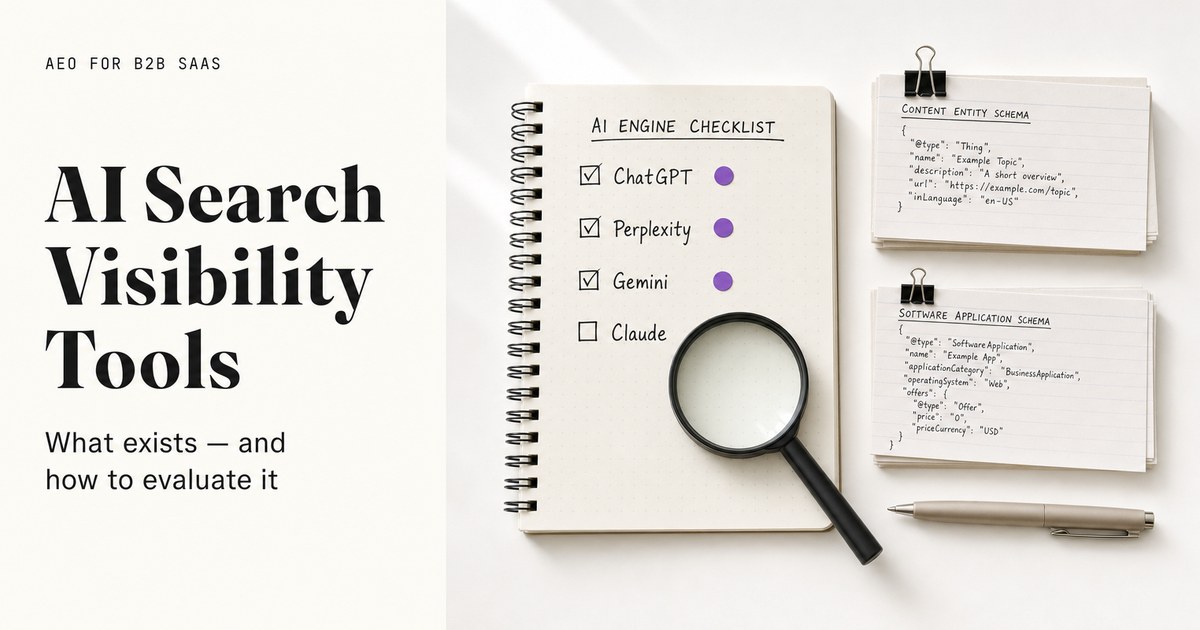
Top-down flat-lay of AI engine name cards, a checklist notebook, and a magnifying glass on white surface
Generative engine optimization (GEO) is the practice of structuring content so AI-generative search engines surface and cite it in answers. The honest answer to "what is the best GEO software?" is that the category is too new for any platform to have earned that title through documented, independent evidence.
In February 2026, Ahrefs measured a 58% lower average CTR for top-ranking pages on queries with an AI Overview, across 300,000 keywords comparing December 2023 against December 2025 (Ahrefs, February 2026). That measured signal is why this tool category exists and why B2B SaaS teams are now evaluating it.
The three factors that complicate ranking any platform:
Engine coverage varies. A platform may query ChatGPT and Perplexity but not Gemini, Claude, or Google AI Overviews. The engines a platform actually queries determine how useful its citation data is for a given team.
Methodology is rarely published. Most platforms do not document how they query engines, how often, or how they model citation likelihood. A number without a stated method cannot be verified.
The category is evolving quickly. Features announced in one quarter are sometimes removed or renamed in the next. Any snapshot of which platform leads becomes partial within weeks.
What the Established Platforms Offer
Semrush and Ahrefs both added AI visibility reporting features in 2025 and 2026. These modules sit alongside existing technical crawl, keyword, and backlink tools. That gives them an advantage for teams already using these platforms. The AI visibility components generally track brand mention frequency in AI-generated answers across a defined question set.
Purpose-built AI visibility platforms, many launched in 2024 or 2025, tend to query more engines more frequently. They offer more granular citation analysis. The trade-off is that they typically lack the technical site-audit depth of the established platforms.
What Do These Platforms Actually Do? The Three Capability Categories
Answer engine optimization (AEO) and large language model (LLM) visibility platforms fall into three distinct capability categories: citation monitoring (querying AI engines to detect brand mentions), technical accessibility auditing (checking whether AI crawlers can read a site's pages), and content structure analysis (evaluating whether page writing surfaces answers early enough to be cited). Most platforms concentrate in one category. Very few cover all three with equal depth and a documented approach.
45-degree flat-lay of a crawler path diagram on grid paper beside robots.txt sticky notes and a keyboard
The table below maps the three capability categories against what each one checks, what it outputs, and which types of tools typically cover it.
Capability Category
What It Checks
What It Outputs
Typical Platform Type
Citation monitoring
Whether a brand or product appears in AI-generated answers
SEO platform site auditors, dedicated technical tools
Content structure analysis
Answer placement, heading structure, FAQ presence, table usage, definition density
Content score, page-level recommendations
Some AI visibility platforms, editorial tools
Citation Monitoring: What It Measures and What It Does Not
Citation monitoring is the process of querying AI engines with a defined set of buyer questions on a scheduled basis, then recording whether a brand name, product description, or URL appears in the generated answer. It answers "are we being cited?" It does not answer "why are we not being cited?" or "what should we change?"
Most citation monitoring tools send automated queries through AI engine APIs or public interfaces. The frequency of queries, the question sets used, and the engines covered all vary by platform and subscription tier.
Technical Accessibility Auditing: The Crawlability Layer
Technical accessibility auditing checks three things: whether an AI crawler can read a page's content without executing JavaScript, whether the site's robots.txt file explicitly permits crawler access, and whether structured data (markup added to a web page, commonly in JSON-LD format, that describes content in a machine-readable way) matches what is visible on the page. This category overlaps significantly with traditional technical SEO auditing.
A page that ranks well in traditional search but is built entirely in client-side JavaScript may be invisible to AI crawlers. The same is true for pages where bot protection rules block AI crawler user agents. Technical accessibility tools identify that problem. An engineering team resolves it.
Content Structure Analysis: The Least Mature Category
Content structure analysis tools evaluate whether a page is written in a way that AI engines can lift and cite. They check whether direct answers appear early, whether definitions are present, and whether tables and lists structure comparable information. This is the least standardized of the three categories. Scoring criteria differ across platforms, and no independent benchmark has validated which content signals most reliably correlate with citation.
What These Tools Do Not Do (And What No Tool Can)
No LLM visibility optimization software can guarantee that a B2B SaaS site will be cited by AI engines. AI citation is determined by each engine's own models, updated independently and without full public disclosure of every signal used. Tools that monitor, audit, and report give a team the information needed to remove barriers to citation. They do not control the citation decision. Any platform that implies otherwise is overstating what the technology can deliver.
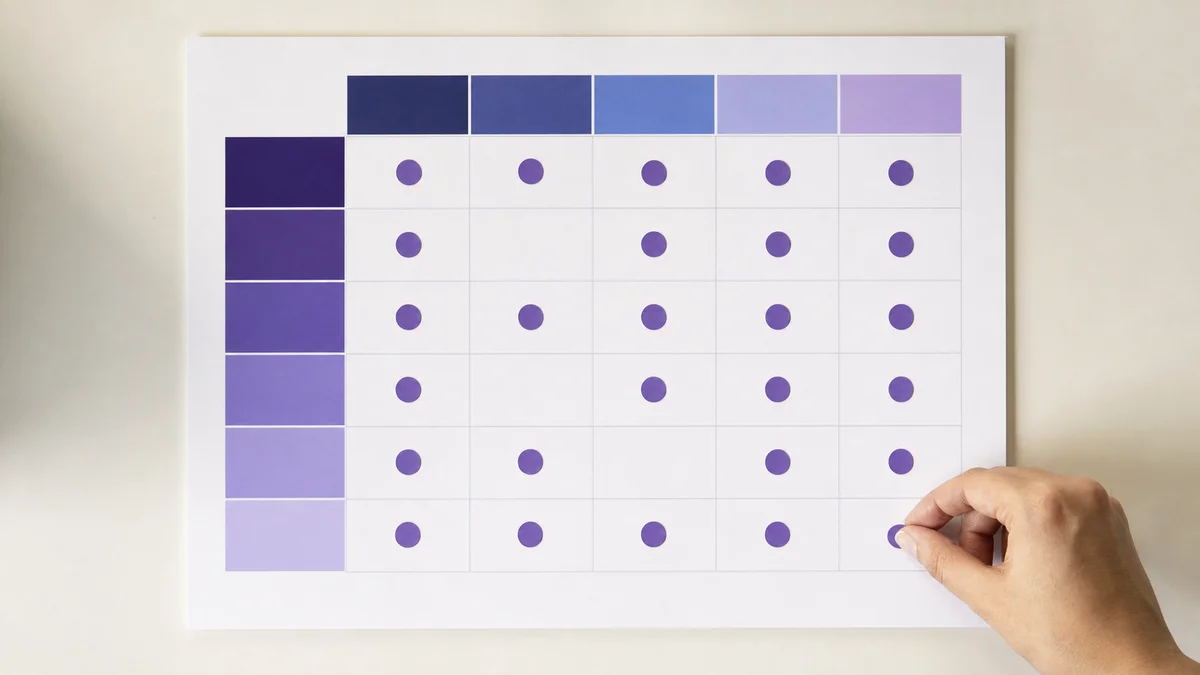
Overhead shot of a printed feature comparison matrix with violet adhesive dots marking capability presence
The measured traffic evidence points in two directions, and both matter for evaluating this tool category. Ahrefs measured a 58% lower average CTR for top-ranking pages on queries with an AI Overview, across 300,000 keywords comparing December 2023 against December 2025 (Ahrefs, February 2026). That is a large measured signal from a large sample.
Seer Interactive found that CTR on results with an AI Overview rebounded 85% in the first two months of 2026 (Seer Interactive, April 2026). Seer Interactive also found that informational results without an AI Overview rose from 2.93% to 3.97% CTR across 901 million impressions in 2025 (Seer Interactive, April 2026). Neither set of figures settles the question for every B2B SaaS site or query type. What they confirm: monitoring both traditional click data and AI citation presence is more informative than monitoring either alone.
Three claims are worth scrutinizing in every platform demo:
"Improve your AI citation rate": Monitoring a rate and improving it are different actions. A tool can measure the rate. Improving it requires content and technical changes.
"Optimize for AI answers": Optimization implies a known target function. The signals AI engines use to select citations are not fully published by any major engine.
"Rank in AI search": AI engines do not maintain ranked lists equivalent to traditional search results. Citation presence in a generated answer is not comparable to a position-one ranking.
How to Evaluate LLM SEO Optimization Software: A Capability Checklist
Evaluating LLM SEO optimization software for a B2B SaaS team requires checking five specific dimensions: which AI engines the platform actually queries, whether custom buyer question lists can be input, how frequently citation checks run, what technical audit checks are included, and whether the platform's own methodology is documented. Platforms that cannot explain their method clearly are difficult to trust, and those that cannot export both AI and traditional visibility signals add unnecessary friction.
Our data: In April 2026, Seer Interactive found CTR on AI Overview results rebounded 85% in the first two months of 2026 (Seer Interactive, April 2026). That counter-signal confirms a tool that monitors only AI citation presence, without also tracking traditional CTR, gives an incomplete picture of B2B search performance.
Use the checklist below before requesting a demo or starting a trial.
Evaluation Dimension
What to Confirm
Red Flag
Engine coverage
Which engines are queried (ChatGPT, Perplexity, Gemini, Claude, Google AI Overviews)
Marketing copy names engines the platform does not actually query
Custom question input
Whether the team can enter its own category and buyer questions
Platform uses only a generic default question set
Query frequency
How often citation checks run per engine
Annual or quarterly checks for a fast-moving signal
Technical audit depth
Whether robots.txt, JavaScript rendering, structured data, and sitemaps are all checked
Only a surface-level score with no issue detail
Methodology documentation
Whether the platform publishes how it queries, models, and scores
No published methodology
Output actionability
Whether results link specific issues to specific page-level actions
Only a dashboard score with no remediation guidance
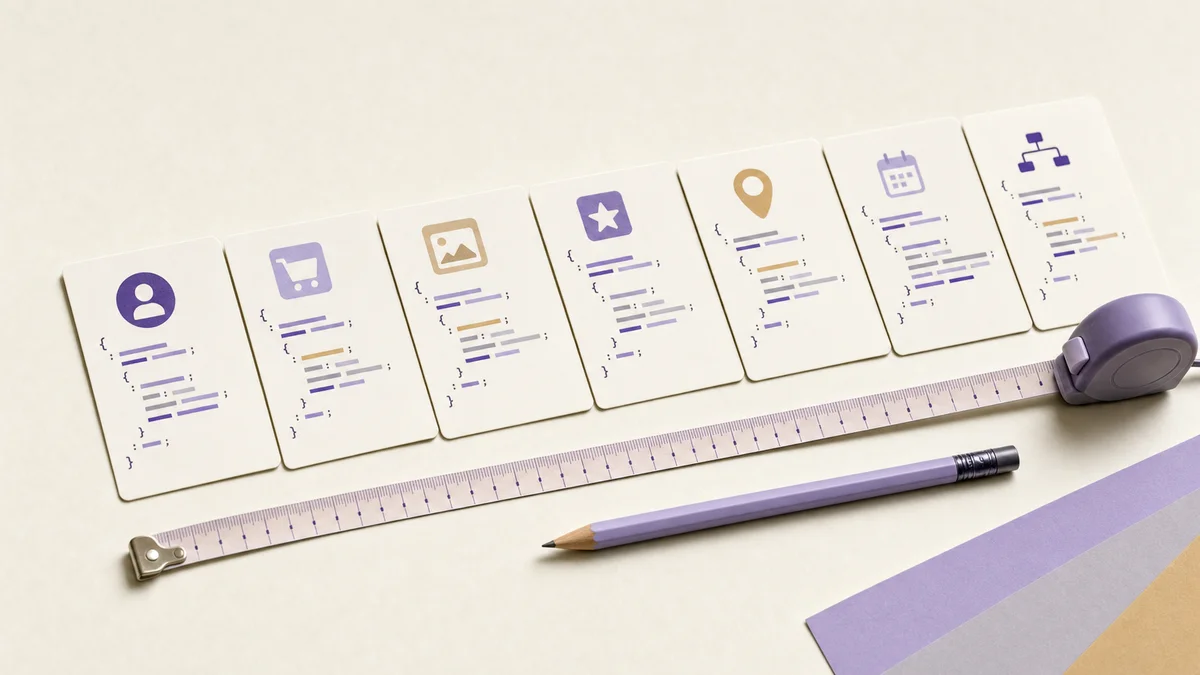
Flat-lay of JSON-LD schema index cards and a measuring tape on cream paper
Questions to Ask in Every Platform Demo
Beyond the checklist, these questions separate platforms with documented methods from those without:
Which AI engine APIs or interfaces does the platform use to retrieve answers? Are these official APIs or scraped responses?
How does the platform handle engine answer variability? The same question can produce different answers in different sessions.
What is the lag between a site change and an updated citation measurement?
How are citations distinguished from brand mentions that appear in a negative or irrelevant context?
Does the platform track the accuracy of brand descriptions in AI answers, not just citation presence?
No platform will answer all five questions fully. Those that engage directly with the complexity are more likely to be measuring something real.
Starting Without a Paid Tool: The Free Measurement Baseline
A practical free baseline for AI search visibility uses a fixed set of 20 or more category and buyer questions, checked monthly across ChatGPT, Perplexity, Gemini, Claude, and Google AI Overviews, recording whether a brand is cited, how the product is described, and which competitors appear. Free technical tools including Google's Rich Results Test cover structured data validation at no cost. This baseline costs time rather than budget and produces actionable data before a paid platform is purchased.
Our data: AEO for B2B SaaS proposes a monthly check of 20 or more category questions across five engines as a measurement baseline, tracking citation presence, accuracy of brand descriptions, and which competitors appear alongside each answer. This question set forms the foundation before any paid platform is evaluated.
Our data: AEO for B2B SaaS runs the same technical checklist it recommends on its own site: content accessible in raw HTML, schema markup present and matching visible content, AI crawlers explicitly permitted in robots.txt, a confirmed XML sitemap, an llms.txt file, and Markdown copies of key pages. A public technical report of those results is planned for publication.
Top-down flat-lay of a monthly desk calendar with AI engine names written into date boxes beside a fine-tip pen
The Free Technical Checklist
Free tools that cover the technical accessibility layer:
Google Search Console: Crawl errors, indexing status, and coverage reports show whether Google's crawler sees content correctly. Many of the same issues affect AI crawlers.
Google Rich Results Test: Validates whether structured data is present and correctly formatted for a given page.
Manual robots.txt review: Check whether AI crawler user agents - including GPTBot (OpenAI's documented crawler), ClaudeBot (Anthropic's documented crawler), PerplexityBot, and Google-Extended - are permitted or blocked in robots.txt.
View-source check: Loading a page's raw HTML source (Ctrl+U in most browsers) shows what an AI crawler sees without JavaScript. If key content is absent, a rendering fix is needed.
llms.txt review:llms.txt is a proposed convention (not yet adopted as a standard by any major AI engine as of October 2026) that signals to AI crawlers which content on a site is intended for ingestion. Creating one is low-cost. Whether major engines act on it is not confirmed in published documentation.
Limitations of the Free Baseline
The free baseline has real constraints. Manual citation checks across five engines for 20 or more questions take roughly two hours per month. Human consistency varies across sessions. The approach produces no historical trend data until several months of records accumulate. It cannot attribute changes in citation presence to specific content or technical changes. And it misses engines the team does not know to check.
Paid platforms address these limitations with scheduling, automation, historical tracking, and multi-engine coverage. The move from a free baseline to a paid tool is justified when the volume of questions to track, the number of engines to cover, or the need for historical trend data exceeds what a manual process can reliably handle.
Who This Approach Is Not For
AI search visibility evaluation for B2B SaaS applies specifically to teams with an existing web presence and measurable organic traffic. The approach assumes the team is already visible in traditional search and wants to understand its standing in AI-generated answers. Teams with no indexable content, those seeking a guaranteed citation outcome, or those operating in B2C, e-commerce, or local search contexts will find the evaluation criteria here do not fit their situation.
This is not the right starting point for:
Teams with no indexable content. If key pages are not indexed by Google, AI engines are unlikely to cite them. Traditional SEO foundations come first.
Teams looking for a guaranteed outcome. No tool produces citations. Tools identify barriers and measure progress. Any platform claiming otherwise should be questioned.
B2C, e-commerce, or local businesses. AI citation behavior in consumer and local contexts differs from B2B category and comparison queries. The criteria above are specific to B2B SaaS buying patterns.
Teams that need compliance sign-off on tool vendors. Platform selection in regulated verticals requires additional review beyond the capability checklist here.
Frequently Asked Questions
What AI search visibility tools exist today?
As of October 2026, AI search visibility tools fall into four broad types: multi-engine citation monitors that query AI assistants on a schedule, technical crawl auditors that check crawler access and structured data, content analysis tools that score page structure for answer-readiness, and analytics integrations that separate AI referral traffic in web analytics. Several established SEO platforms have added modules covering the first two types. Purpose-built generative engine optimization (GEO) platforms compete primarily in citation monitoring.
What are the best free LLM optimization tools?
Free tools useful for large language model (LLM) optimization include Google Search Console for crawl errors and indexing status, Google's Rich Results Test for structured data validation, and manual query testing across ChatGPT, Perplexity, Gemini, and Claude using a fixed set of buyer questions. These cover technical accessibility checking and basic citation monitoring at no cost. Paid platforms add scheduling, historical tracking, and multi-engine automation that manual checks cannot match at scale.
I need to make our pages readable by LLM crawlers - what does LLM visibility optimization software actually do?
LLM visibility optimization software audits whether AI crawlers can access and read a page's content. It checks whether content is in raw HTML rather than requiring JavaScript execution, whether robots.txt explicitly permits AI crawler bots, whether structured data schema matches visible content, and whether a sitemap correctly indexes pages intended for citation. Some platforms also generate or validate an llms.txt file. None of these actions guarantee a citation; they remove barriers to one.
Our pages render in JavaScript and AI crawlers see nothing - what LLM search optimization platform addresses that?
LLM search optimization platforms address JavaScript rendering through a technical audit module that simulates how an AI crawler sees a page without executing JavaScript. If the rendered HTML differs significantly from the raw HTML, the tool flags it as a crawlability risk. The fix is almost always a server-side or static rendering change made by an engineering team. The platform identifies the problem; it does not resolve the rendering architecture itself.
Are there LLM optimization tools that can be configured for our specific B2B SaaS category questions?
Some large language model (LLM) optimization tools allow custom question input, meaning a team can enter the exact buyer questions relevant to its B2B SaaS category rather than relying on a platform's generic default query set. This matters because AI citation presence is question-specific: a company may be cited for one query and absent for another. Confirm before purchase whether a platform allows custom question lists and how many questions can be tracked per account tier.
Conclusion
The AI search visibility and answer engine optimization (AEO) tool category is real and growing. As of October 2026, no single LLM SEO optimization software platform covers citation monitoring, technical crawl auditing, and content structure analysis with equal depth and documented methodology. Established SEO platforms have added AI visibility modules. Purpose-built tools query more engines with more frequency. Neither type has an independent, evidence-based claim to being the best.
For most B2B SaaS teams, the practical path forward is:
Run the free technical checklist first. Crawlability problems come before citation problems.
Set up a manual citation baseline: 20 or more buyer questions across five engines, checked monthly.
Evaluate paid platforms on engine coverage, question configurability, methodology transparency, and output actionability.
Move to a paid platform when the volume or complexity of monitoring exceeds what a manual process can reliably sustain.
Being cited by AI assistants is earned through the quality and accessibility of answers, not through a tool. The right software makes the work measurable. It does not replace the work.
Meet with an expert. A free consultation. Bring the questions buyers ask about your category and brainstorm how to get cited. Meet with an expert