Blog
Generative Engine Optimization Budget for B2B SaaS: What to Fund and What to Skip
Build a generative engine optimization budget for B2B SaaS: split fixed SEO-overlap work from monitoring tools, with sourced price ranges and kill criteria.
A monthly method to measure AI search visibility for B2B SaaS: a 20-question panel across five engines, GA4 referral isolation and 2026 benchmarks.
 Ishan ManchandaNov 17, 2026
Build a generative engine optimization budget for B2B SaaS: split fixed SEO-overlap work from monitoring tools, with sourced price ranges and kill criteria.
The six metrics that matter for AI search visibility in B2B SaaS, how to separate mentions from citations, set per-engine baselines and tie results to pipeline.
How B2B SaaS teams can structure pages for Google AI Overviews: what Google documents, what CTR studies show, and where to spend effort first.
Request a quote and our experts will contact you within 24 hours with tailored solutions and pricing.
Last updated: Nov 17, 2026
By AEO for B2B SaaS Editorial Team | Last updated: November 4, 2026
Measuring AI search visibility for B2B SaaS is the practice of checking, on a fixed schedule, whether answer engines cite your pages, describe your product correctly and send sessions to your site.
Most teams cannot do this today. AI referrals sit inside other analytics channels, and an assistant gets tested by hand when someone remembers. Leadership then asks for a baseline before funding any work, and there is no number to give. This guide shows how to measure AI search visibility with a monthly question panel, a GA4 recipe and the benchmarks that exist, building on the AEO vs SEO pillar.
Key Takeaways
- AI search visibility for B2B SaaS is measured with three signals: citation rate on a fixed question panel, accuracy of brand descriptions, and AI referral sessions.
- A proposed baseline is 20 or more buyer questions, run monthly on five answer engines, with the question set frozen and versioned.
- GA4 has had a native AI Assistant channel since 13 May 2026, but Perplexity and Google AI Mode are not separately isolated.
- Published benchmarks use different samples and denominators, so a competitor-relative panel is more reliable than any single published rate.
Measuring AI search visibility for B2B SaaS means tracking three things: how often answer engines cite your pages for buyer questions, how accurately they describe your product, and how many analytics sessions they send. AI referral traffic averages only 1.08% of website traffic (Conductor, November 2025), so referral counts alone understate exposure.

Conductor's CEO put the shift plainly: "Visibility no longer begins on your website or a results page" (Seth Besmertnik, Conductor, 2025). A website-only view therefore misses most of the picture. The 1.08% figure comes from 13,770 enterprise domains and 3.3 billion sessions sampled between May and September 2025. Treat it as an enterprise average, not a B2B SaaS target.
Citation rate is the share of panel answers in which an answer engine links to or lists your page as a source. Share of answer is the portion of panel answers in which your brand appears compared with named competitors. Both come from the panel; the others come from analytics and engine tools.
| Metric | What it counts | Where the data comes from | Cadence |
|---|---|---|---|
| Citation rate | Answers that cite your pages | Monthly question panel | Monthly |
| Share of answer | Answers that name you versus competitors | Monthly question panel | Monthly |
| Description accuracy | Answers that describe the product correctly | Manual review of panel answers | Monthly |
| AI referral sessions | Visits from answer engines | GA4 and server logs | Weekly |
| Engine-reported citations | Pages cited by Copilot and Bing AI summaries | Bing Webmaster Tools | Monthly |
Report these beside clicks and rankings, not instead of them. A page can hold position one and still lose the answer.
A monthly AI search visibility baseline is a frozen list of 20 or more buyer questions, run on five answer engines every month, with each answer logged for citation, brand description and competitors present. This 20-question panel is a proposed starting method, not a validated benchmark with published results.

Our data: AEO for B2B SaaS proposes a monthly check of 20+ category questions across five engines as a measurement baseline. It tracks citation rate, accuracy of brand descriptions and which competitors appear. This is a proposed method, not a measured result: no sourced figure for B2B citation rates with a stated sample has been found.
Draw questions from sales calls, support tickets and search data. Cover five buyer question types, four questions each.
| Question type | Example pattern | Starting count |
|---|---|---|
| Problem | "How do teams fix [problem your category solves]?" | 4 |
| Category comparison | "What are the best [category] tools for [company size]?" | 4 |
| Vendor evaluation | "Is [your brand] a good fit for [use case]?" | 4 |
| Integration | "Which [category] tools integrate with [system]?" | 4 |
| Pricing | "How much does [category] software cost?" | 4 |
Pick five engines your buyers use, for example ChatGPT, Perplexity, Google AI Overviews, Gemini and Microsoft Copilot. Freeze the question set and version it, so month-to-month changes reflect visibility and not new wording. Add questions only in a new version, and keep the old version running for one cycle.
Repeat each question several times per engine. SE Ranking reported that only 35% of domains repeat in AI answers (SE Ranking, 2026). An arXiv preprint, "Don't Measure Once," recommends multi-run sampling, large prompt portfolios and 2-4 week rolling aggregation (arXiv, April 2026). Report a range, not a single point.
Citation rate is cited answers divided by total answers. Tools can automate this; the comparison of tracking platforms covers what to look for.
Microsoft launched AI Performance in Bing Webmaster Tools as a public preview on 10 February 2026. It reports citations across Copilot and Bing AI summaries, with cited pages and grounding queries, but no click data (Microsoft, February 2026). Microsoft's Fabrice Canel said: "It's just a preview, you will get more in 2026." (Semrush, February 2026).
AI referral traffic is the set of website sessions that arrive from answer engines such as ChatGPT or Gemini. Since 13 May 2026, GA4 has a native AI Assistant channel naming ChatGPT, Gemini, DeepSeek, Copilot and Grok, but Perplexity and Google AI Mode are not separately isolated and the change is not retroactive (Nice Looking Data, July 2026).

Verify the setup by clicking through from an engine and confirming the session lands in the expected channel.
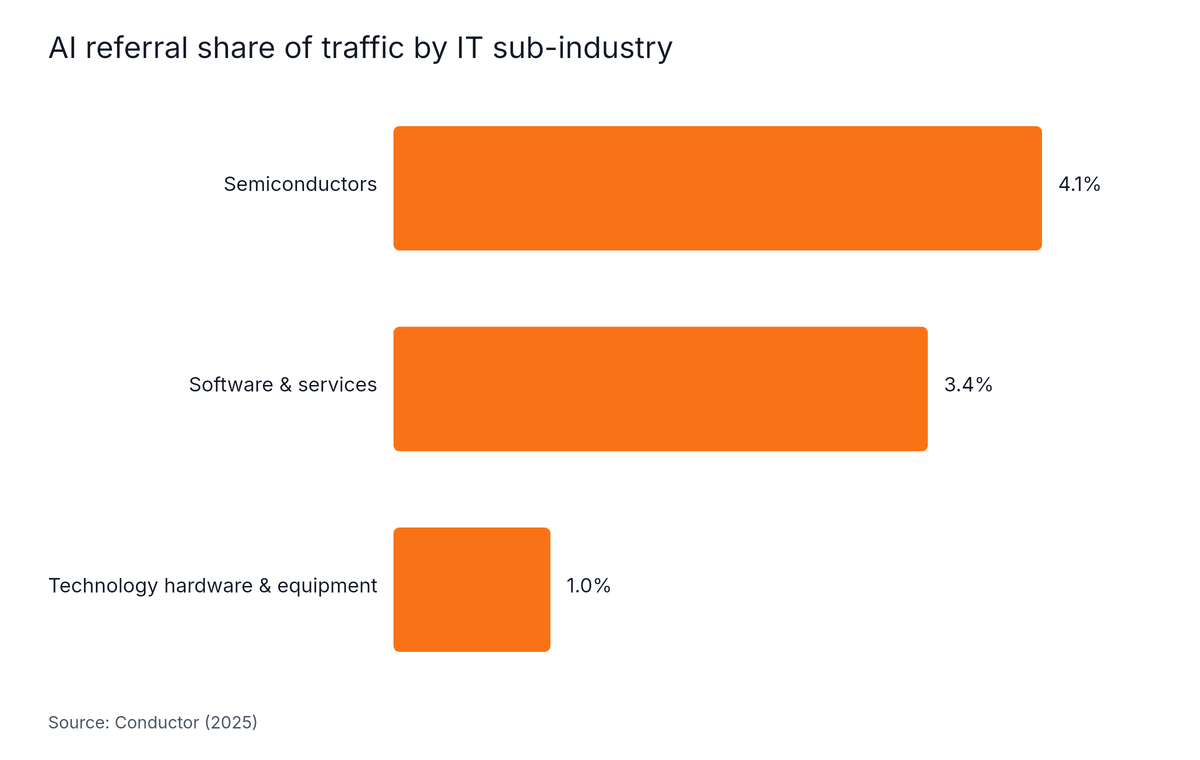
ChatGPT accounts for 87.4% of all AI referral traffic in Conductor's panel (Conductor, November 2025), so a ChatGPT-only view still misses other engines. Within information technology, software and services show 3.37% AI traffic penetration against technology hardware and equipment at 0.99%. Semiconductors lead at 4.09% (Conductor IT benchmarks, 2025).
Source: Conductor, 2025
Contentsquare reports a different view: AI-referred traffic grew 632% year over year yet still represents just 0.2% of total visits, and 0.3% for software (Contentsquare, 2026). The panels differ, so compare your own month-to-month trend, not the absolute level.
Published AI search visibility benchmarks for B2B SaaS in 2026 use different denominators, so no single citation rate is a standard. A Digital Applied audit of 500 SaaS sites found top-quartile sites average 31 citations per month against 3.7 for the bottom quartile (Digital Applied, April 2026).
The table separates what each figure measures. All are vendor or agency research, and none is a validated industry standard.
| Source | Sample | Figure | What it measures |
|---|---|---|---|
| Digital Applied (April 2026) | 500 SaaS landing pages, four engines, 30 days in Mar-Apr 2026 | 31 vs 3.7 citations per month (top vs bottom quartile) | Citation volume per site |
| Walker Sands syndicated press release (April 2026) | 828 enterprise B2B companies, 45M+ keywords | 4.6% not cited at all | Enterprise brands absent from AI answers |
| Victorious via AiLedGrowth (2026) | 177 brands, 107,011 responses, eight platforms (secondary report, original not verified) | SaaS 24.3% mention rate, 13.8% citation rate | Mentions and citations as separate rates |
Walker Sands also found AI Overviews in nearly 50% of results pages for these brands (Walker Sands, April 2026). Its authors wrote: "The data reveals a clear visibility gap between traditional search rankings and actual influence within AI-generated answers." (Walker Sands, April 2026)
Generative engine optimization (GEO) and answer engine optimization (AEO) are overlapping names for earning citations in AI-generated answers. For measurement, both ask whether your B2B SaaS brand is cited when buyers ask category questions. GEO work tends to stress citation inside generated text, while AEO covers answer surfaces more broadly, so one shared panel measures both.

Answer engine optimization (AEO) is the practice of structuring a B2B SaaS site and its content so AI assistants and Google's AI features cite it when a buyer asks a category or vendor question. Generative engine optimization (GEO) is the practice of making content likely to be cited inside AI-generated answers. Some sources split the terms differently, and "large language model (LLM) optimization" is a third name. The guide to what AEO means and the overview of GEO cover the terminology.
Three shifts changed AI search visibility measurement heading into 2026:
Walker Sands' benchmark of 828 enterprise B2B companies also found that AI Overviews appear in nearly 50% of relevant results pages (Walker Sands, April 2026), so rankings alone no longer show influence.
A mention names your brand in the answer text, while a citation links to your page. Track them as separate numbers.
The 20-question baseline is not for teams that need a validated standard, click data or exact numbers. AI search visibility for B2B SaaS is probabilistic: SE Ranking reported that only 35% of domains repeat in AI answers, with two-thirds vanishing between runs (SE Ranking, 2026).
Know these limits before presenting results:
Monitor AI search visibility by running a fixed list of 20 or more buyer questions on five answer engines every month, logging whether your site is cited, how the product is described and which competitors appear. Add GA4 referral reports and Bing Webmaster Tools AI Performance, then report a range from repeated runs rather than one number.
Reported 2026 benchmarks for B2B SaaS include 31 monthly citations for top-quartile SaaS sites against 3.7 for the bottom quartile in a Digital Applied audit of 500 sites (2026), and a 13.8% SaaS citation rate in a Victorious study as reported by AiLedGrowth (2026, original not verified). Each uses a different sample, so compare your panel against competitors.
Benchmarks for B2B SaaS to measure against include a Digital Applied audit of 500 SaaS sites, the Walker Sands benchmark of 828 enterprise B2B companies (2026) and a Victorious study of 177 brands reported by AiLedGrowth. Each uses different denominators, so none is a standard. The most dependable comparison is your own frozen panel run against three named competitors.
Generative engine optimization (GEO) is the practice of making content likely to be cited inside AI-generated answers, a goal that overlaps with answer engine optimization. Heading into 2026 the change is measurement: large benchmark reports from Conductor and Walker Sands appeared, and research now treats visibility as probabilistic, so teams sample repeatedly instead of checking once.
Answer engine optimization (AEO) is the practice of structuring a B2B SaaS site so AI assistants and Google's AI features cite it for buyer questions. Across 2025 and 2026 the measurement side matured: Conductor published a large benchmark in November 2025 (2025), and GA4 added a native AI Assistant channel on 13 May 2026.
In 2026, answer engine optimization (AEO) means writing and structuring B2B SaaS pages so AI assistants cite them when a buyer asks a category or vendor question. It overlaps with SEO in technical foundations but differs in page writing and in measurement, which relies on citation rate across a fixed question panel.
An AI mention is a response that names your brand in its text, while an AI citation is a response that links to or lists your page as a source. The two are separate rates, so a brand can be mentioned often and cited rarely. Track both, plus whether the description is accurate.
Measuring AI search visibility for B2B SaaS is a monthly routine, not a one-off check. Start small, freeze the method and report trends.
The next step is to write the first panel from real buyer questions. For what to change once the baseline shows gaps, read how to get cited by AI assistants. To talk through your own panel, Meet with an expert. A free consultation. Bring the questions buyers ask about your category and brainstorm how to get cited.
Written by
Ishan Manchanda
Ishan Manchanda is co-founder of GrowthSpree, a B2B SaaS marketing consultancy founded in 2017 that has managed $60M+ in ad spend across 300+ B2B SaaS companies. He focuses on demand generation, go-to-market strategy and pipeline growth, and has been featured in Silicon Valley Times, SaaS Mag and the Unbounce podcast.