How to Measure Generative Engine Optimization for B2B SaaS
how to measure generative engine optimizationmeasure GEOAI visibility tracking
How to Measure Generative Engine Optimization for B2B SaaS
A measurement stack for B2B SaaS teams: prompt panels, GA4 AI referrals, Search Console AI reports and pipeline signals, with the evidence behind each.
Request a quote and our experts will contact you within 24 hours with tailored solutions and pricing.
How to Measure Generative Engine Optimization for B2B SaaS
By AEO for B2B SaaS Editorial Team. Last updated: 4 November 2026.
Measuring generative engine optimization (GEO) for B2B SaaS means tracking how often AI assistants cite and describe a brand across fixed buyer questions, then pairing those counts with referral, impression and pipeline data. Forrester's 2026 report says 94% of business buyers now use AI while buying (Forrester, 2026). Yet most teams still report rankings and clicks, which miss answers that never send a visit. This guide sets out a measurement stack that works within those limits. It shows where each number comes from and how far to trust it. GEO overlaps with answer engine optimization (AEO), covered in AEO vs SEO for B2B SaaS.
Key Takeaways
Generative engine optimization (GEO) measurement for B2B SaaS needs three layers: a repeated prompt panel, analytics for AI referrals and impressions, and pipeline proxies.
A single check of an AI assistant is unreliable: SparkToro found different brand lists more than 99% of the time for the same prompt (SparkToro via Search Engine Journal, 2026).
AI visibility reports should show citation frequency across many runs, never a "ranking position in AI".
GA4's AI Assistant channel and Search Console's generative AI report each see only part of AI exposure.
Baselines should be segmented by brand maturity: in one 2026 preprint, niche brands appeared in 11% of first-run answers and household names in 73% (Kumar, arXiv, 2026).
How do you measure generative engine optimization?
How to measure generative engine optimization comes down to three layers: a repeated prompt panel that records citations and brand descriptions, analytics that isolate AI referral traffic and Google's AI impressions, and pipeline signals such as self-reported attribution. Forrester's 2026 survey found 94% of business buyers use AI while buying (Forrester, 2026), so all three layers matter.
Three stacked glass trays holding index cards, representing a GEO measurement stack
Generative engine optimization (GEO) is the practice of making content likely to be cited or mentioned in answers produced by generative AI systems, which run on a large language model (LLM). The table shows what each layer measures and where it falls short.
Layer
What it measures
Data source
Main limit
Prompt panel
Citation rate, brand description accuracy, competitors named
Manual or tool-based runs across engines
Answers vary between runs
Referral analytics
Visits from AI assistants
GA4 AI Assistant channel plus custom referrer filters
Misses visits without a referrer
Google AI reports
Impressions in AI Overviews and AI Mode
Search Console generative AI report
Impressions only at launch
Self-reported attribution
Buyers who say AI influenced them
"How did you hear about us?" field
Depends on buyer memory
Pipeline tie-in
Opportunities and revenue linked to the above
CRM
Correlation, not proof
Each layer answers a different question. The panel shows whether engines name the brand. Analytics shows what happened after a click. Attribution and CRM data show whether any of it reached the pipeline.
Our data: Two measured studies in this publication's evidence file show why click reports alone mislead. Ahrefs measured a 58% lower average click-through rate for the top-ranking page when an AI Overview was present, across 300,000 keywords, comparing December 2023 with December 2025 (published February 2026). Seer Interactive then reported that click-through rates on results with an AI Overview rebounded 85% in the first two months of 2026. The two measurements point in different directions, which is the case for tracking citations beside clicks.
Why does a single check of AI answers mislead?
A single check of AI answers misleads because the same prompt returns different brands almost every time. SparkToro's study of 2,961 prompt runs across ChatGPT, Claude and Google AI Overviews and AI Mode found AI tools produce different brand recommendation lists more than 99% of the time (SparkToro via Search Engine Journal, 2026), so frequency across many runs is the usable measure.
A row of identical white dice each showing a different face, like varying AI answers
The study used 12 prompts and volunteer runs in November and December 2025. Its authors acknowledged limitations, and it was co-run with an AI tracking startup. Rand Fishkin summarised the finding: "If you ask an AI tool for brand/product recommendations a hundred times nearly every response will be unique." (Rand Fishkin, SparkToro, 2026)
Why are repeated runs the fix?
A separate preprint compared cited sources across repeated runs using Jaccard similarity, a 0-to-1 score for how much two sets overlap. Some prompts returned very similar sources (above 0.8). Others stayed persistently low (below 0.2) (Schulte, arXiv, 2026). The preprint is not yet peer-reviewed. Its conclusion is direct: "Monitoring based on one or two prompts will reflect the idiosyncrasies of those prompts rather than campaign-level visibility." (Julius Schulte, arXiv, 2026)
Three rules follow:
Run every prompt several times per engine, not once.
Report appearance as a percentage of runs, with the run count stated.
Drop "ranking position in AI" from reports. Frequency is more stable than position.
How do you build a prompt panel for B2B SaaS?
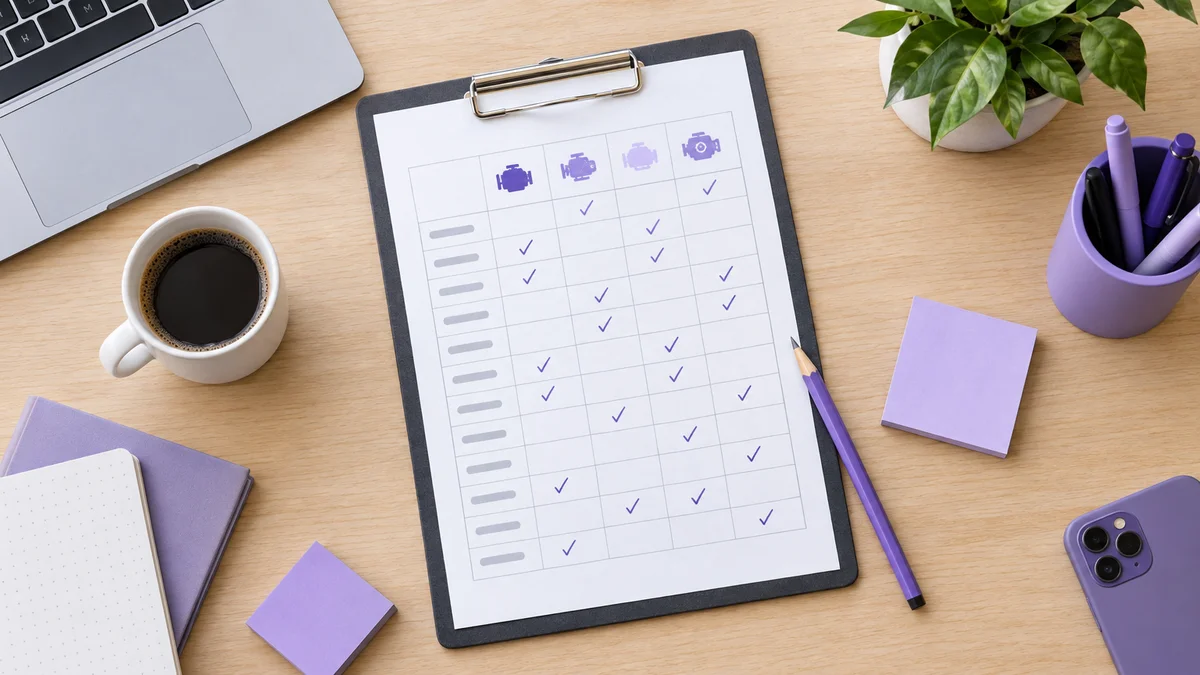
A prompt panel is a fixed list of buyer questions that a B2B SaaS team runs on a schedule across several AI assistants, recording each time whether the brand is cited. A working baseline proposed by AEO for B2B SaaS is 20 or more category questions, five engines and a monthly check.
A clipboard with a printed grid of buyer questions and pencil checkmarks in columns
Buyers do ask assistants for shortlists. G2's April 2026 research found 51% of B2B software buyers now start research in an AI chatbot (G2 via Morningstar, 2026). The panel stands in for that first look at the category.
Which buyer questions belong in the panel?
Cover the full path a buyer takes, not only branded queries:
Prompt type
Example pattern
What to record
Category
"best [category] software for [segment]"
Brands named, sources cited
Competitor comparison
"[Competitor] alternatives"
Whether the brand appears as an alternative
Use case
"how to [job] with software"
Brand mention and how it is described
Integration
"does [product] integrate with [tool]"
Accuracy of the claim
Pricing
"how much does [category] software cost"
Accuracy of any price or tier stated
No published source gives a validated minimum run count for B2B SaaS. Treat the 20-question figure as a working baseline, not a statistical rule. Fix the question list, the engines and the wording before the first run. Changing them later breaks month-to-month comparison.
Which metrics should the panel report?
Citation rate is the share of prompt runs in which an AI answer links to or names the brand's pages as a source.
Mention rate is the share of runs in which the brand is named, with or without a link.
Share of voice is the brand's mentions divided by all brand mentions across the panel, competitors included.
Description accuracy is a manual check of whether the product is described correctly.
What baseline should a brand expect?
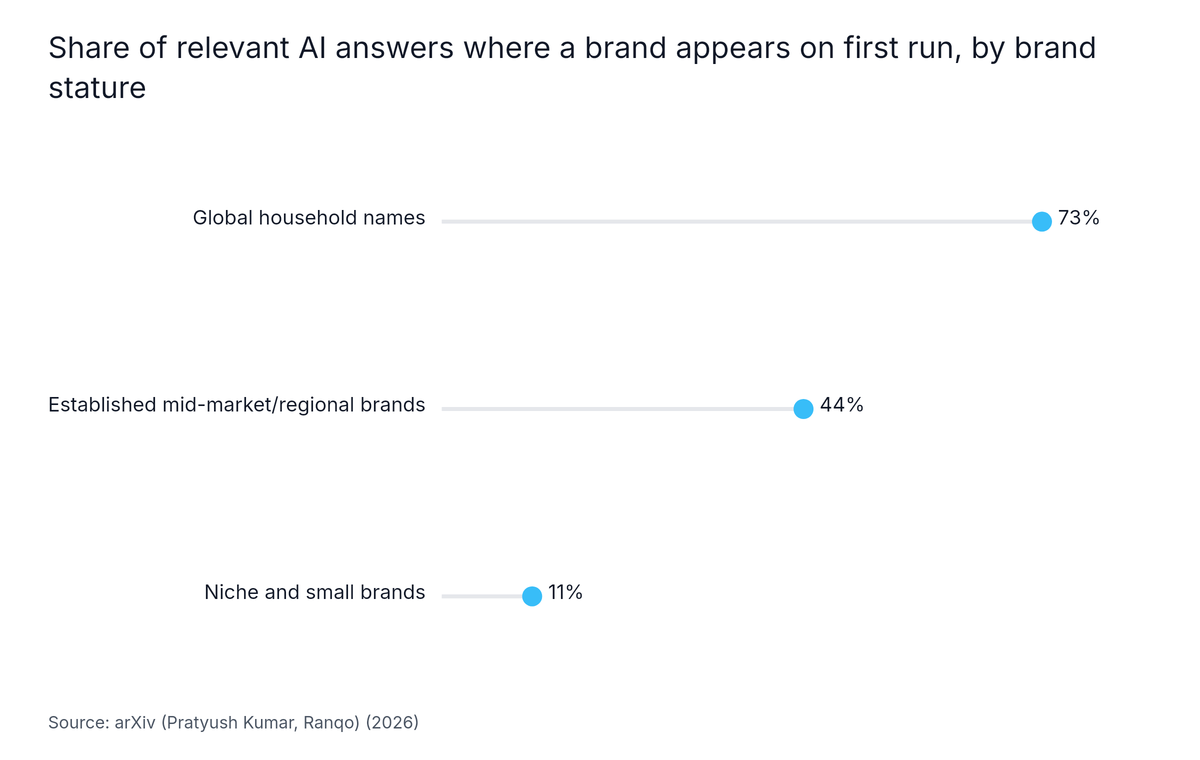
A 2026 arXiv preprint tracked more than 100,000 prompt responses across 100+ brands from March to May 2026. On the first run, global household-name brands appeared in 73% of relevant AI answers, established mid-market brands in 44% and niche brands in 11% (Kumar, arXiv, 2026). The author is affiliated with a visibility-tracking vendor.
Lollipop chart: Share of relevant AI answers where a brand appears on first run, by brand stature. Highest: Global household names at 73%.
Third-party lists also move the numbers. A vendor study of 5.7 million data points from nearly 200,000 AI responses found that a #1 listicle rank lifted B2B SaaS brand visibility by up to +16.5 percentage points (Peec AI, 2026). Track which outside pages the engines cite. For tool options, see AI search visibility tools for B2B SaaS.
How do you track AI referral traffic and Google's AI reports?
Tracking AI visibility in analytics uses two Google tools with clear limits. GA4 added an AI Assistant channel on 13 May 2026 that is forward-only and excludes AI Overviews and AI Mode (GA Agency, 2026), while Search Console's generative AI report, launched 3 June 2026, showed impressions only, with no clicks.
Several narrow water channels merging into one wide channel in a stone garden
The GA4 AI Assistant channel is a Default Channel Group that groups visits from a limited list of assistants under the medium ai-assistant. Because the list is incomplete, add a custom filter for referrers such as chatgpt.com and perplexity.ai. History before May 2026 will not be reclassified.
What does the Search Console report add?
Google described the launch plainly: "Today, we are launching a separate view dedicated to visibility from generative AI features." (Google Search Central team, 2026) It reports impressions, pages, dates and countries or devices for AI Overviews and AI Mode, plus a separate Discover view. Google rolled it out to all websites worldwide by 31 August 2026, according to a Quattr guide.
How big is AI referral traffic?
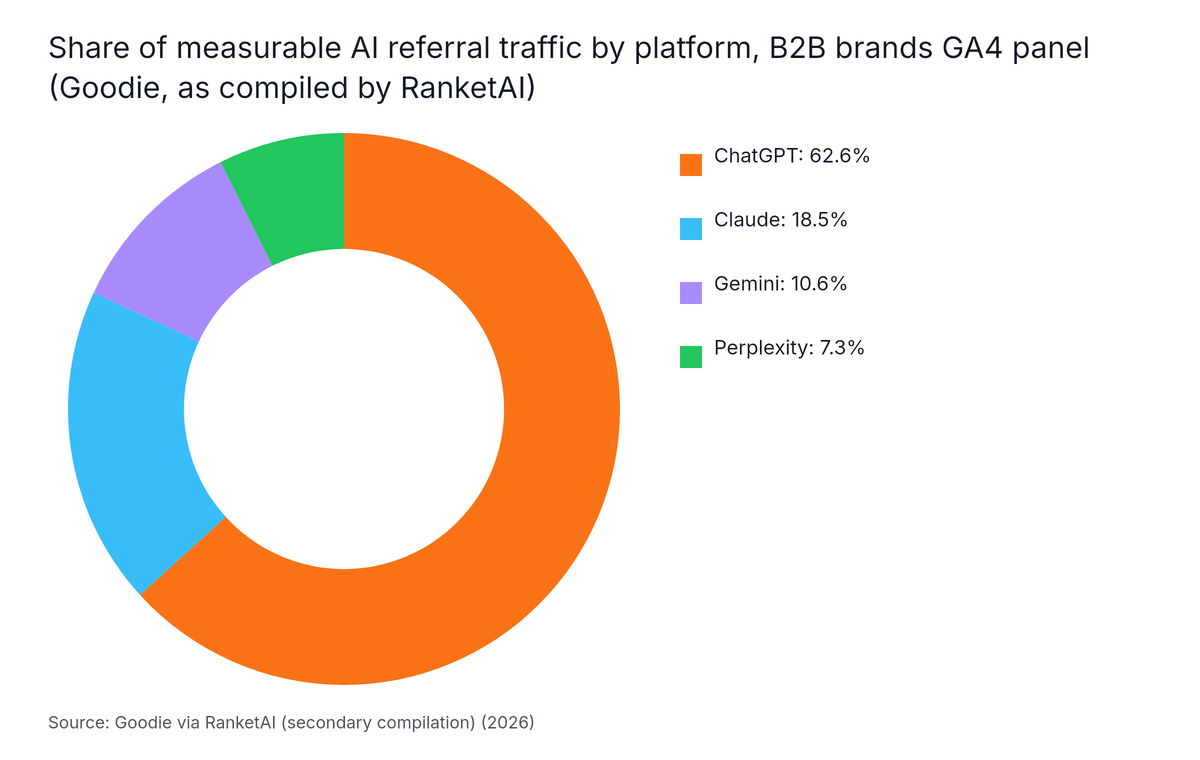
Small, and split across engines. In a GA4 panel of B2B brands, ChatGPT accounted for 62.6% of measurable AI referrals, Claude 18.5%, Gemini 10.6% and Perplexity 7.3% (Goodie via RanketAI, 2026). That is a secondary compilation, so verify it before reuse.
Donut chart: Share of measurable AI referral traffic by platform, B2B brands GA4 panel (Goodie, as compiled by RanketAI). Highest: ChatGPT at 62.6%.
Separately, a SE Ranking study of 101,574 websites (January to April 2026) put AI platforms at 0.32% of all website traffic. Panels disagree, from 0.2% to 1.08% (Mission Growth, 2026). Such small volumes are why non-click metrics matter.
Why do clicks understate AI exposure?
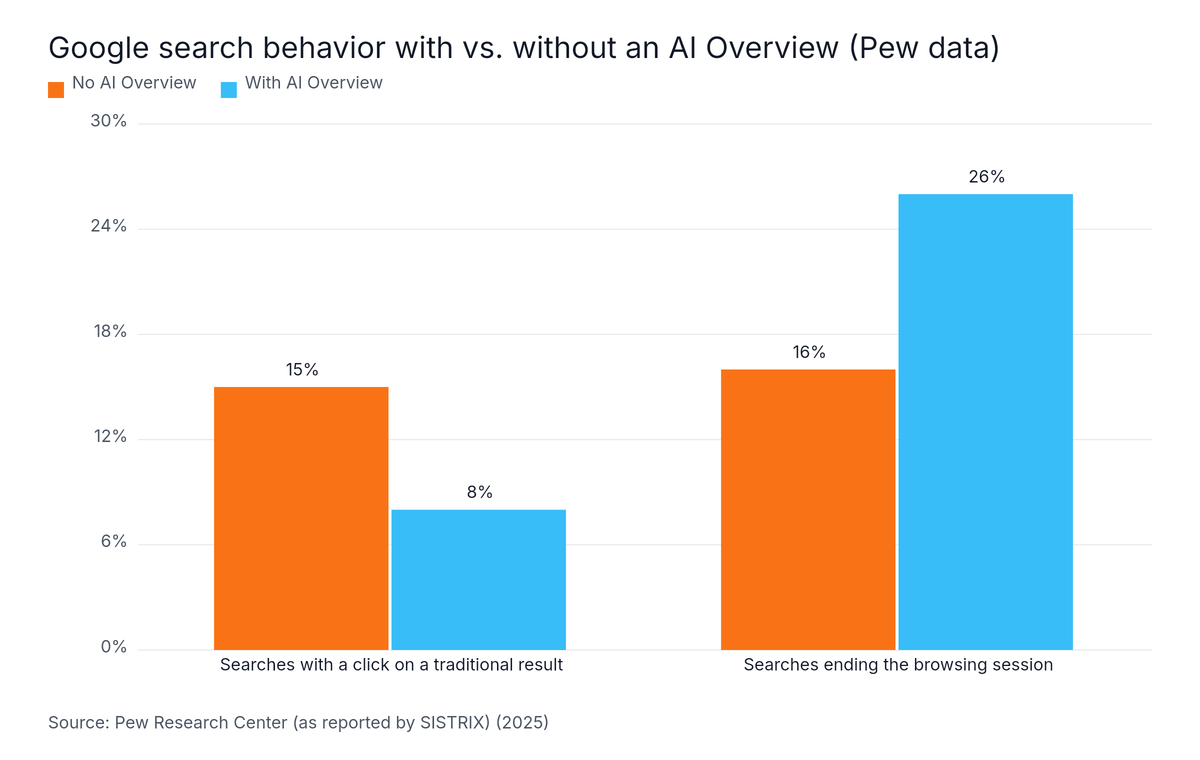
Pew Research browsing data (about 900 US adults, nearly 70,000 Google searches, March 2025) showed users clicked a traditional result in 8% of searches with an AI summary against 15% without one. Links inside the summary were clicked in about 1% of cases (Pew via SISTRIX, 2025). Google disputed the methodology.
Grouped Bar chart: Google search behavior with vs. without an AI Overview (Pew data). Highest: Searches ending the browsing session at 16%.
AI visibility connects to pipeline through proxies, because many AI recommendations never produce a trackable click. As reported secondhand by IMI Softs, a Gartner May 2026 buyer survey found 69% of B2B buyers still turn to a sales rep to validate AI-generated insights, so self-reported attribution and sales conversations carry real signal.
A brass funnel feeding marbles into a clear tube on a studio tabletop
The same report says 45% of buyers used generative AI in a recent purchase (IMI Softs, 2026). Because that is a secondary account of Gartner's survey, check the original before quoting it to leadership. Use this sequence to tie the layers together:
Add a required "How did you hear about us?" field to demo forms, with ChatGPT, Perplexity, Gemini, Claude and "AI search" as options.
Ask sales to log whether prospects mention an AI assistant on first calls.
Create a GA4 segment for AI referral sessions and follow it into CRM opportunities.
Watch branded search and direct traffic for lifts after panel citation rates change.
Report all four beside the panel results each month.
Causality stays uncertain. A rising citation rate and rising branded search can move together without one causing the other, so label these as associations. For the work that raises citations, see how to get a B2B SaaS brand cited by AI assistants.
What are the limits of GEO measurement?
GEO measurement has three limits that B2B SaaS teams should state in every report: AI answers vary between runs, most AI influence leaves no click, and several of the strongest datasets come from vendors or secondary reports. SparkToro's 2026 finding of different lists more than 99% of the time means every number is an estimate, not a rank.
Rand Fishkin put the position bluntly: "any tool that gives a ‘ranking position in AI’ is full of baloney." (Rand Fishkin, SparkToro, 2026) A tool that sells one score deserves questions about its method.
Who should hold off?
Teams with no crawler access or readable pages. Measurement will only confirm absence, so fix the basics first.
Teams expecting one score. A single visibility score from a tool hides its prompt set, engines and method, so ask for all three.
Teams promising leadership a revenue number. The evidence supports directional proxies, not precise attribution.
Which sources deserve caution?
Several figures here come from vendor research (Ranqo, Peec AI, SparkToro's co-runner) or secondary re-reports (Pew via SISTRIX, Goodie via RanketAI, Gartner via IMI Softs). They help set expectations. They do not replace a team's own panel. For related terminology, read what generative engine optimization is.
Frequently Asked Questions
How do you measure generative engine optimization success?
Generative engine optimization success is measured by combining three data sets: citation and mention rates from a repeated prompt panel, AI referral traffic and Google AI impressions from analytics, and pipeline signals such as self-reported attribution. No single number captures it, because many AI answers influence buyers without producing a click.
How many prompts and runs does reliable AI visibility tracking need?
No published source gives a validated minimum run count for B2B SaaS. Because SparkToro found different brand lists more than 99% of the time in 2026, each prompt should be repeated and reported as a frequency. A working baseline is 20 or more category questions checked monthly across five engines.
Does the GA4 AI Assistant channel capture all AI traffic?
The GA4 AI Assistant channel does not capture all AI traffic. Added on 13 May 2026, it is forward-only, covers a limited list of assistants and, per Google's documentation as reported by GA Agency, excludes AI Overviews and AI Mode. Custom referrer filters and self-reported attribution fill part of the gap.
Does the Search Console generative AI report include clicks?
At launch on 3 June 2026, the Search Console generative AI performance report showed impressions only, with no clicks. It covers pages, dates, countries and devices for AI Overviews and AI Mode, with a separate Discover view. Google later rolled it out to all websites worldwide, reported on 31 August 2026.
What is the difference between GEO, AEO and AI search visibility?
Generative engine optimization (GEO) and answer engine optimization (AEO) are overlapping terms for making content citable in AI-generated answers. AI search visibility is the outcome both aim to improve: how often and how accurately a brand appears in those answers. AI search visibility is what teams measure, while GEO and AEO describe the work.
Conclusion: what to set up first
Measuring GEO for B2B SaaS works when each layer admits its limits. Start small and keep the method fixed.
Build a prompt panel of 20 or more buyer questions and repeat each run.
Report citation frequency by engine, never a ranking position.
Segment GA4 AI referrals and add Search Console's generative AI report.
Add self-reported attribution to demo forms and ask sales to log AI mentions.
Label every figure as measured, estimated or predicted, with its sample.
Review the panel monthly and compare against a baseline suited to the brand's maturity. The underlying concepts are covered in what AEO means for B2B SaaS.
Meet with an expert: A free consultation. Bring the questions buyers ask about your category and brainstorm how to get cited.
Written by
Ishan Manchanda
Ishan Manchanda is co-founder of GrowthSpree, a B2B SaaS marketing consultancy founded in 2017 that has managed $60M+ in ad spend across 300+ B2B SaaS companies. He focuses on demand generation, go-to-market strategy and pipeline growth, and has been featured in Silicon Valley Times, SaaS Mag and the Unbounce podcast.
 Ishan ManchandaNov 19, 2026