Last updated: Nov 22, 2026
What Profound Measures for LLM Optimization: A B2B SaaS Overview
By AEO for B2B SaaS Editorial Team. Last updated November 4, 2026.
What Profound's LLM optimization tracking measures, what it leaves out, and how it compares with a free monthly question check, from its own docs.
 Ishan ManchandaNov 22, 2026

Last updated: Nov 22, 2026
By AEO for B2B SaaS Editorial Team. Last updated November 4, 2026.

Build a generative engine optimization budget for B2B SaaS: split fixed SEO-overlap work from monitoring tools, with sourced price ranges and kill criteria.

The six metrics that matter for AI search visibility in B2B SaaS, how to separate mentions from citations, set per-engine baselines and tie results to pipeline.

How B2B SaaS teams can structure pages for Google AI Overviews: what Google documents, what CTR studies show, and where to spend effort first.
Request a quote and our experts will contact you within 24 hours with tailored solutions and pricing.
Profound LLM optimization tracking measures how often AI answer engines mention, cite and accurately describe a brand, using documented metrics such as Visibility Score, Share of Voice, Citation Decay and FactCheck accuracy.
B2B SaaS marketers keep seeing Profound named in peer communities, and the useful question is what its numbers mean. This overview reads Profound's published documentation (as read in November 2026), separates what it measures from what it leaves out, and sets it beside a free monthly question check. It treats LLM optimization for B2B SaaS as the wider topic and offers editorial analysis, not a vendor recommendation.
Key Takeaways
- Profound tracks four documented things: brand appearance (Visibility Score), share of brand mentions (Share of Voice), cited URLs over time (Citation Decay) and claim accuracy (FactCheck).
- Profound's Visibility Score and Share of Voice use different denominators, so the two numbers are not interchangeable.
- Profound's documentation leaves out revenue and pipeline, and FactCheck needs a Knowledge Base before it works.
- A one-off monthly question check captures one sample of a variable output: repeated runs returned the same brand list less than 1% of the time in SparkToro's study.
- Buyers evaluating Profound should test its per-prompt answers against their own manual spot checks.
Profound measures how AI answer engines treat a brand across a tracked set of prompts: whether the brand appears (Visibility Score), its share of all brand mentions (Share of Voice), which URLs get cited over time (Citation Decay) and whether claims are accurate (FactCheck). Profound's own documentation, read in November 2026, defines each metric separately.

Large language model (LLM) optimization is the work of improving how AI assistants mention and describe a brand. It overlaps with answer engine optimization (AEO), the practice of structuring a site and its content so AI assistants cite it when buyers ask category questions. Generative engine optimization (GEO) is a closely related term. Profound's CEO frames the need this way: "Companies now need visibility into what AI systems say about them and the ability to improve those answers." (Cadwallader, Profound via GlobeNewswire, 2026)
Citation Decay is a Profound view that shows per-URL citation curves and half-life. Profound scores only pages that have been live at least 28 days and have at least 5 total citations. The view rests on Profound's own finding that half of the content answer engines cite is less than 13 weeks old (Profound, 2026). That figure is vendor-reported, and the page states no sample method.
FactCheck is Profound's feature that checks claims in AI answers against a Knowledge Base and produces an Accuracy Score. Profound's glossary gives a worked example. Of 50 claims extracted, 30 were verifiable, 24 accurate and 6 inaccurate, so the score is 24 / (24 + 6) = 80% (Profound Help Center, 2026). The other 20 claims are unverifiable and excluded.
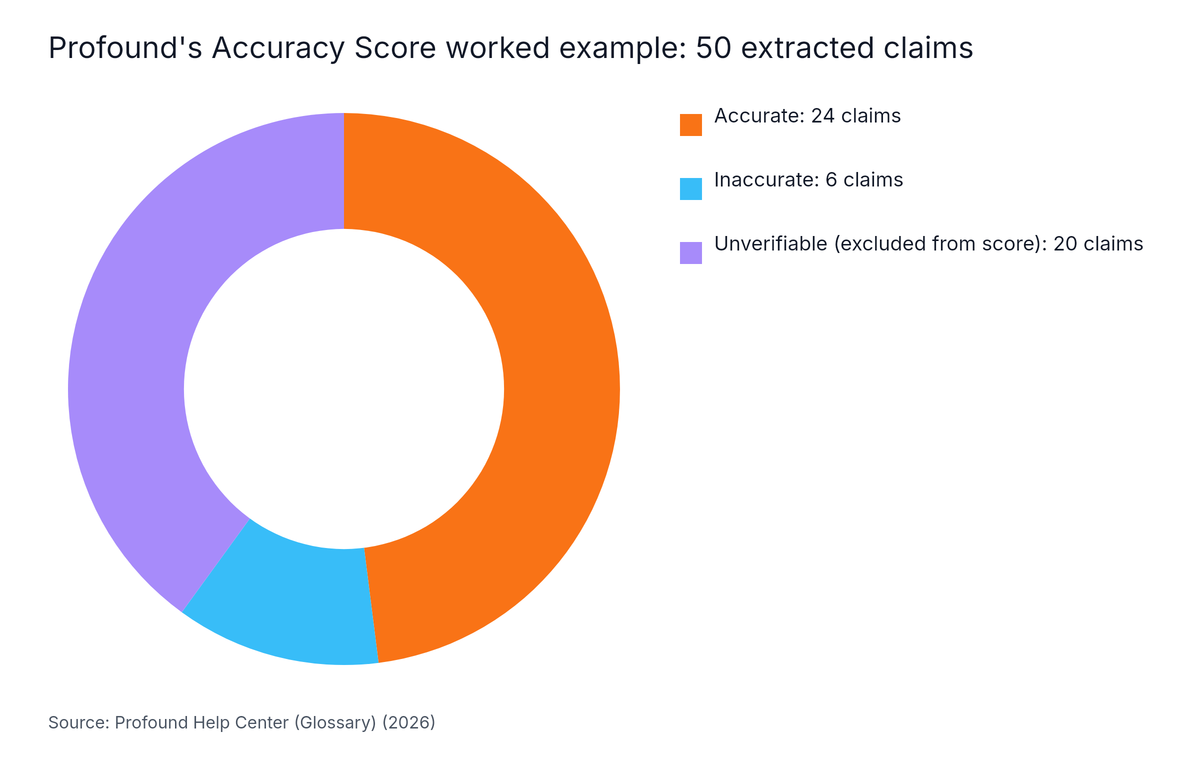
Source: Profound Help Center (Glossary), 2026
Profound's Visibility Score divides responses that include your brand by responses that include at least one brand, so 5 out of 10 equals 50% (Profound Docs, 2026). Share of Voice divides your brand mentions by all brand mentions, so 20 out of 100 equals 20%. The two metrics use different denominators.

Visibility Score is Profound's metric for how often your brand appears among responses that name any brand. Share of Voice is Profound's metric for your mentions as a share of all brand mentions. The first counts responses; the second counts mentions. Both examples come from Profound's Answer Engine Insights documentation, a living page with no publication date.
| Metric | What it counts | Denominator | Documented example |
|---|---|---|---|
| Visibility Score | Responses that include your brand | Responses with at least one brand | 5 of 10 responses = 50% |
| Share of Voice | Your brand mentions | All brand mentions | 20 of 100 mentions = 20% |
| Accuracy Score | Accurate claims | Accurate plus inaccurate claims (unverifiable excluded) | 24 / (24 + 6) = 80% |
Two practical readings follow. A response that names no brand drops out of the Visibility Score denominator, so the score reflects only answers where some brand appeared. A response that names five brands adds five mentions to the Share of Voice denominator, so a crowded category lowers that number even when your brand appears often. For wider context on tool categories, see this comparison of AI search visibility tools.
Profound tracks how answer engines respond to a set of prompts, but the documentation reviewed for this overview does not explain how those prompts are chosen, and engine coverage depends on plan. A B2B SaaS buyer should ask for the prompt source and the engine list in writing before trusting any score.

Profound separates two data layers. The first is the tracked prompt set inside a customer account. The second is the Profound Index, a category benchmark built on 1.9 billion real user conversations across 50+ industries and all major answer engines (Profound via GlobeNewswire, 2026). That is a vendor-reported figure.
The Index also shows why one number can mislead. The Profound Index Summer 2026 report found that in 24 of 30 multi-region industries, a European market had a #1 brand that never cracked the U.S. top five (Profound, 2026). This is vendor research, but the lesson holds: a single visibility score can hide regional differences.
Questions to settle before relying on a tracked prompt set:
Profound's documented metrics do not cover revenue, pipeline or most human clicks. Profound states that more than 97% of ChatGPT-influenced visits carry no AI referral tag (Profound, 2026), a vendor claim, and pipeline sits in a CRM or analytics tool. FactCheck also requires a Knowledge Base to function.

The limits come from Profound's own material:
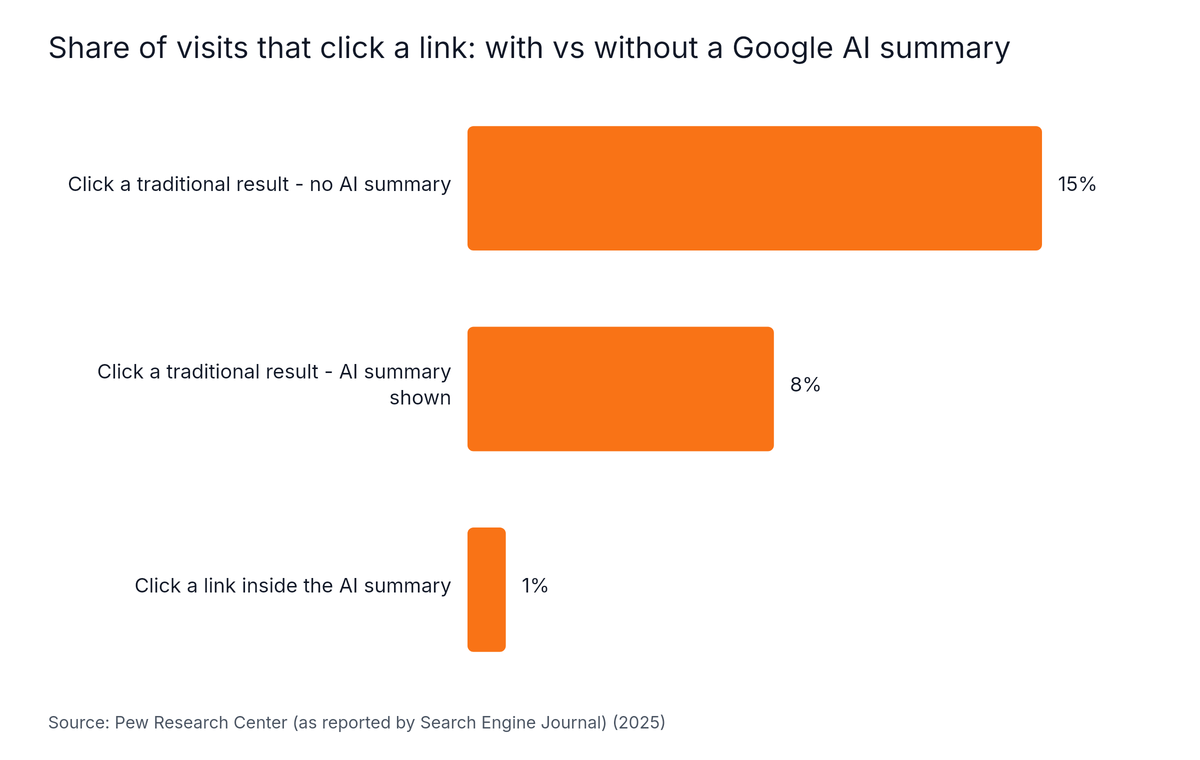
Pew Research Center's browsing study of over 68,000 search queries from over 900 U.S. adults found that Google users clicked a traditional result link in 8% of visits when an AI summary appeared, against 15% without one. Only 1% of visits clicked a link inside the summary (Pew via Search Engine Journal, 2025). That is why presence inside answers is tracked as its own metric. It also shows why presence cannot stand in for traffic.
Profound's tracking is a poor fit for teams that need causal proof that a citation produced a deal. Nothing in Profound's documentation or in the other sources reviewed here shows that link. Teams with no Knowledge Base and no analytics setup will also see fewer of the documented metrics working.
A DIY monthly question check gives a B2B SaaS team a free baseline, but one run per month captures a single sample of a highly variable output. SparkToro's study of 12 brand-recommendation prompts found ChatGPT and Google AI Overviews returned the same brand list less than 1% of the time (Search Engine Journal, 2026).
Rand Fishkin of SparkToro put the problem plainly: "If you ask an AI tool for brand/product recommendations a hundred times nearly every response will be unique." (Fishkin, Search Engine Journal, 2026) A single monthly reading is therefore one draw from a wide spread.
A DIY baseline is a fixed list of buyer questions, checked by hand each month across several engines. It records whether the brand is cited, whether the description is accurate and which competitors appear. The table sets that against Profound's documented approach.
| Dimension | DIY monthly check | Profound (as documented) |
|---|---|---|
| Question set | A fixed list of buyer questions, chosen by hand | A tracked prompt set inside the product |
| Repeat runs | One reading per question per month | Depends on the product's run schedule; confirm in a demo |
| Scoring | A rubric you write: cited yes or no, description accurate yes or no | Visibility Score, Share of Voice, Accuracy Score |
| Accuracy of descriptions | Manual comparison with your own facts | FactCheck, which needs a Knowledge Base |
| Traffic and pipeline | Separate analytics work | Not covered; sits in a CRM or analytics tool |
| Cost | Staff time only | Vendor plan; check current terms |
The guide to getting a B2B SaaS brand cited by AI assistants covers a practical starting point for the monthly method.
A free consultation. Bring the questions buyers ask about your category and brainstorm how to get cited. Meet with an expert
This is an editorial judgment, not a measured finding. A manual check suits teams establishing a first baseline, with a short question list and no budget yet. A paid platform becomes worth testing when variance makes monthly numbers hard to defend, when several regions or personas need tracking, or when leadership wants trend lines. The overview of AI visibility tools lists what to weigh.
A B2B SaaS buyer evaluating Profound should ask five demo questions: how prompts are chosen, how run-to-run variance is handled, which metric denominator applies, whether a Knowledge Base is ready for FactCheck, and how visibility connects to pipeline. Each question tests a limit that Profound's own documentation describes.

A useful trial test: export Profound's per-prompt answers and compare them with your own manual spot checks on the same questions. Where they disagree, ask why. The AEO vs SEO overview explains which parts of the work overlap with search engine optimization (SEO) measurement.
Profound measures how AI answer engines treat a brand across a tracked set of prompts. Its documented metrics cover whether the brand appears (Visibility Score), its share of all brand mentions (Share of Voice), which URLs get cited over time (Citation Decay) and whether claims are accurate (FactCheck). It does not measure revenue or pipeline.
Profound calculates Visibility Score as responses that include your brand divided by responses that include at least one brand, so 5 of 10 gives 50%. Share of Voice divides your brand mentions by all brand mentions, so 20 of 100 gives 20%. The two metrics use different denominators, according to Profound's documentation read in 2026.
Profound does not connect AI visibility to pipeline on its own. Its own article says more than 97% of ChatGPT-influenced visits carry no AI referral tag (2026), and pipeline data sits in a CRM or web analytics tool. Profound separates citation tracking from human referral tracking, so teams must join the data themselves.
A manual monthly question check is enough for an early baseline, but it records only one sample of a variable output. SparkToro's study of 12 brand-recommendation prompts found ChatGPT and Google AI Overviews returned the same brand list less than 1% of the time (Search Engine Journal, 2026), so single monthly readings can mislead.
Profound's documentation shows several limits. FactCheck requires a Knowledge Base to function, Agent Analytics needs CDN or server-log setup, referral tracking misses untagged AI influence, and revenue or pipeline lives in a CRM or analytics tool. Unverifiable claims are also excluded from the Accuracy Score rather than counted as errors.
Profound LLM optimization tracking is best understood as a measurement layer for how answer engines mention, cite and describe a brand. It is not a revenue tracker.
The next step: draft a fixed list of buyer questions, run it by hand once, and use the five demo questions to test any platform against that baseline. The guide to what answer engine optimization means for B2B SaaS is a sensible place to start.
Written by
Ishan Manchanda
Ishan Manchanda is co-founder of GrowthSpree, a B2B SaaS marketing consultancy founded in 2017 that has managed $60M+ in ad spend across 300+ B2B SaaS companies. He focuses on demand generation, go-to-market strategy and pipeline growth, and has been featured in Silicon Valley Times, SaaS Mag and the Unbounce podcast.